← All women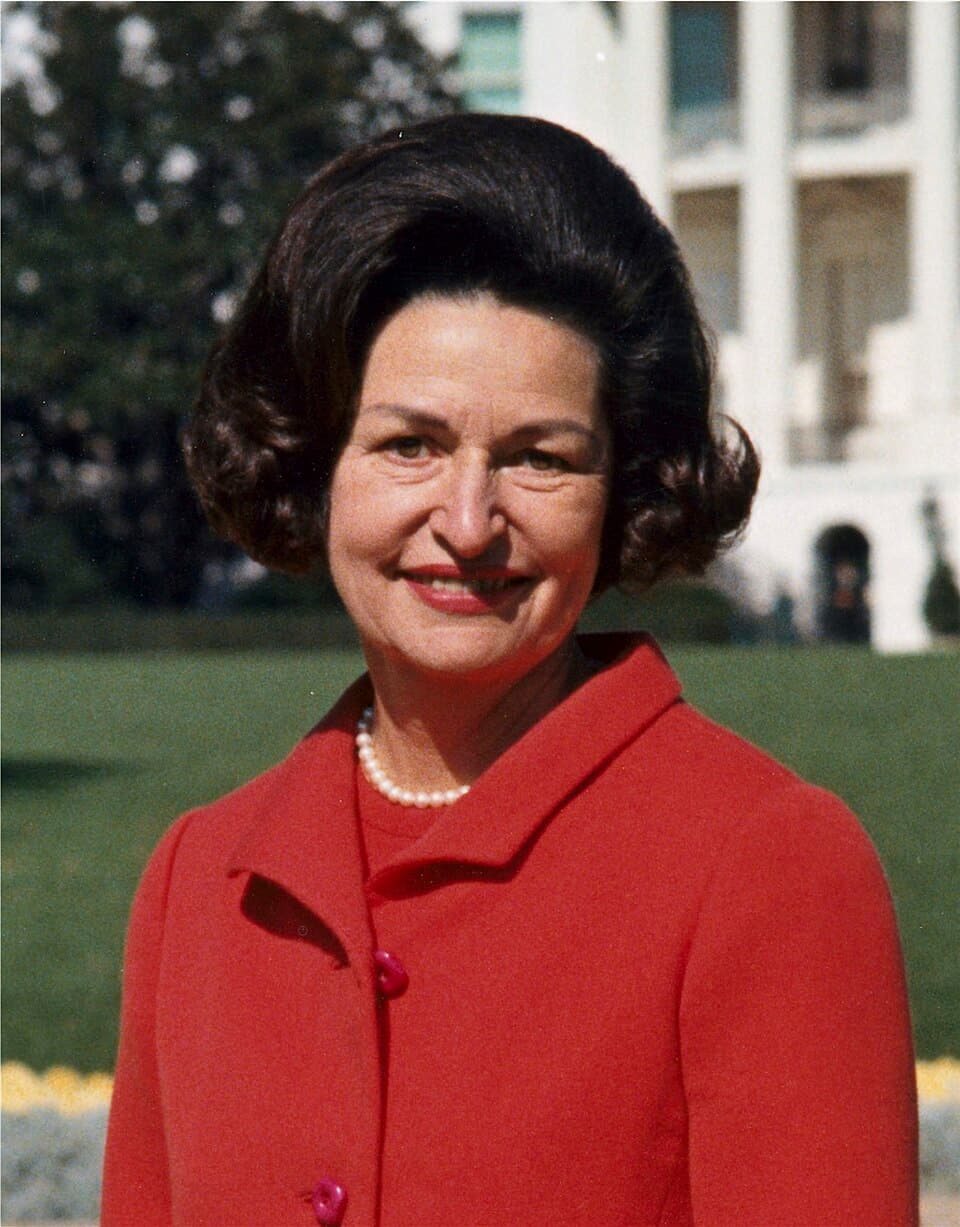
American · Politics · Activism · Science
Lady Bird Johnson
December 22, 1912 – July 11, 2007
Early Life and Background
Claudia Alta "Lady Bird" Johnson (née Taylor) was born on December 22, 1912, near Karnack in the east Texas bayou country.[1][4] She was the third child of Thomas Jefferson Taylor, a prosperous shopkeeper and landowner, and Minnie Pattillo Taylor
Lady Bird’s childhood was marked by both privilege and loss. Her mother died in a household accident when Lady Bird was five, and she was largely raised by her father and relatives.[1][4] The isolation of rural east Texas, combined with her mother’s absence, fostered in her both shyness and a deep attachment to the natural world. She roamed the woods and bayous, developing an early appreciation for wildflowers and landscapes that would later shape her environmental vision.[5] Despite the constraints of the Jim Crow South and limited expectations for women, she excelled academically. After attending public schools, she enrolled at the University of Texas at Austin, an uncommon path for Southern women of her generation.[3][4] She earned a bachelor’s degree in journalism in 1933 and a second bachelor’s degree in history in 1934, training that sharpened her writing, critical thinking, and understanding of politics and society.[3][7] Friends and professors remembered her as serious, studious, and more ambitious than her gentle demeanor suggested. Lady Bird met Lyndon Baines Johnson in Austin in 1934, when he was a young congressional aide and rising political figure. Their whirlwind courtship led to marriage on November 17, 1934, at St. Mark’s Episcopal Church in San Antonio.[1] From the start, their relationship was a working partnership. Lyndon was extroverted, restless, and politically driven; Lady Bird was calm, methodical, and increasingly adept at organization and strategy. In 1937, when Johnson decided to run for a U.S. House seat, Lady Bird used part of her inheritance to help finance his campaign, demonstrating an early willingness to invest financially and emotionally in his political career.[6] During his years in the House and then the Senate, she managed their Washington household, handled correspondence, entertained constituents, and often substituted for him at events when he was called back to Texas. Her most dramatic early business move came during World War II. On January 28, 1943, she completed the purchase of KTBC, a struggling Austin radio station, investing $17,500 of her inheritance and taking ownership in her own name.[1][5] She immersed herself in the station’s operations—negotiating licenses, hiring staff, and seeking better network contracts. Under her management, KTBC obtained a more powerful signal and a CBS affiliation, transforming it into a profitable enterprise and, eventually, a small communications empire that included television.[1][6] This business success was highly unusual for a political spouse in the 1940s. It not only provided the Johnsons with financial independence and political capital but also gave Lady Bird practical experience in media, management, and public messaging—skills that would prove invaluable when she entered the White House. Lyndon Johnson’s political career advanced rapidly. He served in the House from 1937 to 1949, then won a Senate seat and eventually became Senate Majority Leader in the 1950s.[1] Throughout, Lady Bird was a constant presence, traveling back and forth between Washington and Texas, visiting poor rural communities, and observing firsthand the social problems—illiteracy, inadequate health care, and racial inequality—that would later inform her priorities. In 1960, John F. Kennedy chose Johnson as his running mate. Lady Bird threw herself into the presidential campaign, visiting 35 states, frequently in regions where Jackie Kennedy could not travel, and enduring grueling schedules and sometimes hostile crowds.[1][6] Her calm, disciplined style impressed campaign staffers and journalists, who began to see her as one of Johnson’s most effective surrogates. After the Kennedy–Johnson victory, the Johnsons moved into the vice president’s residence. Lady Bird assumed the relatively undefined role of Second Lady, representing the administration at events at home and abroad. She strengthened ties with Texas supporters, continued to oversee their business interests, and increasingly served as Lyndon’s emotional anchor as he chafed in a vice presidency that initially offered limited responsibilities.[17] On November 22, 1963, President John F. Kennedy was assassinated in Dallas while traveling in a motorcade that also included the Johnsons.[12] Lyndon Johnson was sworn in as president aboard Air Force One, with Lady Bird present; from that moment, she became First Lady of the United States.[1] The transition occurred under extraordinary emotional strain and political uncertainty. Lady Bird responded by documenting events in extraordinary detail. Her recorded and transcribed observations, later published as A White House Diary, offer one of the most important eyewitness accounts of the assassination and its aftermath.[5] Even in the first hours, she comforted Jacqueline Kennedy, managed visitors, and began quietly encouraging her husband to project calm and continuity. From the start of the Johnson presidency, Lady Bird played a more substantive policy role than most of her predecessors. By early 1964, as Lyndon Johnson prepared his January 8 State of the Union address declaring a “War on Poverty,” she was already acting as an informal adviser, reading drafts of speeches and discussing education, poverty, and civil rights priorities with him.[17] She saw anti-poverty programs and educational initiatives such as what would become Head Start as aligned with her own concerns for children’s welfare and neighborhood improvement.[4][9] Lady Bird Johnson helped redefine the office of First Lady by building a professional staff and securing a distinct role within the White House. On March 9, 1964, she appointed journalist Elizabeth (Liz) Carpenter as her press secretary, making her the first First Lady to hire her own press secretary and creating a formal East Wing press operation.[7][17] Carpenter coordinated media strategy, issued press releases, and helped frame Lady Bird’s projects for public consumption. Over time, Lady Bird expanded her staff to include a social secretary, project aides, and a staff director, transforming what had been chiefly a social office into an entity capable of research, planning, and public relations.[6][17] She regularly reviewed briefing papers, maintained her own schedule of events and travel, and coordinated with executive agencies on initiatives relating to parks, education, and beautification. By the time she left the White House on January 20, 1969, she had established the precedent of a fully professionalized East Wing operation, headed by a staff director and supported by a press secretary and program staff—an institutional innovation that later First Ladies would expand and normalize.[1][7] Scholars and contemporaries have since credited her with helping create the model of the "modern" First Lady: visible, policy-oriented, and supported by expert staff. Lady Bird also played a pivotal role in electoral politics and the civil rights struggle. During the 1964 presidential campaign, after the passage of the landmark Civil Rights Act of 1964, the South was in political turmoil. Many white Southerners opposed the legislation, and the Johnson campaign faced the defection of voters to Republican candidate Barry Goldwater. In this tense context, Lady Bird undertook a historic journey. On October 6, 1964, she boarded a special train christened the "Lady Bird Special" in Washington, D.C., beginning a four-day, 1,628‑mile whistle‑stop tour through eight Southern states.[1][9] She addressed large crowds, sometimes amid protests and heckling, in defense of her husband’s candidacy and civil rights policies. Observers noted her composure and firm yet conciliatory message—emphasizing regional pride, national unity, and the need for peaceful progress on race. This tour made her the first First Lady to campaign extensively without her husband and showed that a presidential spouse could be an independent, issues-based political actor.[1][4] Many historians credit the tour with helping to stabilize Johnson’s support among moderate Southerners and with signaling that the administration would not retreat from civil rights despite backlash. Beyond the tour, Lady Bird consistently supported civil rights and voting rights legislation in private conversations and public remarks, even as such stances risked alienating segments of the Johnsons’ home base in Texas and the broader South.[4][15] Lady Bird Johnson is best remembered for her leadership in beautification and environmental conservation, work that bridged urban planning, landscape architecture, and emerging ecological awareness. She believed that access to natural beauty—trees, flowers, clean streets, and parks—was not a luxury but a necessity for human dignity and civic pride. On February 11, 1965, she formally launched the First Lady’s Committee for a More Beautiful Capital, enlisting civic leaders, experts, and local officials to improve Washington, D.C.’s parks, schoolyards, and streetscapes.[3][5] The committee focused on planting trees and flowers, cleaning up neglected areas, and creating playgrounds and small parks in underserved neighborhoods. Lady Bird insisted that beautification should aid the poor and reflect social equity, not merely enhance tourist vistas.[4][9] Her most far-reaching initiative was the campaign for the Highway Beautification Act of 1965. Concerned about the proliferation of billboards, junkyards, and strip development along the nation’s rapidly expanding interstate system, she framed scenic protection as a national responsibility. She traveled widely, produced films, addressed civic groups, and lobbied members of Congress to support regulations that would control outdoor advertising and encourage roadside landscaping.[1][2] On October 22, 1965, President Johnson signed the Highway Beautification Act—often dubbed "Lady Bird’s Bill"—with the First Lady at his side.[2][9] The law provided incentives for states to remove certain billboards and screen junkyards, and it promoted the planting of trees and wildflowers along federal highways. Although enforcement was uneven and the act controversial among advertisers and property owners, it marked the first major federal legislation inspired and driven by a First Lady’s campaign.[15] Lady Bird continued to promote environmental awareness throughout the Johnson years. She dedicated the Glen Canyon Dam on September 22, 1966, balancing praise for economic development and recreation with calls for scenic preservation.[1] She also embarked on a two‑day, eight‑state Western Tour beginning on March 19, 1968, highlighting conservation projects and parks across the West and urging communities to value open space, clean air, and water.[5] Her advocacy helped build public support for a series of major conservation laws enacted during the Johnson administration, including the Wilderness Act, the Land and Water Conservation Fund, and the Wild and Scenic Rivers Act, among others.[5][9] While she did not draft these statutes, her visibility and moral suasion contributed to a broader climate favorable to environmental legislation. Many historians consider her a key transitional figure between earlier conservationists and the 1970s environmental movement. In addition to environmental work, Lady Bird Johnson was an important supporter of the Great Society agenda. She strongly backed anti-poverty initiatives and educational programs designed to help disadvantaged children. Her interest converged with the administration’s push for the Economic Opportunity Act, signed on August 20, 1964, which launched the War on Poverty and created programs such as Job Corps and Head Start.[15] Lady Bird took particular pride in Head Start, visiting centers, reading to children, and speaking about the importance of early childhood education for breaking the cycle of poverty.[9] She often linked her beautification projects to social goals—for example, arguing that attractive, well-maintained schoolyards boosted children’s morale and aspirations. She also supported major health-care reforms. On July 30, 1965, she attended the signing of the Social Security Amendments of 1965, which established Medicare and Medicaid, and publicly applauded the extension of medical coverage to the elderly and the poor.[17] Her presence at key bill signings symbolized her endorsement of the Great Society’s efforts to use federal power to enhance social welfare. Later in life, she voiced support for women’s rights, including the proposed Equal Rights Amendment, which she called "the right thing to do," aligning herself with the broader women’s movement emerging in the 1960s and 1970s.[6][7] Lady Bird and Lyndon Johnson had two daughters, Lynda Bird (born 1944) and Lucia ("Luci") Baines (born 1947).[1] Lady Bird strove to maintain a semblance of normal family life despite intense public scrutiny, frequent moves between Texas and Washington, and her husband’s demanding schedule. She encouraged her daughters’ education and later celebrated their careers and public service. The Vietnam War cast a long shadow over the Johnson presidency and the Johnson family. As public opposition to the war grew, Lady Bird was frequently confronted by protesters and anguished letters. She privately expressed misgivings about the war’s human cost but remained loyal to her husband’s decisions, seeking to provide emotional support as he faced protests and political isolation.[10] Her diaries reveal a woman torn between empathy for antiwar sentiment and a sense of duty to the presidency. Throughout these years, Lady Bird functioned as Lyndon Johnson’s confidante, editor, and emotional ballast. Aides later recalled that she could calm him during bouts of anger and depression, urge him to rest, and gently shape his choices by framing options in terms of long-term legacy rather than short-term politics.[10][14] Her influence, though largely informal, helped steady the administration through some of its most turbulent moments. When Richard Nixon was inaugurated on January 20, 1969, the Johnsons returned to Texas. Lyndon Johnson died in 1973, leaving Lady Bird a widow at age 60.[1] She threw herself into projects related to history, conservation, and her husband’s legacy. She was deeply involved with the Lyndon Baines Johnson Library and Museum on the campus of the University of Texas at Austin. From the library’s dedication in 1971 and especially by July 4, 1977, when she participated in programming and the opening of new permanent exhibits, she worked closely with staff to shape exhibits, encourage scholarship, and host public forums.[5] Her goal was to present a balanced picture of the Johnson years, including both the achievements of the Great Society and the controversies of Vietnam. Her environmental work also entered a new phase. On December 22, 1982, she co‑founded the National Wildflower Research Center near Austin with actress Helen Hayes and other supporters, dedicating the institution to the research, preservation, and promotion of native plants and wildflowers.[5][7] The center collected seeds, ran demonstration gardens, and educated the public and highway departments about the ecological and aesthetic benefits of native species. As the center’s profile grew, the University of Texas System Board of Regents voted on November 17, 1995 to rename it the Lady Bird Johnson Wildflower Center, formally honoring her leadership in native‑plant conservation.[5] The Center later moved to a larger site and eventually became the state botanic garden of Texas, further entrenching her environmental legacy. In her later years, Lady Bird suffered a stroke in 2002 that impaired her speech and mobility, but she remained engaged with family, friends, and the institutions she had helped build.[1] She continued to attend events at the Wildflower Center and the LBJ Library whenever possible, embodying the continuity of her commitments across generations. Lady Bird Johnson received numerous awards recognizing both her public service and her environmental leadership. In 1977, she was awarded the Presidential Medal of Freedom, the nation’s highest civilian honor, for her contributions to the country as First Lady and conservation advocate.[6][7] In 1988, she received the Congressional Gold Medal, further cementing her status as a figure of bipartisan respect.[6][7] On September 15, 2005, the American Academy for Park and Recreation Administration awarded her the Pugsley Medal for "personal leadership in the development of the park systems in Washington, D.C., and in Austin, Texas" and for the "inspirational national leadership" she provided in bringing beautification and conservation to the forefront of the national agenda.[11] This honor placed her alongside leading professionals in parks and recreation, recognizing that her work had permanently altered the landscape of American public spaces. Various highways, schools, and public buildings have been named after her, as have trails and conservation initiatives. The continuing operation of the Lady Bird Johnson Wildflower Center and ongoing scholarship using her White House Diary and other papers serve as living memorials to her influence. Lady Bird Johnson’s legacy is multifaceted, encompassing environmentalism, the evolution of the First Lady’s role, and the social history of the 1960s. She is widely credited with helping to launch the modern environmental movement by popularizing the idea that beauty, nature, and urban design are essential components of quality of life.[2][4] Her work helped move conservation from the margins to the center of federal policy discourse at a time when pollution, sprawl, and ecological degradation were becoming national concerns. Her concept of "beautification" went beyond flowers and aesthetics. She linked environmental quality to public health, children’s development, racial justice, and poverty alleviation, arguing that neglected neighborhoods deserved trees and parks as much as affluent ones.[4][9] This integrative vision anticipated later environmental justice movements that highlighted the disproportionate environmental burdens borne by poor and minority communities. Institutionally, she transformed the First Ladyship. By hiring her own press secretary in 1964, building a professional East Wing staff, and leading a major legislative campaign, she set precedents for her successors. Scholars often place her in a lineage stretching from Eleanor Roosevelt to Hillary Rodham Clinton and beyond, as part of a trajectory toward increasingly activist and policy-engaged First Ladies.[14][17] Her White House Diary, based on contemporaneous tape recordings and notes, remains one of the richest primary sources on the Johnson presidency, the Kennedy assassination, and domestic politics in the 1960s. Historians rely on it to reconstruct decision-making processes, personal dynamics, and the emotional climate of the era.[5][10] Lady Bird’s personal style—soft-spoken, self-effacing, and rooted in Southern manners—sometimes led contemporaries to underestimate her political acumen and strategic sense. Recent scholarship has emphasized that beneath this gentle demeanor was a shrewd, disciplined operator who understood power and used access and persuasion rather than confrontation.[10][14] Her example broadened the acceptable ways women could exercise influence in public life. On July 11, 2007, Lady Bird Johnson died at her home in Austin, Texas, at the age of 94.[1][9] She was survived by her two daughters, seven grandchildren, and numerous great‑grandchildren.[15] Former presidents, First Ladies, members of Congress, and environmental organizations issued tributes recognizing her as a pioneer of conservation, a champion of civil rights and anti‑poverty efforts, and a model of steadfast public service. She was buried beside her husband at the family cemetery on the LBJ Ranch in the Texas Hill Country, amid the trees and wildflowers she loved. The landscapes of America’s highways, the parks and schoolyards she helped inspire, and the ongoing work of the Lady Bird Johnson Wildflower Center all stand as enduring testaments to her belief that beauty and justice in the environment are essential to the national character.[1][5]Career Beginnings and Partnership with Lyndon B. Johnson
Ascent to the National Stage
Becoming First Lady in Crisis
Institutional Innovation: Professionalizing the East Wing
Campaigning and Civil Rights
Beautification, Conservation, and the Environmental Movement
Support for the Great Society and Social Policy
Personal Life, Family, and Vietnam-Era Strains
Later Life After the White House
Awards, Honors, and Recognition
Legacy and Historical Impact
Death
Dated achievements
20 indexed.
- Dec221912Politics
Birth of Claudia Alta "Lady Bird" Taylor
Claudia Alta Taylor, later known as Lady Bird Johnson, was born in Karnack, Texas, to Thomas Jefferson Taylor and Minnie Pattillo Taylor.
View details Lady Bird Johnson - Wikipedia - Nov171934Politics
Marriage to Lyndon B. Johnson
Claudia Alta Taylor married Lyndon B. Johnson in San Antonio, Texas, beginning a political partnership that led to the White House.