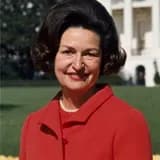
Lady Bird Johnson left the White House having expanded the First Lady's office with a staff director, press secretary, and policy role unprecedented for the position.
On January 20, 1969, Lady Bird Johnson departed the White House at the conclusion of Lyndon B. Johnson's presidential term, leaving behind an East Wing transformed by five years of institutional innovation.
Over the course of her tenure, she had established a formal office with a dedicated press secretary (Elizabeth Carpenter), a staff director, and a policy apparatus capable of independently planning, launching, and executing national initiatives such as the Highway Beautification Act campaign and the beautification of Washington, D.C. This represented an unprecedented degree of professionalization and political engagement for the office of First Lady, moving well beyond the traditional hostessing and ceremonial functions that had defined the role for most of American history.
Her departure marked the conclusion of a First Ladyship widely regarded by historians and political scientists as one of the most substantively influential of the twentieth century, comparable in institutional impact to Eleanor Roosevelt's tenure decades earlier. The staffing model and policy-oriented approach she established provided a direct institutional template that subsequent First Ladies—from Betty Ford to Rosalynn Carter, Hillary Clinton, and Michelle Obama—would build upon, cementing her legacy as a key architect of the modern, professionally staffed office of the First Lady.