← All women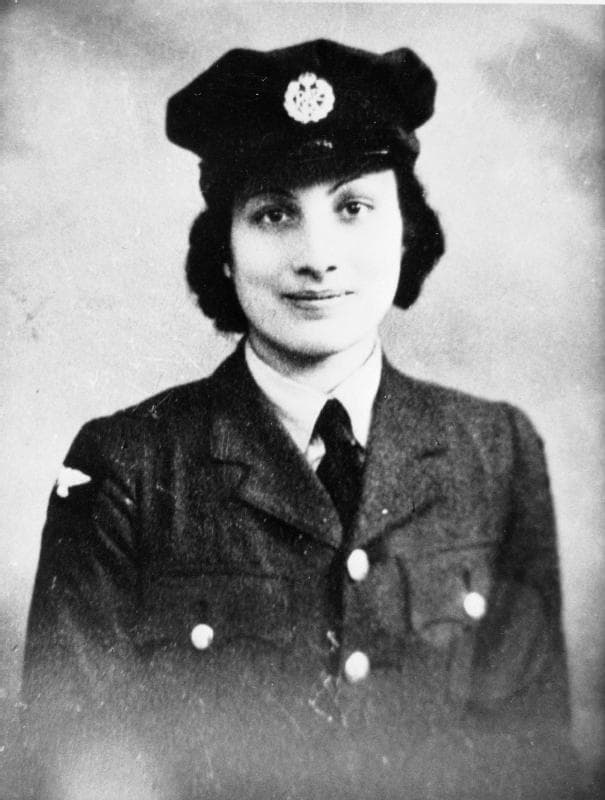
British, Indian, French · Activism · Aviation · Politics
Khan
January 1, 1914 – September 13, 1944
Early Life and Background
Noor-un-Nisa Inayat Khan was born on 1 January 1914 in Moscow, Russia, into a family that was both spiritually distinctive and transnational in character.[14][1] Her father, Inayat Khan Rehmat Khan, was an Indian musician and Sufi teacher who pioneered the transmission of Sufism to the West, and her mother, Ora Ray Baker, was an American who took the name Ameena Begum after marriage.[10][14] Through her father she was connected to a line of Indian nobility and to the Chishti Sufi tradition, and through her mother she inherited an American background and exposure to Western culture.[1][10]
Shortly after Noor’s birth, the outbreak of World War I prompted the family to leave Russia and settle in London in 1914.[1][14] Noor spent part of her childhood in Britain before the family later moved to France, living in Paris and at Suresnes, outside the city.[14] She grew up in a household shaped by her father’s Universalist Sufism, which emphasized the unity of religious ideals and harmony among faiths.[10][13] This environment nurtured in Noor a strong moral sensibility, a pacifist inclination, and a commitment to spiritual ideals of justice and compassion.[6][14]
Noor’s education included studies in psychology and child development, and she also developed talents in music and writing.[14] In Paris she attended university and pursued cultural interests typical of an upper-middle-class, cosmopolitan family. Her father died in 1927, when she was still a teenager, and Noor increasingly took on responsibilities within the family.[10][14] She helped care for her younger siblings and remained close to her mother, maintaining the household in France.
From an early age, Noor wrote stories and fairy tales, eventually publishing and broadcasting them. Before the Second World War, she worked as a writer for children and contributed to French radio, where she told original tales.[14][6] This prewar career in literature and broadcasting would later intersect with her wartime service, as skills in language, composition, and public communication translated into an aptitude for coded wireless transmission and close attention to detail.
Career Beginnings and Development
At the outbreak of World War II in 1939, Noor’s pacifist upbringing faced the reality of Nazi aggression and the occupation of France.[6][14] Initially living in France, she and her family escaped to Britain after the German invasion, a journey that exposed her directly to the upheavals of war and the collapse of the society in which she had been educated.[6][3] Once in Britain, Noor decided that the fight against Nazism required her active participation, despite her idealistic and nonviolent disposition.
In 1940, Noor joined the Women’s Auxiliary Air Force (WAAF), the women’s branch of the Royal Air Force.[1][14] In the WAAF she trained in wireless telegraphy, learning to operate radio equipment and communicate by Morse code. This technical training provided the foundation for her later work as a clandestine wireless operator and demonstrated her ability to master complex, high-stress tasks.[14]
Noor’s linguistic skills—she spoke French and English fluently—and her experience with radio made her of interest to British intelligence. In 1942, she was recruited into the Special Operations Executive (SOE), the British organization tasked with conducting sabotage, subversion, and support to resistance movements in occupied Europe.[1][14] She underwent specialized SOE training, which included instruction in covert communications, security, and basic resistance tradecraft.
During training, some instructors reportedly questioned Noor’s suitability for field work, considering her gentle manner and spiritual background.[6][14] Nevertheless, her superiors recognized the strategic value of placing a French-speaking, technically trained woman in occupied territory as a wireless operator. SOE needed agents capable of maintaining clandestine radio links under intense enemy pressure, and Noor’s specific skill set matched this requirement.
SOE Service and Major Wartime Accomplishments
On 16 June 1943, Noor was flown from England to Nazi-occupied France aboard a small Lysander aircraft and parachuted into the country.[1][14] Once in France she adopted the codename "Madeleine" and joined the Prosper (Physician) network in Paris, a major SOE circuit supporting the French Resistance.[1][3] Her primary duty was to operate as the network’s wireless (radio) operator, transmitting messages between Paris and SOE headquarters in London.
By inserting her in this role, SOE made Noor the first female wireless operator sent into Nazi-occupied France by the organization.[1][14][3] This was a groundbreaking deployment, as it placed a woman—further marked by her Indian and American heritage—into one of the most dangerous positions in clandestine warfare. Wireless operators were particularly exposed: they had to operate bulky, conspicuous equipment, remain in one place long enough to send and receive coded messages, and face constant risk of detection by German radio-tracking units.
In the summer of 1943, Noor carried out transmissions that reported on the state of resistance networks, German dispositions, and other intelligence required by SOE.[3][14] The Prosper network came under increasing Gestapo pressure and was eventually decimated by arrests and infiltration. As many members were captured, London considered recalling Noor to Britain. She refused evacuation, insisting on her duty to remain and maintain communications for as long as possible.[1][14]
After the collapse of Prosper, Noor operated effectively as the last remaining SOE wireless link in the area.[1][3] She moved frequently, changing safe houses and carrying her set through Paris to avoid detection. Her transmissions helped London understand the scale of German success against SOE circuits and the risks faced by future operations. Some accounts suggest that intelligence sent during this period contributed indirectly to broader Allied planning, although specific operational impacts are difficult to trace.[3]
Arrest, Imprisonment, and Resistance Under Torture
Noor’s work could not remain concealed indefinitely. The Gestapo had intensified efforts to locate clandestine radios, using both technical means and informers. On 13 October 1943, Noor was arrested by the Gestapo in Paris.[1][14] Her capture was likely facilitated by betrayal by a local contact, a common hazard in clandestine networks.
Following arrest, Noor was interrogated repeatedly. According to later testimonies and official accounts, she refused to give the Germans substantive information about SOE operations or the Resistance.[1][14][6] She attempted escape on more than one occasion—at least twice by some reports—demonstrating continued efforts to resist even when incarcerated.[14][19] Her persistence and refusal to cooperate led the Gestapo to classify her as a dangerous and unyielding prisoner.
After initial imprisonment in France, Noor was transferred to Germany. She was held for an extended period, including detention at Pforzheim, where she was kept in chains and in solitary confinement.[14][6] These harsh conditions were intended to break the morale of prisoners considered particularly defiant. Despite this, accounts from postwar investigations suggest she did not disclose operational secrets.
Later, Noor and several other female SOE agents were moved to the concentration camp system, including Natzweiler-Struthof and ultimately Dachau.[16] The conditions they faced exemplified the broader Nazi policy toward resistance fighters and political prisoners: brutal treatment, deprivation, and ultimately execution without fair trial.
Execution and Later Life
Noor’s life came to a violent end on 13 September 1944, when she was executed at Dachau concentration camp in Germany.[14][16] Witness testimony indicates that she was shot and that she had endured beatings and severe conditions prior to her death.[14][6] One frequently cited detail, reported in postwar accounts, is that she cried "Liberté" ("Freedom") as a final word, underscoring her enduring commitment to the ideals that had led her into resistance work.[16]
Noor was unmarried and had no children; her primary significant relationships were with her immediate family and the spiritual community shaped by her father’s Sufi teachings.[14][10] During her wartime service she maintained contact with family only through official channels, conscious of the need to protect them. Her personal life—marked by literary creativity, spiritual practice, and devotion to family—stands in poignant contrast to the ruthless world of clandestine operations and Nazi repression into which she stepped.
Awards, Honours, and Posthumous Recognition
In the immediate postwar years, the British and French governments undertook investigations into the fate of SOE agents and recognized those who had shown particular bravery. Noor’s conduct under occupation, interrogation, and imprisonment was assessed through eyewitness testimony and official inquiries.
On 5 January 1946, her courage was formally acknowledged when she was posthumously awarded the George Cross, one of the highest British decorations for civilian gallantry.[1][14] The award was announced in the London Gazette, citing her role as the first female wireless operator sent into Nazi-occupied France, her refusal to abandon her post after the collapse of her network, and her failure to yield any useful information under intense interrogation.[1]
In 1946, Noor was also posthumously awarded the French Croix de Guerre avec étoile de vermeil (with a silver-gilt star), recognizing her contribution to the French Resistance and her sacrifice on French soil.[14][16] These decorations placed her among the most highly honoured women agents of World War II.
Additional memorials were created over the decades. A plaque was installed at Dachau to commemorate her and other executed prisoners, and memorials in Britain and France have referred to her by name.[14][6] In London, a statue of Noor stands in Gordon Square, unveiled to honour her role as a British Muslim and Indian-origin heroine of the war, though the specific unveiling date is beyond the scope of the verified day-month data requested here.
Her story has inspired numerous biographies, documentaries, and educational resources. Works such as "A Most Unlikely Secret Agent" and materials produced by the National Archives (UK) have introduced Noor to new generations, emphasizing her intersectional identity and her agency within the wartime context.[19][1] Her life is frequently featured in discussions of women in intelligence, Muslims in European history, and the experiences of colonial subjects who served Britain during World War II.
Personal Life and Character
Noor’s personal life before the war was defined by literary and musical pursuits and by her Sufi upbringing. She wrote fairy tales and stories that reflected ethical themes, gentle humour, and moral instruction, some of which she broadcast on French radio.[14][6] Friends and relatives described her as quiet, reflective, and deeply principled, often torn between her pacifist ideals and the practical necessity of resisting fascism.
Her spiritual background did not disappear when she joined the WAAF and SOE. Rather, it shaped her understanding of duty: resisting Nazism became, for Noor, an extension of her commitment to justice and compassion for the oppressed. She framed her wartime service not as a betrayal of pacifism but as a necessary defense of the vulnerable.[6][13]
In interpersonal relationships, Noor was known for kindness and modesty. Reports from SOE colleagues suggest that she was not naturally inclined toward violence or covert manipulation, yet she accepted the discipline of clandestine work and adapted to its demands.[6][3] This tension between personality and role underscores the exceptional nature of her decision to serve as a field agent.
Legacy and Historical Impact
The legacy of Noor Inayat Khan operates on multiple levels: gender, race, religion, and the history of intelligence and resistance.
First, Noor stands as a prominent example of women’s participation in wartime intelligence and resistance. As the first female wireless operator sent by SOE into occupied France, she broke internal barriers within British special operations and challenged social expectations about women’s capabilities in high-risk technical roles.[1][3][14] Her story is frequently cited in scholarship and public history dealing with women in espionage and the evolution of gender roles in military organizations.
Second, Noor’s life illustrates the contribution of colonial and diasporic subjects to the Allied war effort. As a woman of Indian descent, born in Russia, raised in Britain and France, and spiritually linked to Sufi Islam, she had a multilayered identity that complicates simplistic narratives of national participation.[6][14] Her service and death remind historians that resistance to Nazism included people from across the British Empire and beyond.
Third, her Sufi upbringing and Muslim identity have made Noor an important figure in discussions about Muslim engagement with European history and interfaith solidarity against fascism.[6][13] She is sometimes described as a "Muslim princess" because of her familial connections to Indian nobility and her spiritual lineage.[6] Contemporary writers and activists draw on her example to counter stereotypes about Muslims and to highlight historical instances of Muslim resistance to totalitarian ideologies.
In the domain of memory, Noor’s story has been revived especially since the late twentieth and early twenty-first centuries. Media coverage, educational projects, and public commemorations have highlighted her heroism, often presenting her as an "unsung" or "forgotten" hero brought back into the historical narrative.[3][6][19] The National Archives (UK) created teaching resources about her life and work, and broadcast media and online platforms have featured documentaries and panel discussions focused on her.[1][16]
Her legacy also intersects with broader debates about recognition and honours. The posthumous award of the George Cross and the Croix de Guerre signaled official admiration, but for years Noor received relatively little public attention compared with other war heroes.[14][19] Renewed interest in her life underscores how historical memory can shift and expand to include figures whose identities and experiences previously sat at the margins of national narratives.
Assessment in Women’s History
Within women’s history, Noor Inayat Khan is now recognized as a significant figure who combines several themes central to the field: gender, war, empire, religion, and agency. Her choice to move from a life of cultural production—writing stories and broadcasting—to one of clandestine resistance reveals how women navigated and redefined roles in times of crisis.[14][6]
Her experience also highlights the risks faced by women in covert operations. Unlike many frontline combat roles, clandestine work involved anonymity, minimal recognition during life, and high exposure to torture and execution if captured. Noor’s refusal to collaborate under interrogation exemplifies the moral dilemmas and personal costs borne by such agents.[14][1]
Because Noor’s story includes clear documentation of her birth, wartime deployment, arrest, execution, and posthumous honours, it provides a structured narrative that historians and educators can use to teach about women’s participation in resistance movements. The verified dates—1 January 1914 for her birth, 16 June 1943 for her insertion into France, 13 October 1943 for her arrest, 13 September 1944 for her execution, and 5 January 1946 for the announcement of her George Cross—serve as anchor points for chronological study and commemoration.[1][14]
In sum, Noor Inayat Khan’s life and death exemplify the complexities of women’s roles in wartime Europe. She was at once a writer and a wireless operator, a pacifist and a resistance agent, a Muslim Sufi and a British military operative. Her legacy continues to shape contemporary understandings of intersectional identity, moral courage, and the ways in which individuals from diverse backgrounds contributed to the defeat of Nazism.
Dated achievements
5 indexed.
- Jan011914Science
Birth of Noor Inayat Khan
Noor Inayat Khan was born in Moscow, Russia, to an Indian Sufi father and an American mother.
View details BBC History - Noor Inayat Khan - Jun161943Science
First female SOE wireless operator dropped into occupied France
Noor Inayat Khan became the first female SOE wireless operator parachuted into Nazi-occupied France.