← All women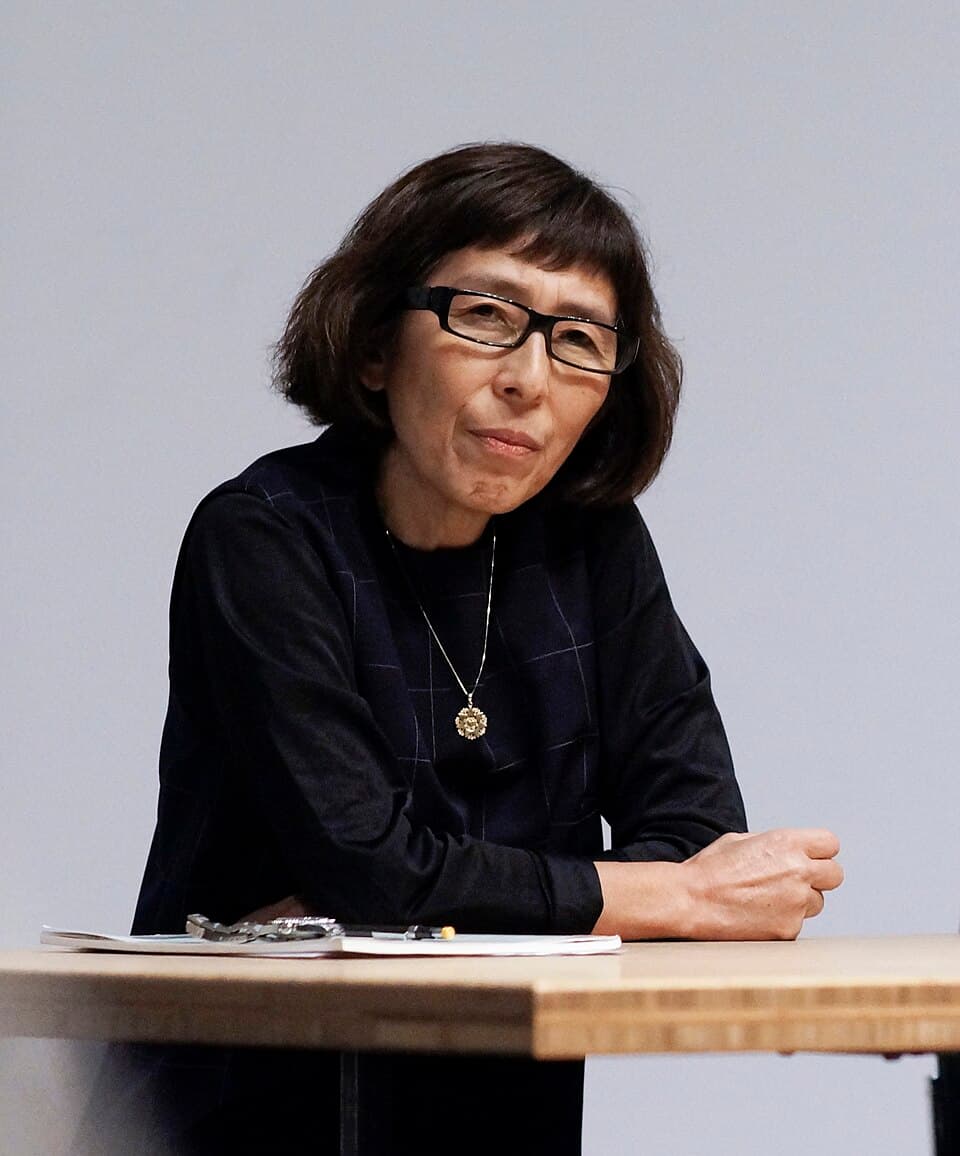
Japanese · Arts
Kazuyo Sejima
October 29, 1956 – present
Early Life and Background
Kazuyo Sejima (妹島 和世, Sejima Kazuyo) was born on 29 October 1956 in Mito, in Ibaraki Prefecture, Japan.[1][11] She grew up in the decades following Japan’s postwar reconstruction, a period marked by rapid economic growth and intense architectural experimentation. Sejima herself has noted that early exposure to the work of Japanese architect Kazuo Shinohara through photographs sparked her interest in architecture and contemporary design.[9] This fascination with unconventional domestic spaces and modern forms would later inform her own architectural language, characterized by lightness, transparency, and an acute sensitivity to everyday life.
Sejima pursued formal architectural training at Japan Women’s University1979 and her master’s degree in architecture in 1981.[1][10][11] Studying in an environment explicitly dedicated to women’s education was significant in a profession where female participation remained limited; it provided both technical training and a context in which women could envision professional careers in fields traditionally dominated by men.
Education and Early Career
After completing her master’s degree in 1981, Sejima joined the office of prominent Japanese architect Toyo Ito, working at Toyo Ito & Associates from 1981 to 1987.[1][3][10] Ito’s practice was known for experimental forms and conceptual rigor, and Sejima’s six years there were formative. She learned to explore new relationships between structure, materials, and space, and to conceive architecture as a medium for everyday experience rather than purely monumental expression.[8][9]
In 1987, Sejima established her own firm, Kazuyo Sejima & Associates, in Tokyo.[1][3][8][10] This move marked a decisive step toward independent practice at a relatively young age, particularly notable for a woman architect in Japan at the time. Her early projects focused on houses and small-scale buildings, where she developed a minimalist vocabulary and refined spatial strategies. These works emphasized open plans, carefully framed views, and intricate circulation paths, distinguishing her approach from more formally aggressive contemporary trends.
Emergence as a Leading Architect
During the late 1980s and early 1990s, Sejima’s work began receiving formal recognition. On 15 June 1989, she received the Special Prize for Residential Architecture from the Tokyo Architecture Association, an early acknowledgment of her innovative contributions to housing design.[1] The following year, on 20 July 1990, she was awarded the SD Prize at the SD Review, a respected platform for emerging architectural talent.[1] These honors highlighted the originality of her residential and small-scale projects and signaled her growing prominence within Japan’s architectural community.
Sejima’s reputation expanded further in the early 1990s. On 18 May 1992, she won Second Prize in the Commercial Space Design Award, recognizing her work in interior and commercial architecture.[1] Later that year, on 6 November 1992, she received the "Young Architect of the Year" award from the Japan Institute of Architects.[5][8] This national award marked her as one of the most promising architects of her generation. In 1994, she continued to gain distinction in commercial design, winning First Prize in the Commercial Space Design Award ’94 on 30 September 1994.[5]
Her work also began attracting international attention. On 10 November 1995, Sejima received the Kenneth F. Brown Asia Pacific Culture and Architecture Design Award from the University of Hawai‘i for the Saishunkan Seiyaku Women’s Dormitory.[1] This project was praised for its humane, communal spaces and rethinking of worker housing, demonstrating her ability to address social and cultural issues through minimalist design.
Founding SANAA and Collaborative Practice
In 1995, Sejima co‑founded the firm SANAA (Sejima and Nishizawa and Associates) with architect Ryue Nishizawa, a former employee and collaborator.[1][3][8][13] Based in Tokyo, SANAA quickly became a leading international practice, known for its refined simplicity, spatial fluidity, and careful integration of buildings into their surroundings.[8][11] While Sejima continued to operate her own office, SANAA served as the main platform for her large-scale and international projects.
SANAA’s portfolio includes numerous landmark buildings. The 21st Century Museum of Contemporary Art in Kanazawa, completed in 2000 and opened to the public on 26 September 2004, is one of their best-known works.[1] The museum’s circular plan, transparent façades, and dispersed gallery volumes invite visitors to move freely and experience art and city as intertwined realms. Soon after its opening, Sejima and Nishizawa received the Golden Lion for this project at the 9th Venice Architecture Biennale on 12 September 2004, where it was recognized as the most significant work in the exhibition.[8][10]
Other major SANAA projects include the Rolex Learning Center at the École Polytechnique Fédérale de Lausanne, the New Museum of Contemporary Art in New York, the Toledo Museum of Art Glass Pavilion in Ohio, the Christian Dior Omotesando Building in Tokyo, the Louvre‑Lens in France, the Grace Farms project in Connecticut, and multiple university and cultural buildings in Europe, North America, and Asia.[6][8] Across these works, Sejima’s design approach emphasizes porous boundaries, subtle transitions, and spatial experiences that encourage users to move, linger, and interact.
International Recognition and Major Awards
Sejima’s architecture has won numerous national and international honors. In 1998, she received a Prize of the Architectural Institute of Japan (AIJ), followed by another AIJ prize in 2006, recognizing the quality and innovation of her built work.[14] On 9 November 2000, she was awarded the Erich Schelling Architecture Prize by the Schelling Architecture Foundation in Karlsruhe, Germany, which honors forward‑looking architectural thought and practice.[6]
On 21 October 2005, Sejima and Nishizawa received the Rolf Schock Prize in Visual Arts, awarded by the Royal Swedish Academy of Sciences and associated academies.[1][6] This prize acknowledged their architecture as a significant contribution to the visual arts, emphasizing the aesthetic and conceptual dimensions of their work. On 18 March 2007, they were honored with the Kunstpreis Berlin (Art Prize Berlin) from the Akademie der Künste, further cementing their status within European cultural institutions.[6]
In 2007, Sejima was elected an International Fellow of the Royal Institute of British Architects (RIBA), recognizing her influence on global architectural practice.[14] Her growing list of honors reflected both her built projects and her broader contributions to architectural discourse.
The Pritzker Architecture Prize
Sejima’s global prominence reached a new level in 2010. On 29 March 2010, the Pritzker Architecture Prize jury announced Kazuyo Sejima and Ryue Nishizawa as the 2010 laureates.[8] The Pritzker is widely regarded as architecture’s highest honor. Sejima became only the second woman ever to receive the prize, following Zaha Hadid in 2004, and it was the first time a woman‑led partnership had been recognized in this way.[8][9][11][13]
The jury cited projects such as the 21st Century Museum of Contemporary Art, the New Museum, and the Rolex Learning Center, praising SANAA’s "deceptively simple" buildings with "powerful, fluid, and seemingly effortless" spaces.[8] On 17 May 2010, a formal ceremony on Ellis Island in New York Harbor celebrated the laureates, where Sejima and Nishizawa received the bronze medallion and citation from the Hyatt Foundation.[8]
The Pritzker Prize significantly reinforced Sejima’s role in women’s architectural history, demonstrating that collaborative, understated design could be recognized at the highest level and broadening the public perception of what a leading architect might look like.
Curatorial and Institutional Leadership
In addition to her design practice, Sejima has played important roles in architectural institutions and cultural initiatives. In 2010, she was appointed Director of the Architecture Sector of the Venice Biennale, becoming the first woman to hold this position.[16][9] On 7 July 2010, her appointment was formally noted, and she curated the 12th International Architecture Exhibition under the title "People Meet in Architecture".[16][1] The exhibition explored how architecture mediates encounters between people and their environments, emphasizing experiential installations and user-centered design.
In 2014, Sejima was selected as the first architecture mentor in the Rolex Mentor and Protégé Arts Initiative, working with Chinese architect Yang Zhao.[16] This role highlighted her standing as a mentor to younger practitioners and underscored the importance of intergenerational exchange in contemporary architecture.
Sejima has also served on prestigious juries and boards. In 2018, she joined the jury of the Pritzker Architecture Prize, with her appointment publicly noted on 7 June 2018.[9] As a former laureate, she contributes her experience and perspective to the selection of future Pritzker winners. On 30 March 2023, the United States–Japan Foundation announced her appointment to its Board, recognizing her leadership in architecture and her ability to strengthen cultural ties between the two countries.[8]
Academic Career and Teaching
Teaching has been an integral part of Sejima’s career. She has held positions at Princeton University, the École Polytechnique Fédérale de Lausanne, Tama Art University, and Keio University.[8][12] According to the University of Pennsylvania’s Stuart Weitzman School of Design, she is currently a professor at the Politecnico di Milano, a visiting professor at Japan Women’s University and Osaka University of Arts, an emeritus professor at Yokohama National University, and director of the Tokyo Metropolitan Teien Art Museum.[6] Through these roles, Sejima has influenced a wide range of students and contributed to the development of architectural education in Japan and internationally.
Her teaching emphasizes careful observation, sensitivity to context, and the importance of spatial experience. Students are encouraged to think about how architecture can subtly shape everyday interactions, echoing themes present in her built work.
Later Honors and Recognition
Sejima has continued to receive major honors in later years. In 2016, she was named the recipient of the Jane Drew Prize, announced on 7 March 2016, in recognition of her role in advancing the status of women in architecture and raising their profile within the profession.[7] In 2018, she served as a World Judge for the Prix Versailles, an international award for commercial architecture.[1]
On 19 October 2022, Sejima and Nishizawa were announced as recipients of the 2022 Praemium Imperiale in Architecture, one of the world’s major arts prizes awarded by the Japan Art Association.[1][10] This accolade situated their work alongside leading figures in other artistic disciplines and reinforced architecture’s importance within global cultural production.
In 2024, Sejima was recognized as a Person of Cultural Merit by the Japanese government, an honor bestowed on individuals who have made outstanding contributions to Japanese culture.[1] On 3 October 2025, she and Nishizawa received the Royal Gold Medal for architecture from RIBA at a ceremony in London, one of the profession’s most prestigious lifetime honors.[1][10] These recognitions underscore her enduring impact on both national and international architectural discourse.
Personal Life
Published sources focus primarily on Sejima’s professional achievements and do not provide detailed information about her personal life, including marriage or children. Biographical entries from encyclopedic and institutional sources such as Britannica, the Pritzker Prize, and university profiles address her education, career, and awards but omit private family details.[1][6][8][11] This reflects both her own preference for privacy and a broader pattern in which architects’ biographies concentrate on built work and institutional roles.
Sejima’s public identity is thus largely shaped by her architecture, teaching, and cultural leadership rather than by personal narratives. Her contribution to women’s history lies in her professional trajectory and visibility as a successful woman architect operating at the highest levels of her field.
Legacy and Historical Impact
Kazuyo Sejima is widely regarded as one of the most influential architects of her generation. Her work with Kazuyo Sejima & Associates and SANAA has reshaped expectations about how contemporary buildings can look and function. Rather than relying on overt formal gestures, her architecture focuses on subtle modulations of space, light, and movement, creating environments that feel both delicate and robust.
In women’s architectural history, Sejima’s significance is multifaceted. She was among the earliest Japanese women to gain global recognition as a practicing architect, becoming the second woman to receive the Pritzker Architecture Prize and the first woman to direct the Architecture Sector of the Venice Biennale.[1][8][16] These milestones expanded the representation of women in top-tier architectural institutions and provided powerful precedents for future generations.
Her projects, especially the 21st Century Museum of Contemporary Art in Kanazawa, have had a lasting impact on museum and cultural building design. By integrating transparent boundaries, flexible layouts, and user-centered circulation, Sejima and SANAA’s work has influenced architects worldwide and contributed to a broader shift toward open, experiential public spaces.[8][10]
Sejima’s roles as teacher, mentor, juror, and institutional leader further amplify her legacy. Through her professorships, mentorship in the Rolex Mentor and Protégé Arts Initiative, and service on the Pritzker jury and various boards, she has helped shape both architectural education and the mechanisms by which architectural excellence is recognized.[6][9][16]
Later Life and Continuing Work
As of the mid‑2020s, Kazuyo Sejima remains professionally active. She continues to lead Kazuyo Sejima & Associates, co‑direct SANAA with Ryue Nishizawa, teach at universities, and participate in major cultural and architectural institutions.[1][6] Recent SANAA works, such as the expansion of the Art Gallery of New South Wales (Naala Badu Building) and other educational and cultural projects, indicate that her practice remains at the forefront of contemporary design.[6]
Her recognition as a Person of Cultural Merit in 2024 and receipt of the RIBA Royal Gold Medal in 2025 attest to her continued influence and the sustained relevance of her architectural philosophy.[1][10] Sejima’s career exemplifies how a woman architect from a regional Japanese background can, through persistent experimentation and collaboration, help redefine global architectural culture.
Through her built works, teaching, and institutional leadership, Kazuyo Sejima has left—and continues to build—a legacy of architecture that invites people to meet, move, and dwell in spaces that are at once simple and profoundly engaging.
Dated achievements
20 indexed.
- Oct291956Arts
Birth in Ibaraki Prefecture, Japan
Kazuyo Sejima was born in Ibaraki Prefecture, Japan, later becoming one of the country's most internationally renowned architects.
View details Kazuyo Sejima - Wikipedia - Jun151989Arts
Special Prize for Residential Architecture, Tokyo Architecture Association
Sejima received the Special Prize for Residential Architecture from the Tokyo Architecture Association, one of her earliest recognized achievements.