← All women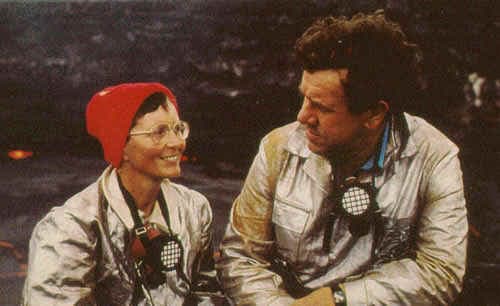
French · Science · Exploration
Katia Krafft
April 17, 1942 – June 3, 1991
Early Life and Background
Catherine Marie Joséphine "Katia" Conrad, later known as Katia Krafft, was born on 17 April 1942 in Soultz-Haut-Rhin, a town in the Haut-Rhin department of Alsace in northeastern France.[3][4][5][7][11][15] Some biographical sources instead list nearby Guebwiller as her birthplace, reflecting minor regional discrepancies in the record, but all agree on the date and Alsatian origin.[1][2][8][9][12][15] She grew up in the Rhine valley during the Second World War and the difficult postwar years, a context that combined material scarcity with rapid scientific and technological change.
Her father was a goldsmith and her mother a schoolteacher, a family environment that blended manual precision, artistic sensibility, and respect for education.[4][5] From an early age she showed a strong interest in the natural world, particularly in dramatic phenomena such as volcanoes, which she encountered through books, photographs, and newsreels.[1][8][10][11][14] These images of erupting mountains impressed her with both their beauty and their destructive potential, and she later recalled that they sparked a lifelong fascination.
Growing up in a borderland region with a complex Franco-German history, Krafft experienced multiple cultural influences and languages. This background would prove useful in her later international career, allowing her to communicate with colleagues and authorities across Europe and beyond.[3][6][11] Despite the fact that few women from her milieu entered scientific fields, she set her sights on higher education in the physical sciences.
Education and Formative Influences
Krafft’s school performance and determination led her toward the selective French teacher-training path. In 1957, she passed the entrance examination for the École Normale, gaining access to an institution that prepared future educators and opened doors to advanced study.[1][14] This success marked her transition from a small Alsatian town to the broader academic world.
She continued her studies at the University of Strasbourg, where she specialized in physics and chemistry, and where some sources specify a focus on geochemistry.[2][8][11][14] Strasbourg was a major regional university and scientific center, and Krafft encountered modern approaches to earth sciences, including volcanology, at a time when plate tectonics and new geophysical methods were transforming understanding of the planet’s interior.
Her early scientific work involved careful observation and measurement, traits that would later characterize her volcanological career. A Spanish-language profile notes that her first scientific job already acknowledged her promise in volcanology, encouraging her to deepen her specialization in the study of volcanic phenomena.[14] During her university years she was exposed to both laboratory and field-based geoscience, developing the methodological rigor that would underpin her later, visually dramatic expeditions.
Importantly, Krafft pursued this path when women remained a small minority in the physical sciences and geosciences. Contemporary accounts and later retrospectives highlight her as one of the first highly visible female volcanologists, whose public profile and media presence would contribute to greater recognition of women’s capacity to work in hazardous, field-intensive disciplines.[3][6][9][10][11][14]
Meeting Maurice Krafft and Early Career
At the University of Strasbourg, Katia met Maurice Paul Krafft, a fellow Alsatian with a similarly intense interest in volcanoes.[2][6][8][11] The two bonded over their shared fascination with eruptive landscapes and their desire to witness eruptions firsthand rather than study them solely through remote data or historical reports. Their scientific and personal partnership formed in this academic setting and continued throughout their lives.
By the late 1960s, the couple had begun to establish themselves in the nascent field of modern observational volcanology. In 1968, they helped create the Centre de Volcanologie in Cernay, in Alsace, a small but influential center that collaborated with organizations such as the International Association of Volcanology and Chemistry of the Earth’s Interior (IAVCEI), the Smithsonian Institution, and the United States Geological Survey.[5][14] This network gave them access to global information on volcanic activity and to colleagues working on hazard assessment.
Katia’s early career focused on gas sampling from active volcanoes and very close-range photographic documentation of eruptions.[2][4][5][11] She developed techniques and portable equipment that allowed her to collect data directly from fumaroles and crater rims, often wearing silver heat-resistant suits in high-temperature environments.[2][5][10][11] Unlike many geoscientists who relied heavily on remote sensing or post-eruption fieldwork, she insisted that proximity and visual detail were essential for understanding eruptive dynamics.
In the late 1960s, her promise was recognized through the Prix de la Vocation, awarded in 1969 by the Fondation Marcel-Bleustein-Blanchet.[3][14] The prize supported young people without financial means in pursuing their vocation, and it helped finance her early volcanological projects. Around this time, she also developed what Italian sources describe as the first portable device for volcanic gas analysis, enabling in-situ sampling that contributed to improved eruption prediction.[3][14] These innovations solidified her role as a technically skilled and inventive field scientist.
Marriage and Joint Volcanological Career
Katia and Maurice married around 1970, formalizing a partnership that combined scientific expertise, logistical daring, and a flair for communication.[1][2][5][6][8][9] From this period onward, they traveled extensively as a couple to study volcanoes on all continents, financing many of their expeditions through the sale of books, photographs, and films rather than through large institutional grants.[2][5][11]
Over roughly two decades, the Kraffts visited more than 300 volcanoes and witnessed in excess of 140–175 eruptions, a number often described as an unmatched record for direct observation.[6][9][11] They worked on stratovolcanoes, shield volcanoes, and caldera systems across regions including the Mediterranean, the Caribbean, Africa, Asia, and the Pacific. Their preferences tended toward highly active and explosive systems, where the risks were greatest but the scientific and visual rewards most dramatic.
Katia’s contributions were central to this joint career. She served not only as co-investigator and gas specialist but also as a key cinematographer and photographer. Her eye for framing and movement transformed eruptive events into compelling visual narratives that could convey scale, speed, and danger more effectively than static scientific reports.[2][5][9][11] She was frequently shown in images wearing bright protective clothing while standing close to lava flows or crater edges, symbolizing both scientific commitment and personal bravery.
Major Works and Scientific Contributions
Beginning in the early 1970s, the Kraffts produced a substantial corpus of books, scientific papers, and films on volcanoes. Their first book on volcanoes appeared in 1971, and over the next two decades they authored or co-authored around twenty books
Katia’s scientific work often focused on the chemistry of volcanic gases, the phenomenology of eruptions, and the implications of these phenomena for hazard assessment. She refined field methods for collecting gas samples and documented how changes in gas composition and emission rates could signal evolving magma conditions.[3][11][14] Her insights were part of a broader movement toward using geochemical monitoring to anticipate eruptions. The couple became particularly known for their pioneering close-up films of volcanic activity. They produced footage of lava fountains, lava lakes, ash plumes, lahars, and especially pyroclastic flows, the fast-moving, high-temperature currents that are among the most lethal volcanic hazards.[2][5][6][9][10][11] Secondary sources credit them with the first film recordings of a pyroclastic flow, though precise dates for this innovation are not documented in publicly accessible records.[6][9] Katia’s role as a cinematographer is attested by credits in later documentaries. She is listed on the film database IMDb for contributions to productions such as "Deadly Peaks, Killer Volcanoes" (1997) and episodes of "Nature" (1982), indicating that her material and expertise were valued by major science media outlets.[9] Their footage was frequently licensed to broadcasters and educational producers, making their images of eruptions some of the most widely seen volcanic scenes of the late twentieth century. Beyond documentation, Katia and Maurice actively promoted the use of visual evidence in risk communication. They argued that authorities and communities could better understand the urgency of evacuation if they saw vivid images of past disasters. In discussions of tragedies such as the 1985 Nevado del Ruiz eruption in Colombia, where mudflows (lahars) killed thousands in Armero, the Kraffts emphasized that clearer communication of the hazard could have saved many lives.[2][10][11] Their films and lectures became tools for advocating improved preparedness and early warning systems. Early in her career, Krafft received the Prix de la Vocation in 1969, a prize established by the Fondation Marcel-Bleustein-Blanchet to support young people pursuing their calling despite limited financial means.[3][14] This recognition not only validated her choice of volcanology—a relatively unconventional path—but also provided resources for fieldwork and equipment at a critical stage. In the early 1970s, she and Maurice’s work attracted attention from high-level political figures. A French news feature notes that in 1972 they met Valéry Giscard d’Estaing, then France’s Minister of the Economy and Finance, and received prizes for their contributions.[5] Such recognition illustrated the growing appreciation for their role in public education about natural hazards and their success in bringing complex geoscience to broader audiences. Over subsequent years, their books, films, and lectures earned them reputations as celebrity volcanologists. They appeared in television programs, magazine articles, and public events, with Katia often highlighted as an emblematic figure of female achievement in a dangerous scientific field.[2][5][10][11] While many of these honors were informal or media-based rather than strictly academic, they collectively underscored the impact of her work on popular understanding of volcanoes. Katia and Maurice’s marriage in around 1970 was inseparable from their professional collaboration.[1][2][5][6][8][9] They organized their lives around responding rapidly to volcanic crises, often leaving on short notice to document new eruptions. Their home base in Alsace served mainly as a logistical hub between expeditions. The couple did not have children, a choice that some profiles link to the demands and risks of their lifestyle.[2][5][11] Instead, they poured their energy into travel, research, and communication. They were known for staying in modest accommodations, using royalties and speaking fees to fund new trips rather than accumulating material wealth.[2][5] Katia was frequently described as calm, analytical, and methodical, complementing Maurice’s more flamboyant and public-facing persona.[2][8][10] She handled many technical and organizational aspects of their work, from gas sampling and data recording to camera operation and field safety decisions. Colleagues and observers noted that her presence offset the couple’s willingness to take risks, providing a measure of cautious judgment even as they approached dangerously active vents. In the 1970s and 1980s, the Kraffts’ activities increasingly focused on hazard communication and disaster prevention. They produced films that contrasted the serene appearance of dormant volcanoes with the devastating effects of sudden eruptions, highlighting the need for continuous monitoring and community education.[2][5][10][11] Katia’s work contributed to a broader shift in volcanology toward integrating scientific insight with public outreach. She and Maurice collaborated with civil-defense agencies, scientific institutions, and media organizations to present eruptive phenomena in ways that would be accessible to non-specialist audiences.[2][5][11] Their efforts aligned with emerging international discussions on disaster risk reduction, particularly in the wake of catastrophic events such as the 1980 eruption of Mount St. Helens and the Nevado del Ruiz disaster. Sources describe her as one of the first publicly prominent female volcanologists, a symbolic milestone for women’s emancipation in geosciences.[3][6][9][10][11] She appeared in films and photos not only as an observer but as an authoritative voice explaining volcanic processes, countering stereotypes about women’s roles in science and in hazardous fieldwork. As their reputation grew, so did debates about the risks they took. Some colleagues admired their courage and the scientific and communicative value of their close-up footage; others worried that their proximity to lava and pyroclastic flows could encourage dangerous emulation. Katia engaged with these debates by emphasizing that their primary goal was to use dramatic imagery to save lives, particularly in developing countries where resources for monitoring and evacuation were limited.[2][5][10][11] In 1991, increased activity at Mount Unzen on Japan’s Kyushu island drew global attention. The volcano had a history of deadly eruptions, and magma extrusion during this period raised concerns about potential pyroclastic flows and lahars affecting nearby towns.[2][6][11][12][15] Katia and Maurice traveled to Unzen, as they had to many other eruptions, to document the ongoing activity and to provide imagery that might aid local and international understanding of the hazard. On 3 June 1991, a large pyroclastic flow descended from Unzen’s active dome, sweeping across a ridge where the Kraffts and a group of journalists and scientists had gathered to observe and report on the eruption.[2][4][5][6][9][11][12][15] The flow’s speed and trajectory were greater than anticipated, and the group had insufficient time to escape. Katia and Maurice were killed alongside dozens of others, their bodies later recovered from the devastated site.[2][6][11] The Unzen tragedy immediately became a major international news story. Obituaries and tributes emphasized the couple’s long record of documenting eruptions, their commitment to risk communication, and the irony that they died in the kind of event they had spent their careers trying to help communities survive.[2][5][6][10][11] For many observers, their deaths raised painful questions about the balance between scientific and communicative goals and personal safety. Following her death, Krafft’s filmed material continued to appear in documentaries and educational films. In 1997, she was credited as a cinematographer or contributor to the documentary "Deadly Peaks, Killer Volcanoes", which drew on archival footage to illustrate the power and danger of volcanic eruptions.[9] Her work also appears in science television series such as "Nature" and later productions that revisit the Kraffts’ story.[8][9][10] Their life and partnership were later memorialized in numerous articles and retrospective features, including pieces in outlets such as National Geographic and Atlas Obscura, which describe Katia as a fearless pioneer who stood at the edge of active volcanoes to bring their reality to the world.[8][10] In the 2020s, the documentary film "Fire of Love" renewed public interest in the couple, emphasizing Katia’s scientific role and her presence as a woman in extreme fieldwork. Posthumous recognition also extended to educational initiatives. Profiles of "Women who study the Earth" and similar outreach projects have highlighted Krafft as a role model for girls and women interested in geosciences, underlining her combination of intellectual rigor, technical skill, and personal courage.[14] Her images—often showing her calmly operating equipment near lava flows—have become emblematic icons illustrating women’s participation in scientific exploration. Katia Krafft’s legacy operates on several levels. Scientifically, she contributed to improved understanding of volcanic gas emissions and eruptive phenomenology, and her close-up observations added valuable qualitative and visual data to the study of active volcanoes.[2][3][11][14] Her work fed into a broader movement to use geochemical and observational monitoring to anticipate eruptions and understand the behavior of different volcanic systems. In terms of hazard communication, she and Maurice transformed how volcanic risk was presented to the public. By combining clear explanations with vivid, often terrifying imagery, they helped officials and communities grasp the scale and speed of phenomena such as pyroclastic flows and lahars.[2][5][10][11] Their films and lectures influenced civil-defense campaigns and educational materials in multiple countries, contributing to a gradual shift toward more proactive disaster preparedness. For women’s history and the sociology of science, Krafft stands out as one of the earliest widely recognized female volcanologists, and one of the few women of her generation to achieve global visibility in a high-risk scientific field.[3][6][9][10][11][14] Her presence in media and educational materials challenged stereotypes about who could be a scientist and who could undertake dangerous fieldwork. She demonstrated that women could be leaders in both technical and communicative aspects of earth science. Her life also raises enduring ethical questions about risk in scientific exploration. The admiration she receives for her courage is tempered by debates over the dangers of approaching active vents and the responsibility scientists and communicators have to protect themselves and others. These discussions continue to shape guidelines for volcanologists and documentary crews, and they keep her story relevant to contemporary conversations about safety, responsibility, and the value of firsthand observation. In sum, Katia Krafft is remembered as a pioneering French volcanologist, an innovative science communicator, and a trailblazing woman in geosciences, whose life and work have left a lasting imprint on both the scientific study of volcanoes and public understanding of volcanic risk.Awards, Honors, and Recognition
Personal Life and Working Partnership
Later Work and Influence on Volcanic Hazard Communication
Death at Mount Unzen
Posthumous Use of Footage and Media Legacy
Legacy and Historical Impact
Dated achievements
4 indexed.
- Apr171942Science
Birth of Katia Krafft
Catherine Joséphine "Katia" Conrad was born in Soultz-Haut-Rhin, Alsace, France, on 17 April 1942.
View details Katia and Maurice Krafft - Wikipedia - Jan231973Science
Field observation of Icelandic volcanic eruption
On 23 January 1973, Krafft was summoned to observe an eruption in southern Iceland, exemplifying her hands-on field methodology.