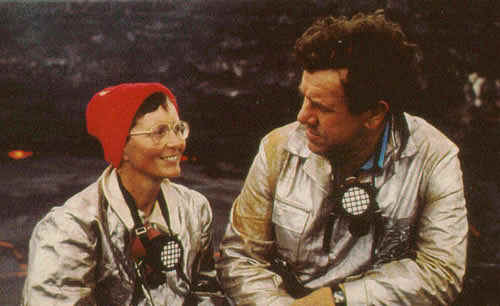
Catherine Joséphine "Katia" Conrad was born in Soultz-Haut-Rhin, Alsace, France, on 17 April 1942.
Katia Krafft was born Catherine Joséphine Conrad on 17 April 1942 in Soultz-Haut-Rhin, in the Alsace region of France, during the Second World War and the German annexation of the territory. Some sources place her birth in the nearby town of Guebwiller, but the date of 17 April 1942 is consistently confirmed across biographical accounts.
Growing up in Alsace, a region with a distinct Franco-German cultural identity, Katia developed an early fascination with the natural world, reportedly triggered in part by an early encounter with the concept of volcanic eruptions and the devastation they could cause. This childhood curiosity would eventually blossom into a lifelong, singular devotion to volcanology.
Her birth marks the starting point of a life that would radically reshape public and scientific engagement with active volcanoes. Few could have predicted that the girl born amid wartime Alsace would become, alongside her husband Maurice, one of the most recognized and pioneering volcanologists of the twentieth century, using still-nascent film technology to bring the drama and danger of eruptions to global audiences.
Her early life in a modest Alsatian family, combined with her later scientific training, laid the foundation for a career defined by direct, close-range observation of volcanic phenomena — an approach that was as innovative as it was perilous.
Images