← All women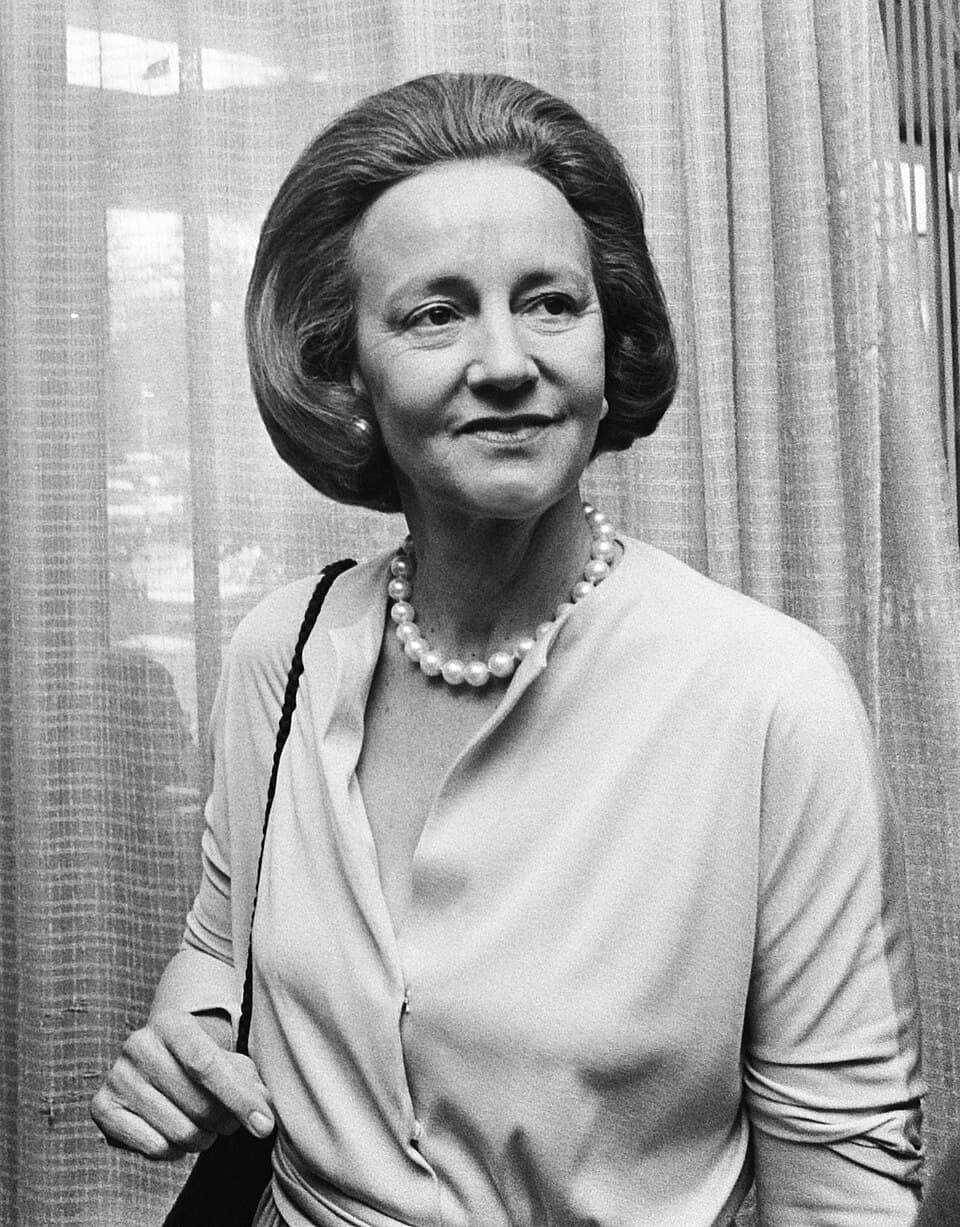
American · Politics · Literature
Katharine Graham
June 16, 1917 – July 17, 2001
Early life and family background
Katharine Meyer Graham was born on June 16, 1917, in New York City, the daughter of publisher Eugene Meyer and writer and activist Agnes Ernst Meyer. Her father was a financier who later purchased The Washington Post, while her mother was a prominent public intellectual whose interests in education, reform, and culture exposed Katharine to public affairs from an early age. She grew up in a privileged but demanding environment, one shaped by wealth, civic responsibility, and high expectations. The world into which she was born still offered few paths for women into executive or journalistic power, but her family’s immersion in politics, publishing, and philanthropy gave her an unusually close view of public life.
Graham attended private schools and later studied at the University of Chicago, where she encountered ideas and institutions that broadened her perspective. Her early education and family background gave her a strong sense of public duty, but she did not initially imagine herself as a newspaper executive. Like many women of her generation and social class, she faced powerful expectations about domestic life and marriage. Her later career would be marked by the tension between those expectations and the role she eventually accepted as one of the most important media leaders in the United States.
Entry into the Washington Post world
After her father purchased The Washington Post in 1933, Graham eventually joined the paper, gaining early experience in the editorial and circulation departments. This work gave her practical exposure to the operations of the newspaper business, although it did not yet place her in a position of authority. In 1940, she married Philip Graham, a lawyer who would later become publisher of the Post. The marriage connected her even more closely to the newspaper that would define her public life. The couple had four children, and Graham temporarily left the Post in 1945 to focus on raising her family, an arrangement consistent with the expectations placed on many women of her era.
Philip Graham’s rise within the company changed the family’s relationship to the newspaper. During his tenure, the Washington Post Company expanded, acquiring additional media properties including Newsweek. Yet Philip also suffered from severe mental illness. In 1963, after his suicide, Katharine Graham assumed control of the Washington Post Company. The transition was sudden and emotionally devastating, and it forced her to take on a role that many contemporaries would have considered beyond the conventional limits of women’s authority. She had little reason to expect to become the chief executive of a major communications company, but she gradually built the confidence and authority necessary to lead it.
Rise to publisher and corporate leader
Graham’s formal rise continued through the 1960s. She became president of the Washington Post Company in 1969 and publisher of The Washington Post later that year, making her the public face of the paper’s leadership. She worked closely with editors and reporters, including Benjamin Bradlee, whom she hired in 1965 and who became a central figure in the paper’s transformation into one of the nation’s most respected news organizations. Under Graham’s oversight, the Post sharpened its editorial standards, strengthened investigative reporting, and deepened its ambition to become a national newspaper of record.
Her leadership emerged at a time when women were still rare in top business positions. Graham had to establish credibility in boardrooms and newsrooms where her authority was often assumed to be temporary or symbolic. Instead, she became a decisive executive whose judgments carried national consequences. In 1972, she became chief executive officer of the Washington Post Company, and she was the first woman to serve as CEO of a Fortune 500 company. That milestone was a landmark in corporate history and a major advance for women’s representation in business leadership. Her tenure as CEO lasted until 1991, while she remained board chair and continued to influence the company’s direction for years afterward.
Pentagon Papers and Watergate
Graham’s most consequential public decisions came during the early 1970s. In 1971, the Post began publishing the Pentagon Papers after she approved the move despite legal and political risks. The papers, a classified history of U.S. involvement in Vietnam, had profound implications for the public’s understanding of government secrecy and the war. Graham’s willingness to proceed underscored her independence and her commitment to press freedom, especially in the face of pressure from the Nixon administration. The episode became one of the defining First Amendment battles of the twentieth century.
The following year, after the Watergate break-in on June 17, 1972, Graham backed the Post’s prolonged investigative coverage of the scandal. Reporters Bob Woodward and Carl Bernstein, supported by editor Benjamin Bradlee and by Graham herself, pursued the story despite skepticism and pushback. The Post’s persistence helped expose political corruption and contributed to the larger chain of events that led to President Nixon’s resignation on August 9, 1974. Graham’s role was not to write the stories herself, but to protect the institutional conditions that made the reporting possible. Her backing of the newsroom became a model of executive courage and editorial independence.
These events changed the public image of the Washington Post and elevated Graham into a national figure. They also revealed how much depended on leadership behind the scenes. In an era when women were often excluded from the highest levels of journalism and politics, Graham helped direct a paper that stood up to presidential power. Her stewardship of the Post during this period remains one of the most celebrated examples of a woman exercising decisive influence over American public life.
Industry influence, board service, and recognition
By the mid-1970s, Graham’s stature extended beyond her own company. She became the first woman director of the Associated Press and the American Newspaper Publishers Association, breaking barriers in institutions that shaped American journalism nationwide. These appointments reflected her growing influence and the respect she had earned across the industry. They also signaled a slow but important change in the professional culture of media leadership, where women were beginning to gain recognition in spaces that had long been closed to them.
In addition to her media leadership, Graham helped guide the Washington Post Company into a broader communications conglomerate with interests in newspapers, magazines, cable, and broadcasting. The company grew significantly under her oversight, and her business accomplishments complemented her journalistic reputation. She stepped down as publisher in 1979, but remained chairman of the board and continued to shape the company’s long-term direction. Her continued authority after leaving day-to-day newspaper management underscored her lasting importance within the enterprise.
Personal life
Graham’s personal life was deeply intertwined with her public career. Her marriage to Philip Graham produced four children and connected her to the newspaper business in ways that would become central to her future. His mental illness and death were profoundly painful experiences, later discussed candidly in her memoir. That candor helped make her one of the most respected autobiographical voices of her era. She was known to family and friends as Kay, a figure who balanced social grace with growing resolve and public authority.
Her memoir, Personal History, published in 1997, offered a direct account of marriage, grief, self-discovery, and leadership. The book was praised for its honesty and for its unvarnished portrayal of the costs of power. In 1998, it won the Pulitzer Prize for Biography or Autobiography. The award recognized a different but related dimension of her legacy: her ability to interpret her own life with the same seriousness and clarity that had characterized her business leadership.
Later life and death
Graham remained active in public life into her later years and was widely honored for her influence on journalism and women’s leadership. She was celebrated by institutions ranging from journalism organizations to women’s history groups, and she became a standard reference point for discussions of female executive power in the twentieth century. In 2001, while attending a conference in Sun Valley, Idaho, she suffered a fall and head injury. She died in Boise, Idaho, on July 17, 2001. Her death marked the end of a life that had reshaped both the Washington Post and the broader expectations of what women could lead.
Legacy
Katharine Graham’s legacy rests on several overlapping achievements. She transformed a family newspaper into a nationally respected institution, backed landmark reporting that helped defend press freedom, and broke major barriers in business and journalism. Her rise to become the first female CEO of a Fortune 500 company made her a landmark figure in corporate history, while her support for the Pentagon Papers and Watergate reporting made her central to the story of modern American investigative journalism. Her leadership helped redefine what women could do in business, media, and public life.
What makes Graham especially important in women’s history is that her influence was both symbolic and practical. She did not merely represent a first; she made consequential decisions that changed institutions and public events. Her example helped demonstrate that women could command authority in industries that had long resisted them. As publisher, executive, board chair, memoirist, and civic figure, she left a legacy that continues to shape how American journalism and women’s leadership are understood.
Dated achievements
15 indexed.
- Jun161917Politics
Birth of Katharine Meyer (Graham)
Katharine Meyer (later Graham) was born in New York City to Eugene Meyer and Agnes Ernst.
View details Katharine Graham - Wikipedia - Jun141940Literature
Marriage to Philip Graham
Katharine Meyer married Philip Graham, linking her to The Washington Post.
View details