← All women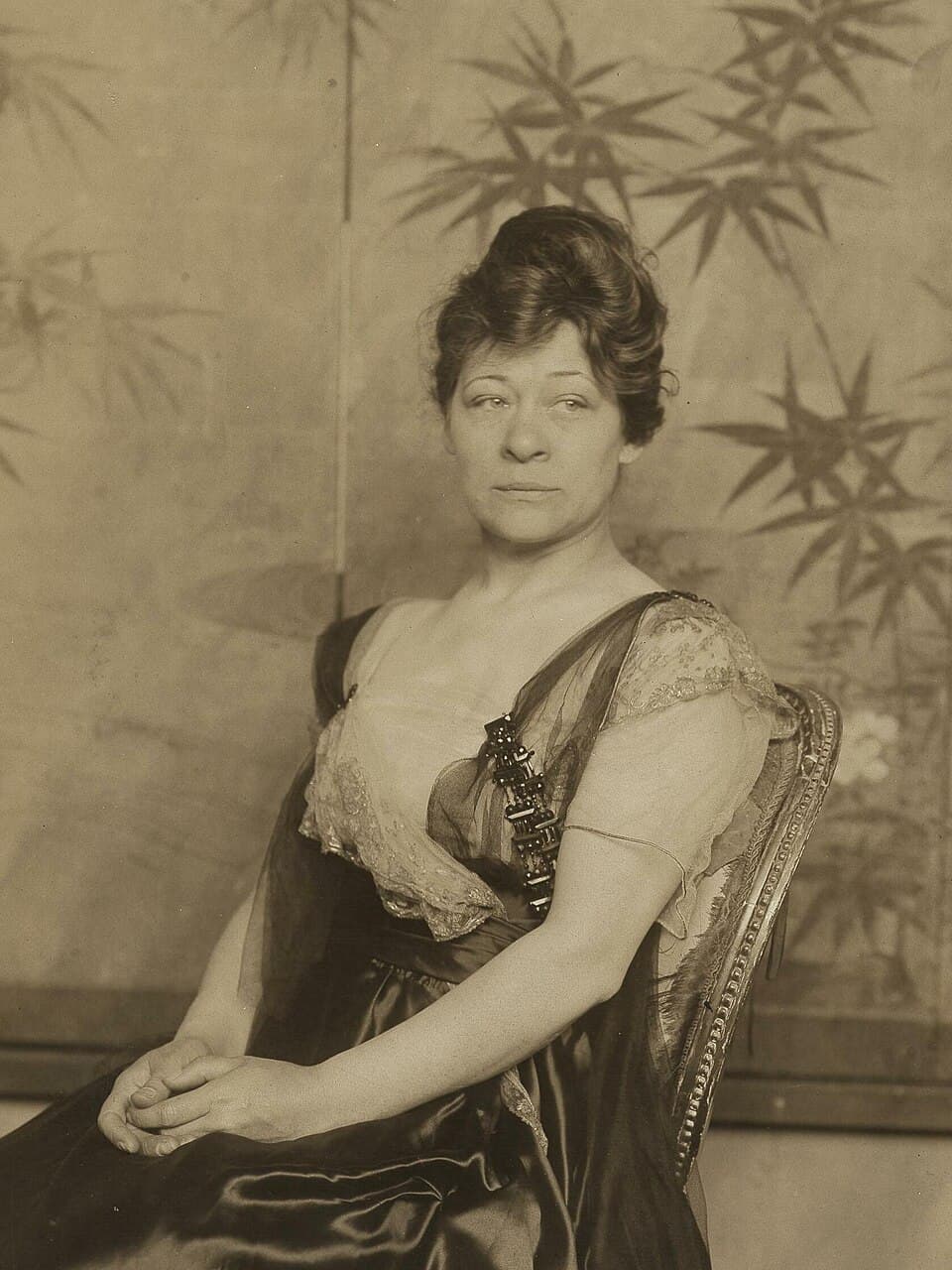
American · Arts
Juliana R. Force
December 25, 1876 – August 28, 1948
Early Life and Background
Juliana R. Force (born Juliana Rieser) was born on 25 December 1876, in Doylestown, Bucks County, Pennsylvania, into a middle‑class family of German immigrants.[1][3][4][11] Her parents, Maxmillian (Maximilian) Rieser, a grocer and hatter, and Juliana (Julie Ann) Schmutz, had emigrated from Baden, Germany, and eventually raised nine children, including Juliana and her twin.[1][4][10] Growing up in a large household supported by small‑scale trade, she experienced a modest upbringing far removed from the elite circles that typically shaped museum leaders.
Sources note that her surname was originally spelled Reiser and later regularized as Rieser, while she came to be widely known simply as "Juliana."[4][5] In 1886, when she was around ten, the family moved to Hoboken, New Jersey, bringing her closer to New York City’s expanding business and cultural environment.[5][10] Her education included attendance at an evangelical boarding school for girls, followed by a brief period of teaching at a business school.[5] These experiences gave her administrative skills and discipline but did not yet connect her directly to the art world.
Force’s early years are significant in women’s history because they show a pathway from immigrant, working‑class origins to national prominence in the arts. Her later achievements were not the product of inherited wealth or formal academic status; instead, they grew from secretarial work and informal, practice‑based learning, demonstrating how women without traditional cultural capital could still profoundly shape American institutions.
Career Beginnings and Development
By the turn of the twentieth century, Juliana Rieser had entered clerical work to support herself, first as a secretary and later as the head of a secretarial school in New York.[3][5][10][14] This phase proved pivotal. Her organizational aptitude and reliability as a secretary led to employment within elite households, which in turn opened doors to the art world.
She initially worked for Helen Hay Whitney, wife of Payne Whitney, gaining experience in managing complex social and philanthropic activities.[10][14] Soon afterward she became the private secretary to sculptor and patron Gertrude Vanderbilt Whitney, heiress to the Vanderbilt fortune.[3][5][12][14] Whitney maintained studios in New York and increasingly engaged with American artists. Through this role, Force was drawn into the orbit of Greenwich Village’s bohemian community and the burgeoning modern art scene.
Force’s responsibilities expanded well beyond stenography. She managed Whitney’s studio practice, helped oversee commissions, and gradually took charge of the artist clubs and exhibition spaces that Whitney sponsored.[12][14] During the 1910s and 1920s she became manager of the Whitney Studio, later the Whitney Studio Club and Whitney Studio Galleries in Greenwich Village.[1][4][5][12] These venues served as important platforms for young and experimental American artists whose work was often overlooked by larger institutions.
Her early career thus evolved from clerical labor to cultural administration. Although she lacked formal training in art history, contemporaries noted her "natural aesthetic sensitivity," which guided her judgments about artists and works.[3] Her rise illustrates how women in the early twentieth century could leverage secretarial roles to enter influential positions in cultural organizations, even when formal credentials or academic recognition were limited.
Formation of the Whitney Museum and Directorship
By the late 1920s, Gertrude Vanderbilt Whitney had amassed a substantial collection of American art, including works by contemporaries such as John Sloan, Edward Hopper, Stuart Davis, Thomas Hart Benton, and Isamu Noguchi.[8][12] When she offered this collection—reportedly around 500 works—to the Metropolitan Museum of Art, the institution declined.[3][12][15] This rejection prompted Whitney, advised and supported by Juliana Force, to pursue the creation of a new museum devoted to American art.
In 1930, the Whitney Museum of American Art opened in New York City.[1][3][5][15] At its founding, Juliana R. Force was appointed the museum’s first director, making her a pioneering female leader in a major American art museum.[1][3][4][5][15] As director, she shaped exhibitions, acquisitions, and overall policy. Her role is frequently compared to that of Alfred H. Barr Jr. at the Museum of Modern Art, which had been founded the year before, underscoring her status among the most influential museum professionals of her generation.[5]
Force’s directorship was characterized by a strong preference for living artists and for works that expressed distinctly American themes. She continued to work closely with Whitney, but art historians and critics have emphasized that it was Force who "organized the shows, selected the purchases, and defined the direction of the museum in its first two decades," while Whitney provided the financial backing.[7][12] This division of labor is central to recent revisionist histories, which argue that Force’s curatorial and administrative vision fundamentally shaped the Whitney’s identity.
Public Works of Art Project and New Deal Involvement
During the Great Depression, the U.S. federal government launched the Public Works of Art Project (PWAP), a New Deal program that provided paid commissions to artists to create murals, paintings, and sculptures for public buildings. In 1933–1934, Juliana R. Force served as administrator of Region 2, covering New York City and New York State.[1][2][3][12]
In this role, Force chaired the regional committee, reviewed proposals, and helped select artists and projects.[2][12] Her administrative abilities, honed in the Whitney’s programs, were deployed on a much larger scale, supporting hundreds of artists during a period of extreme economic hardship. This work extended her influence beyond the Whitney, situating her within the broader story of government patronage of the arts.
Her involvement in PWAP is historically important for two reasons. First, it underscores the central role of women administrators in implementing New Deal cultural programs, which have sometimes been narrated primarily through male officials. Second, it demonstrates her consistent commitment to the economic and professional support of artists, aligning her museum work with public policy initiatives that recognized artistic labor as socially valuable.
Championing American Folk Art and Modernism
Several sources credit Juliana R. Force with initiating the first exhibition of American folk art in the United States, organized under the Whitney umbrella in the 1930s.[4][2] Although the precise opening date is not securely documented, this exhibition is widely cited as a pioneering event.
By presenting folk art alongside modern art, Force broadened the definition of "American art" to include the work of self‑taught and vernacular creators. This approach challenged hierarchies that privileged European academic training and urban elites, and it expanded the Whitney’s mission beyond a narrow focus on avant‑garde modernism.
Within the museum’s mainstream program, Force supported exhibitions and acquisitions that helped canonize artists now central to U.S. art history. Under her leadership, the Whitney staged important shows for figures such as Albert Pinkham Ryder, Robert Feke, and Winslow Homer in the years leading up to her death.[5] These exhibitions contributed to the historical reappraisal of nineteenth‑century American art and clarified lineages for twentieth‑century developments.
Her curatorial decisions thus helped to construct a narrative of American art that integrated folk traditions, early national painters, and modernist experimenters. This narrative, while selective, laid groundwork for later scholarship and for the Whitney’s evolution as a museum dedicated to the complexities of U.S. artistic production.
Ethical Advocacy: The 1946 Campaign on German Art
In 1946, in the aftermath of World War II, Juliana R. Force played a notable role in debates over the status of cultural property seized during the conflict. When the American government prepared a touring exhibition of German art treated as war booty, she joined Frederick M. Clapp, director of the Frick Collection, in spearheading a campaign to oppose this plan and to advocate for the artworks’ return to Germany.[5]
This episode, though less well known than her Whitney work, is crucial for understanding her professional ethics. Force’s position stepped beyond nationalist triumphalism and asserted that museums and governments had responsibilities toward the rightful cultural contexts of artworks. Her stance anticipated later international norms and treaties that discourage the display of looted art and call for restitution.
From the perspective of women’s history, her participation in this campaign emphasizes that women museum directors were not only administrators and curators but also policy actors engaged in international cultural issues. She used the authority of her Whitney directorship to influence broader debates about postwar justice and cultural diplomacy.
Personal Life
In 1912, Juliana Rieser married Dr. Willard Burdette Force, a dentist.[3][5][10] After marriage she became known as Juliana Rieser Force, and in professional contexts often simply as Juliana R. Force or "Mrs. Juliana Force."[5][14] The couple had no children.[10]
Contemporary descriptions and later accounts portray Force as a striking personality within Greenwich Village and the Whitney circle. She is often described as a "flamboyant" or "feared" yet generous figure, adept at both diplomacy and tough negotiation.[8][12] Her fashion, including literal hats, and her commanding presence added to her reputation as a modern woman who combined bohemian sensibilities with administrative authority.
Despite lacking formal academic credentials in art history, she cultivated deep relationships with artists and patrons, and provided personal counsel, financial assistance, and professional guidance to many. Scholars note that artists such as Sloan, Davis, Hopper, Benton, and Noguchi benefited from her support, whether through purchases of their work, stipends, or advocacy within museum and patronage networks.[8][12]
Her marriage and social position also illuminate the intersection of gender and class in early twentieth‑century cultural institutions. As the spouse of a professional man and the employee of a wealthy heiress, she navigated multiple social strata, translating between artists, patrons, and bureaucrats in ways that few of her contemporaries could.
Awards, Honors, and Recognition
While Force did not receive high‑profile national medals or prizes comparable to those later bestowed on museum leaders, her contemporaneous recognition came chiefly through institutional titles and posthumous memorials. At her death, she held the title of founding director of the Whitney Museum of American Art, a distinction repeatedly emphasized in historical accounts and critical essays.[3][7][15]
In 1948–1949, the Whitney Museum organized a significant memorial exhibition titled "Juliana Force and American Art: A Memorial Exhibition" to honor her contributions.[13][16] The exhibition catalogue, preserved in archives, documents the works and artists associated with her vision and signals the museum’s acknowledgment of her formative influence.
Later scholarly and critical work has further recognized her importance. The Dictionary of Art Historians includes an entry on her career.[5] Essays such as "Gertrude & Juliana" in The New Criterion and specialized theses on modern art in America have revisited her role, often arguing that traditional narratives gave disproportionate credit to patrons like Whitney while underestimating Force’s curatorial and administrative leadership.[7][11][12]
These forms of recognition, though not formal honors in the sense of state awards, constitute a sustained historiographical acknowledgment of her significance in shaping twentieth‑century American art institutions.
Later Life and Death
Throughout the 1930s and 1940s, Juliana R. Force continued to direct the Whitney Museum, overseeing exhibitions that deepened its focus on American art and solidified its reputation.[1][3][5] Under her guidance, the museum mounted shows on artists including Albert Pinkham Ryder, Robert Feke, and Winslow Homer, aligning modern practice with historical American precedents.[5]
By the late 1940s her health was declining. In July 1948 she was taken to Doctors Hospital in New York City, where she was treated for cancer.[10] She remained director of the Whitney until her death, a testament to her sustained commitment despite serious illness.
On 28 August 1948, Juliana R. Force died of cancer at Doctors Hospital in Manhattan, aged 71.[1][2][3][4][6][10] The following day, she was buried in Doylestown, Pennsylvania, in the town of her birth.[2][4][10] Obituaries and retrospectives emphasized her central role in building the Whitney and acknowledged the debt owed to her by generations of American artists.
In September 1949, the Whitney’s memorial exhibition "Juliana Force and American Art" opened, and critical commentary of the time, including coverage in The New York Times, highlighted both her energy and taste and the importance of institutionalizing American art.[13][16] These events marked the institutional transition from the founding era shaped by Force to the museum’s next phase under new leadership.
Legacy and Historical Impact
Juliana R. Force’s legacy rests on several intertwined achievements. First, as founding director of the Whitney Museum of American Art, she played a decisive role in establishing one of the world’s leading institutions devoted to American art.[1][3][5][15] Her aesthetic judgments influenced which artists and works entered the canon, and her insistence on supporting living artists helped define the Whitney’s identity as a dynamic, contemporary museum rather than a purely historical collection.
Second, Force was a pioneer among women museum leaders. At a time when major U.S. museums were largely directed by men and when women’s roles were often confined to philanthropy or auxiliary organizations, she occupied an executive position that required negotiating with artists, patrons, trustees, and government agencies.[3][5][7] Her career demonstrates that women could exercise substantial institutional power in the arts, even if their contributions were sometimes overshadowed by those of wealthy patrons.
Third, her work with the Public Works of Art Project and her advocacy regarding postwar cultural restitution reveal a conception of museum practice that extended beyond collection building to encompass social responsibility.[2][3][5] By supporting artists during the Depression and by opposing the display of looted German art, she participated in debates that continue to shape cultural policy.
Finally, her championing of American folk art and lesser‑recognized historical artists broadened the scope of what counted as "American art" within major institutions.[2][4][5] This inclusive vision laid groundwork for later expansions of the canon to include diverse regions, classes, and stylistic traditions.
Recent scholarship, including institutional histories and art‑historical theses, has begun to restore Force to the center of the Whitney’s story, arguing that her role has been underappreciated relative to that of Gertrude Vanderbilt Whitney.[7][11][12] In the context of women’s history, Juliana R. Force stands as an exemplar of how administrative acumen, aesthetic sensitivity, and ethical conviction can combine to reshape a nation’s cultural landscape.
Dated achievements
6 indexed.
- Dec251876Science
Birth in Doylestown, Pennsylvania
Juliana Rieser was born in Doylestown, Pennsylvania, to Maxmillian Rieser and Juliana Schmutz, German immigrants.
View details Juliana Force - Wikipedia - Jan011930Science
Appointed Founding Director of the Whitney Museum of American Art
Juliana R. Force became the first director of the newly founded Whitney Museum of American Art in New York City.