← All women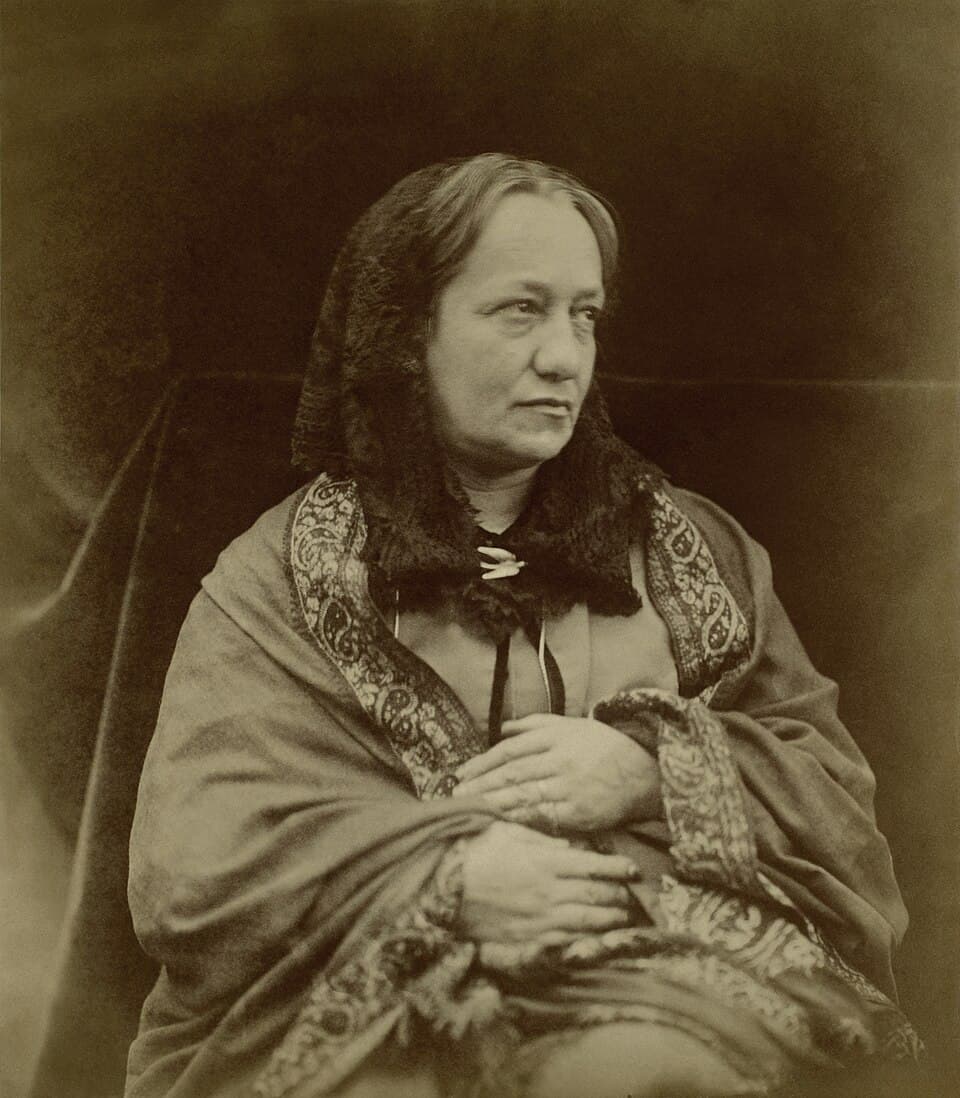
British · Arts
Julia Margaret Cameron
June 11, 1815 – January 26, 1879
Early Life and Background
Julia Margaret Cameron (née Pattle) was born on 11 June 1815 in Calcutta, India, then part of British India.[2][3][6][12][13][14] She grew up in the riverside district of Garden Reach, in a large and socially prominent Anglo-Indian family. Her father, James Peter Pattle, was a British officer in the East India Company, while her mother, Adeline Marie de l’Etang, descended from French aristocrats and had served as a lady-in-waiting at the court of Empress Joséphine.[6][5][9] This mixed British–French heritage and colonial setting exposed Cameron early to multiple cultures, languages, and social worlds.
Accounts differ slightly on the number of children in the family, but Cameron is generally described as one of several sisters in a large brood, often noted as the fourth of seven or ten children.[1][5][6][16] The Pattle sisters became known in Anglo-Indian society for their beauty, sociability, and strong personalities. Growing up amid colonial privilege, Cameron’s childhood combined the realities of imperial administration with the cosmopolitan refinement of a Europeanized elite.
Cameron’s education took place largely in Europe. She was sent to school in England and France, including time in Versailles, where she received a solid grounding in languages, literature, and the arts.[12][19] This transnational upbringing laid the groundwork for her later immersion in Victorian intellectual circles and gave her a broad cultural repertoire on which she would draw when staging allegorical and literary photographic scenes.
Marriage, Family, and Colonial Transitions
After returning to British India, Julia Margaret Pattle married Charles Hay Cameron in Calcutta in 1838.[3][2][12][18] Charles, approximately twenty years her senior, was a distinguished jurist and member of the Indian Law Commission. The marriage connected Julia directly to the colonial legal establishment and reinforced her position within the Anglo-Indian elite. Together, the couple eventually had six children, though they also cared for nieces and other dependents, forming a large extended household.[18]
In 1848, following Charles Cameron’s retirement from official service, the family left India and moved to EnglandTunbridge Wells and later in London, integrating into the metropolitan social world that linked colonial administrators, writers, artists, and scientists. The Camerons became close to the Tennyson family and other leading figures of Victorian culture.
The family’s most consequential relocation came when they acquired the property Dimbola at Freshwater on the Isle of Wight. There, Cameron joined a vibrant intellectual community centered on the poet Alfred, Lord Tennyson, whose home Farringford lay nearby.[2][1] Freshwater attracted artists, scientists, and writers, among them the painter G.F. Watts, astronomer Sir John Herschel, and other luminaries whom Cameron would later photograph. Her household thus straddled domestic responsibilities and intense social engagement with key Victorian thinkers.
Beginnings in Photography
Cameron did not turn to photography until middle age. According to multiple accounts, in 1863, while she was living at Freshwater, her daughter and son-in-law presented her with her first camera as a gift.[4][7][10][20] The Metropolitan Museum of Art dates this event more precisely to December 1863, when she was about forty-eight years old.[8] She quickly transformed a chicken coop at Dimbola into a makeshift studio, installing skylights and adapting domestic spaces for darkroom work.[20]
Unlike many contemporaries who approached photography as a commercial craft, Cameron immersed herself in it as an artistic and spiritual vocation. Contemporary recollections and her own writings describe her working from morning until night, experimenting with lenses, exposure times, and compositions.[8][20] She taught herself the wet collodion process, handled large glass plates, and mastered the demanding chemical procedures required to produce albumen prints—technical tasks usually associated with male professionals.
On 29 January 1864, Cameron created a portrait of nine‑year‑old Annie Philpot, the image she would later call her "first success".[2][8] The photograph, titled Annie, displayed the soft focus, intimate framing, and emotional intensity that became hallmarks of her style. According to her later account, neighbors flocked to see the image, encouraging her to continue. The success of Annie convinced Cameron that photography was her artistic calling and catalyzed a period of extraordinary productivity.
Developing a Distinctive Artistic Style
Beginning in the mid‑1860s, Cameron produced a remarkable body of work that challenged prevailing norms of photographic practice. She favored large, close-up portraits, tightly framing the head and shoulders to emphasize facial expression and psychological presence.[2][4] Her choice of soft focus, achieved by slightly defocusing the lens or using lenses with particular optical properties, defied the era’s standard of sharpness as the mark of technical excellence. Scratches, smudges, and chemical imperfections often remained visible on her prints, which she regarded as integral to their expressive character.[1]
Cameron’s subjects included family members and household staff, but also many of the most prominent figures of Victorian intellectual life. She photographed Charles Darwin, Sir John Herschel, Alfred Tennyson, the painter G.F. Watts, historian Thomas Carlyle, and sculptor Thomas Woolner, among others.[2][4][10] These portraits were not neutral records; they aimed to capture what she called the "divine" in each sitter, emphasizing moral character, genius, or spiritual depth.
Beyond portraiture, Cameron created allegorical and narrative photographs inspired by mythology, the Bible, and literature.[2][4] She staged scenes from Tennyson’s Idylls of the King, using local models and elaborate costumes to depict Arthurian heroines and knights.[10] Other works presented personifications of virtues, Madonnas and angels, and mythic figures. Here, Cameron drew on the visual language of Pre-Raphaelite painting and academic art, repositioning photography as a medium capable of complex, multi-figure compositions with symbolic intent.
During the 1860s and 1870s, Cameron produced hundreds of photographs—some sources estimate around 900 to 1,000 prints—in an intense burst of creativity lasting roughly eleven to twelve years.[5][15] She sold and exhibited her work, making use of commercial printing and distribution networks, but also cultivated an artistic identity that emphasized inspiration and feeling over purely commercial concerns.
Professional Recognition and Exhibitions
Cameron’s work soon attracted both admirers and critics. She became associated with the Photographic Society of London (later the Royal Photographic Society) and exhibited with major photographic organizations.[10] Although the exact date of her joining is uncertain, sources place her membership in the mid‑1860s, likely around 1864–1865, making her one of the early women to participate actively in such professional circles.[10][4][20]
In 1865, Cameron held her first significant exhibition at Colnaghi’s gallery in London, a respected venue for fine art.[10] Showing her photographs in this context bolstered her claim that photography belonged among the arts rather than merely among the mechanical trades. Her portraits and allegorical compositions were marketed to collectors and viewed alongside paintings and engravings, reinforcing their aesthetic status.
Despite this recognition, Cameron’s reception was mixed. Some critics praised the beauty and emotional power of her work, while others attacked her technical departures from sharp focus. Commentators complained of blur, uneven exposure, and visible plate flaws.[1][9] For Cameron, however, these qualities were integral to the atmosphere and spiritual resonance she sought. Her insistence on artistic autonomy in the face of such criticism is a central aspect of her historical significance.
Major Works and Publications
Among Cameron’s most notable projects were her illustrations to Alfred Tennyson’s poetry. She produced a series of photographs to accompany a deluxe edition of Idylls of the King, depicting characters such as Guinevere, King Arthur, and other Arthurian figures.[2][10] These images combined literary interpretation with complex staging, demanding significant logistical and artistic effort.
Another key body of work is her cycle of "Madonna" and angel images, often using domestic models to evoke religious themes.[8][2] Here Cameron exploited the medium’s ability to convey soft light, tender gesture, and intimate expression, aligning photographic imagery with longstanding traditions of Christian art.
Cameron also produced portfolio collections and contributed prints to photographic publications. Her work circulated in Britain and abroad, gradually reaching audiences beyond her immediate circle. While many of her photographs are dated only by year, the surviving prints, inscriptions, and contemporary catalogues form a substantial, widely studied oeuvre.
In addition to visual work, Cameron wrote about her experiences as a photographer. Her brief autobiographical text, "Annals of My Glass House", was composed at Dimbola and dated to 17 February 1875.[8] In it, she recounts the origin of her practice, the gift of the camera, the chaos of her household during intensive photographic sessions, and the joy she derived from successful images. Though unfinished and published posthumously, the "Annals" provide invaluable insight into her self-understanding and working methods.
Personal Life, Gender, and Artistic Identity
Cameron’s photographic career unfolded within the constraints and opportunities of Victorian gender norms. As a married woman of means, she was expected to oversee domestic affairs and family life rather than pursue technical or professional work. Her entry into photography was facilitated by her social position, which gave her leisure, access to educated sitters, and space for a studio, but it also exposed her to skepticism about the propriety and seriousness of a woman engaging with chemicals, cameras, and commercial exhibition.
Household members and local residents often served as models, and her studio activities disrupted domestic routines. Cameron herself described how she would conscript servants and relatives into elaborate sessions, sometimes to their exasperation.[8] The combination of domestic space and artistic labor challenges simple divisions between public and private spheres, illustrating how a Victorian woman transformed home into workshop.
Her relationship with her husband appears to have been broadly supportive. Charles Hay Cameron, though not a photographer, did not prevent her from pursuing her art and accompanied her in later life to Ceylon, where she continued to photograph.[12][18] The couple’s shared intellectual milieu, including their friendships with Tennyson and other thinkers, helped legitimize Cameron’s activities. Nonetheless, the reception of her work was often coded by gender; male critics sometimes framed her soft focus and sentiment as feminine shortcomings, while later historians have reclaimed these qualities as deliberate aesthetic choices.
Later Life in Ceylon
In 1875, Cameron left Britain and relocated with her husband to Ceylon, now Sri Lanka, where they had family interests in coffee plantations.[10][12] They settled near Kalutara, continuing a pattern of life lived between the metropole and colonies. Despite the move, Cameron did not abandon photography; she made images of local people and surroundings, though fewer works from this period survive or are as widely known as her Freshwater pictures.[12][18]
The years in Ceylon were marked by declining health and the practical challenges of photographic work in a tropical climate. Yet Cameron maintained her artistic identity and sense of vocation. Her death on 26 January 1879 in Kalutara ended a career that, though short in chronological terms, had already begun to reshape understandings of what photography could achieve.[2][3][12][13][14]
Death
Cameron died on 26 January 1879 in Kalutara, Ceylon, at the age of sixty‑three.[2][3][12][13][14] She was buried in Sri Lanka, near her husband, closing a life that had traversed Calcutta, European schools, Victorian England, and the Indian Ocean world.[18] At the time of her death, photography was still a relatively young medium, and her reputation was not yet fully secure; some contemporaries continued to question her technical competence.
In subsequent decades, however, her prints were preserved by family members and institutions, eventually entering major museum collections such as the Victoria and Albert Museum, the Metropolitan Museum of Art, the National Portrait Gallery, and others.[1][8][10][4] These repositories played a crucial role in the twentieth‑century reevaluation of her work.
Legacy and Historical Impact
Today, Julia Margaret Cameron is widely regarded as one of the most important portraitists of the nineteenth century and a pioneering figure in the history of photography.[2][3][4][9][19] Her insistence on photography as an art form, and her willingness to prioritize emotional truth over technical perfection, anticipated later movements that emphasized subjectivity and expression.
Art historians credit Cameron with developing a painterly photographic style characterized by soft focus, dramatic lighting, and symbolic content.[4][1][8] Her portraits of famous Victorians have become canonical images, shaping how these figures are visually remembered. The allegorical and literary series, meanwhile, demonstrate photography’s capacity to engage complex narratives and mythic themes, challenging the notion that the camera merely records reality.
From a women’s-history perspective, Cameron’s career holds particular significance. She was one of the few women photographers of the Victorian era to achieve broad recognition and to participate in professional societies and exhibitions.[7][10] Her trajectory—from receiving a camera at forty-eight to producing hundreds of celebrated images within little more than a decade—shows how middle‑aged women could enter and transform a technical and artistic field despite societal expectations.
Her writings, especially "Annals of My Glass House", offer rare self-reflective testimony from a nineteenth‑century woman artist about her own methods and ambitions.[8][10] They help historians understand the gendered dimensions of early photographic practice, including the ways domestic spaces and informal social networks could be mobilized to support creative work.
Cameron’s influence extends into modern and contemporary photography. Later portraitists and art photographers have cited her as an inspiration for close framing, emotional emphasis, and the willingness to embrace imperfection as a source of meaning. Exhibitions and scholarly studies continue to analyze her work in relation to Victorian culture, colonial history, and feminist art history.[1][8][17]
In museums and educational materials—from specialist essays to school resources—Cameron is now presented as a pioneer and a "positive force" in early photography, illustrating how one woman’s artistic conviction helped expand the possibilities of a new visual medium.[7][17] Her life and work thus occupy a central place in any almanac of women’s history, standing at the intersection of gender, empire, and the emergence of photography as an art.
Dated achievements
5 indexed.
- Jun111815Arts
Birth of Julia Margaret Cameron
Julia Margaret Pattle was born in Calcutta, British India, on 11 June 1815, into a prominent Anglo-Indian family.
View details Julia Margaret Cameron - Wikipedia - Dec011863Arts
Receives her first camera as a gift
In December 1863, Cameron's daughter and son-in-law gave her a camera, launching her photographic career at age 48.