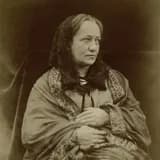
Julia Margaret Cameron died at Kalutara, Ceylon (now Sri Lanka), on 26 January 1879, reportedly with the word 'Beautiful' on her lips.
Julia Margaret Cameron died on 26 January 1879 at Kalutara, Ceylon (present-day Sri Lanka), where she and her husband Charles Hay Cameron had relocated in 1875 to be near their sons and manage the family's coffee estates. According to family accounts, her last word was reportedly "Beautiful," spoken as she looked up at the night sky—a fittingly poetic end for an artist devoted to capturing beauty and expression through the camera lens.
By the time of her death, Cameron had produced an extraordinary body of work spanning roughly fifteen years, including intimate portraits of leading Victorian intellectuals and artists—among them Alfred, Lord Tennyson, Charles Darwin, Sir John Herschel, and Thomas Carlyle—as well as elaborate allegorical and literary tableaux inspired by subjects such as Arthurian legend and biblical narrative.
Although her work received mixed critical reception during her lifetime, with some contemporary critics dismissing her soft-focus, unconventional technique as technically flawed, Cameron's reputation grew enormously in the twentieth century as photography historians and curators recognized her radical departure from documentary convention as a deliberate and pioneering artistic choice. Today she is celebrated as one of the most important portrait photographers of the nineteenth century, and her death in Ceylon marked the end of a career that, despite starting late in life, left an indelible mark on the history of photographic art.