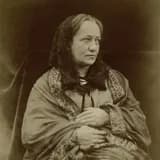
In December 1863, Cameron's daughter and son-in-law gave her a camera, launching her photographic career at age 48.
In December 1863, Julia Margaret Cameron received her first camera as a gift from her daughter Julia and son-in-law Charles Norman, accompanied by the note that it might "amuse" her during her solitude at Freshwater on the Isle of Wight, where her husband was frequently away in Ceylon managing coffee plantations.
At 48 years old, Cameron was considerably older than most who took up the new medium, and she had no formal artistic or technical training in photography. She converted a coal shed at her home, Dimbola Lodge, into a darkroom and a glazed henhouse into a studio, teaching herself the demanding wet collodion process through trial, error, and sheer determination.
This gift proved to be a turning point not just in her own life but in the history of photography itself. Within a remarkably short time, Cameron transformed from an enthusiastic amateur into one of the most original and influential photographic artists of the Victorian era, producing iconic portraits of figures such as Alfred Tennyson, Charles Darwin, and Thomas Carlyle, alongside allegorical and religious tableaux. Her late start defied the conventions of the era, which offered few avenues for women to pursue technical or artistic professions, and her rapid mastery of the medium stands as a testament to her singular creative vision.