← All women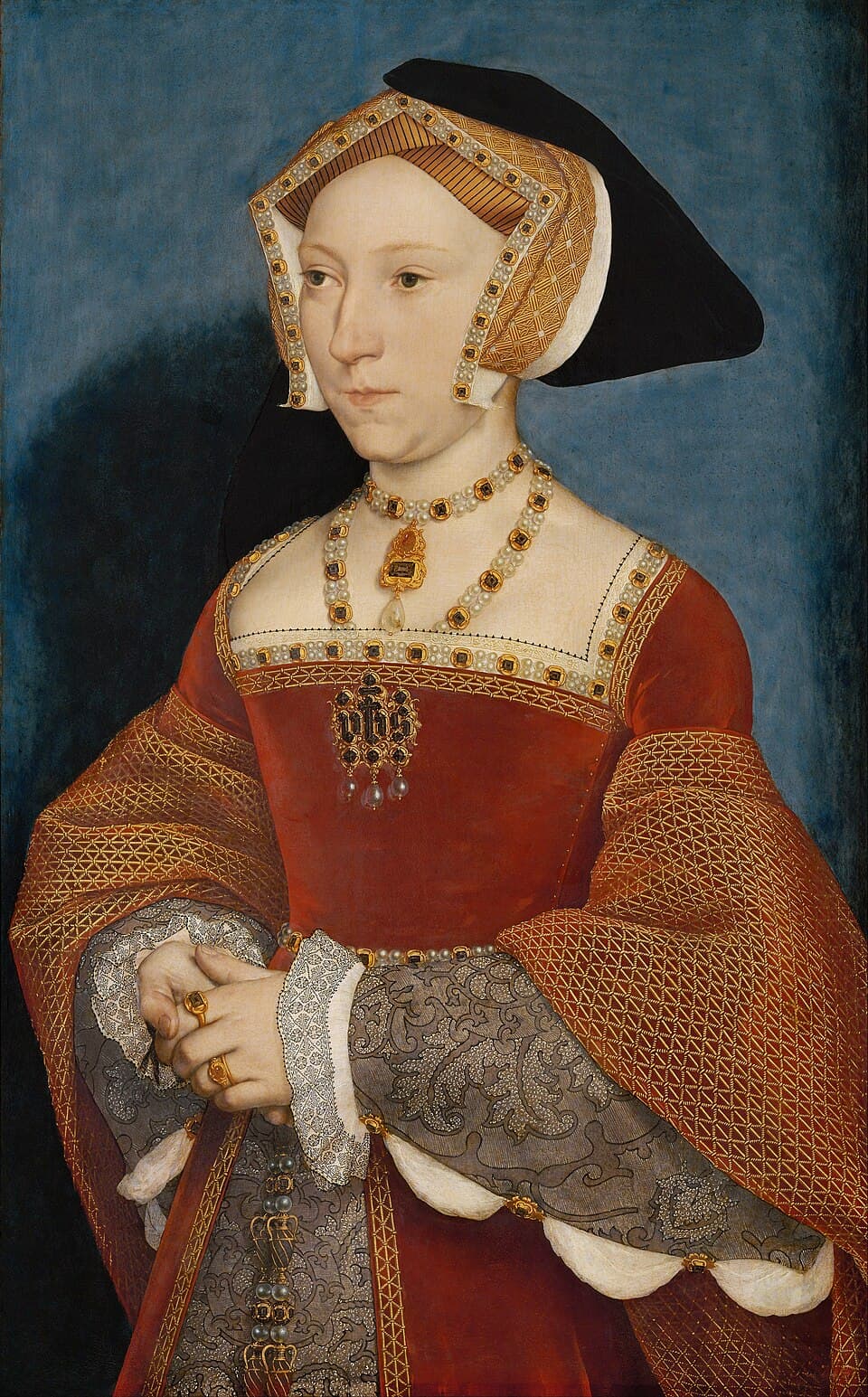
English · Politics
Jane Seymour
1508 – October 24, 1537
Early Life and Background
Jane Seymour was born around 1508 (some sources suggest as late as 1509), most likely at Wulfhall, the Seymour family estate in Wiltshire, England. Precise records of her birth do not survive, and historians rely on estimates based on court records and later accounts of her age at the time of her marriage. She was one of several children born to Sir John Seymour and Margery Wentworth, members of the English gentry with connections to the royal court reaching back generations.
Little is documented about Jane's formal education, though it is believed she received the typical upbringing of a gentlewoman of her era, focused on needlework, household management, religious instruction, and courtly manners rather than academic scholarship. Unlike Anne Boleyn, who had spent years at the sophisticated French court and was known for her wit and intellectual engagement, Jane was noted by contemporaries for a quieter, more modest and reserved demeanor. This contrast would later become central to how she was perceived at the English court.
Entry into Court Life
Jane's path to the throne began through her service as a lady-in-waiting, first to Queen Catherine of Aragon and later to Anne Boleyn, Henry VIII's first and second wives respectively. Her family's connections to the royal household enabled this placement, which was a common route by which gentry families sought advancement and influence.
Serving in the households of two queens gave Jane a close, firsthand view of the turbulence, danger, and opportunity present at Henry's court. She would have witnessed the drawn-out annulment proceedings between Henry and Catherine of Aragon, as well as the rise and eventual dramatic fall of Anne Boleyn. By early 1536, Henry VIII's attentions had begun to shift toward Jane herself, a development that unfolded even as his marriage to Anne Boleyn was disintegrating amid accusations of infidelity and failure to produce a male heir.
Courtship and Rapid Rise
The exact timeline of Henry's courtship of Jane is not fully documented with precise dates, but it is clear that his interest intensified through the early months of 1536, coinciding with Anne Boleyn's fall from favor. Jane, whether by her own design or the careful orchestration of her ambitious family and political allies (including factions opposed to Anne Boleyn and the Boleyn family's influence), positioned herself as a modest, virtuous alternative to the queen.
Historians have long debated the extent of Jane's personal agency in these events versus the machinations of her brothers, Edward and Thomas Seymour, and other court factions who saw an opportunity to displace the Boleyn family's power. What is certain is that the pace of events was extraordinarily swift: Anne Boleyn was arrested on 2 May 1536, tried and convicted of treason, adultery, and incest, and executed on 19 May 1536. Remarkably, Henry and Jane were betrothed the very next day, on 20 May 1536.
Marriage and Queenship
On 30 May 1536, just eleven days after Anne Boleyn's execution, Jane Seymour married Henry VIII in a private ceremony at Whitehall Palace, becoming his third queen consort. The speed of this transition shocked many observers both domestically and abroad, though it was consistent with the ruthless pragmatism that characterized Henry's approach to marriage and succession.
Jane made her first documented public appearance as queen on 2 June 1536 at Greenwich Palace, and was formally proclaimed Queen of England on 4 June 1536. As queen, Jane adopted a motto reflecting her intended role: "Bound to obey and serve," signaling a deliberate contrast to the more assertive and politically engaged style of Anne Boleyn. She dressed conservatively, avoided overt political entanglements, and cultivated an image of piety and domestic virtue.
Despite her reserved public persona, Jane is credited with several notable acts during her brief tenure as queen. She is often remembered for her role in helping to reconcile Henry VIII with his elder daughter, the Lady Mary (later Mary I), whom Henry had estranged and declared illegitimate following his split from Catherine of Aragon. Jane's gentle intercession helped restore Mary to a degree of favor at court, though full legal legitimacy was not restored during Jane's lifetime.
Jane was also known for her sympathy toward the traditional Catholic faith and was said to have been troubled by the religious upheavals of the English Reformation, though she wielded little direct political power to influence Henry's ecclesiastical policies. Some historical accounts suggest she made a plea to Henry regarding the Pilgrimage of Grace, a major popular uprising against religious reforms in 1536, though her involvement in political affairs remained limited compared to her predecessors.
Pregnancy and the Birth of an Heir
The central achievement of Jane's queenship, and the event for which she is most remembered, was her pregnancy and the subsequent birth of a male heir. On 26 January 1537, an official royal announcement confirmed that Queen Jane was pregnant, sparking widespread celebration and anticipation across England. Henry VIII had by this point been married three times, driven substantially in his marital decisions by the urgent dynastic need for a legitimate son to secure the Tudor succession.
After a lengthy and difficult labor lasting more than two days, Jane gave birth to a healthy son, Prince Edward, at Hampton Court Palace on 12 October 1537. The birth was met with extraordinary public celebration: church bells rang throughout London, bonfires were lit, and the Tower of London fired an estimated two thousand rounds in celebration. For Henry, this event represented the fulfillment of years of religious and political upheaval, including his break from the Catholic Church and the establishment of the Church of England, all substantially motivated by his quest for a male heir.
Three days later, on 15 October 1537, Prince Edward was christened in an elaborate ceremony at Hampton Court Palace. Jane, already showing signs of the illness that would prove fatal, watched the proceedings from behind a screen, too unwell to participate fully but propped up to receive well-wishers. Her stepdaughters played prominent roles in the ceremony: the Lady Mary served as godmother, while the four-year-old Lady Elizabeth carried the chrisom cloth.
Death and Burial
Jane's health, which had seemed to stabilize in the days immediately following Edward's birth, took a serious turn for the worse in the following week. Contemporary accounts suggest she may have eaten rich or unsuitable foods against her physicians' advice, exacerbating complications likely related to childbirth. Modern medical historians continue to debate whether the specific cause of death was puerperal fever (a form of sepsis) or a pulmonary embolism, though all agree on the timeline of her decline.
Jane Seymour died at Hampton Court Palace shortly before midnight on 24 October 1537, approximately twelve days after giving birth to Edward. Henry VIII was reportedly devastated by her death, entering a genuine period of mourning that was notably longer and more heartfelt than his reactions to the fates of his other wives. He did not remarry for over two years, an unusual gap given his history of swift remarriages.
Jane's funeral was conducted with full royal honors, and on 12 November 1537, she was interred in St George's Chapel at Windsor Castle. In a telling indication of the special place she held in Henry's affections and historical memory, he later specified in his will that he wished to be buried beside her—a wish that was fulfilled upon his own death in 1547.
Legacy and Historical Impact
Jane Seymour occupies a unique position among Henry VIII's six wives, often remembered through the mnemonic "divorced, beheaded, died, divorced, beheaded, survived," in which she is the wife who "died"—the only one to pass away while still reigning as queen, rather than being divorced, annulled, or executed. Her successful delivery of a male heir, Prince Edward (later Edward VI), secured her a favored and sympathetic place in the historical narrative of the Tudor dynasty, in stark contrast to the tragic fates of Catherine of Aragon and Anne Boleyn.
Her family's fortunes rose dramatically as a result of her marriage and her son's birth; her brother Edward Seymour would go on to serve as Lord Protector of England during the minority of King Edward VI, wielding substantial political power in the years following Henry's death. This elevation of the Seymour family reshaped English politics for a generation.
Jane's brief queenship, though lacking the political drama and cultural impact of Anne Boleyn's tenure or the international significance of Catherine of Aragon's decades-long marriage, is nonetheless historically pivotal. Her successful production of a male heir represented the resolution—however temporary, given Edward VI's early death in 1553—of the succession crisis that had driven England's break from the Catholic Church and reshaped the religious and political landscape of the nation.
Jane Seymour has remained a figure of enduring fascination in popular culture, historical fiction, and academic scholarship, often portrayed as the "good" or "favored" wife in contrast to her more controversial predecessors. Her tomb beside Henry VIII in St George's Chapel, Windsor, stands as a lasting physical testament to the unique regard in which she was held, cementing her legacy as the wife who gave Henry VIII what he had sought above all else: a son to inherit his throne.
Dated achievements
8 indexed.
- May301536Science
Marriage to Henry VIII and Accession as Queen Consort
Jane Seymour married Henry VIII at Whitehall Palace, becoming Queen of England as his third wife just 11 days after Anne Boleyn's execution.
View details Jane Seymour - Wikipedia - Jun021536Science
First Public Appearance as Queen
Jane Seymour made her first public appearance as Queen at Greenwich Palace, documented in a contemporary letter dated 2 June 1536.