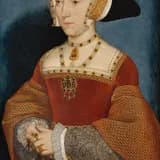
Jane Seymour died at Hampton Court Palace, likely from postnatal complications, twelve days after giving birth to Prince Edward.
Jane Seymour died at Hampton Court Palace shortly before midnight on 24 October 1537, approximately twelve days after giving birth to her son, Prince Edward. Her death is generally attributed to complications arising from childbirth, with modern medical historians debating whether puerperal fever (sepsis) or a pulmonary embolism was the ultimate cause.
In the days following Edward's birth, Jane's condition had fluctuated; she initially seemed to be recovering but then suffered a serious relapse, reportedly after eating rich foods against her physicians' advice. Her health deteriorated rapidly in her final days, and despite the attentions of the royal physicians, nothing could be done to save her.
Jane's death profoundly affected Henry VIII, who was said to have genuinely mourned her loss more deeply than any of his other wives. He entered a period of formal mourning and did not remarry for over two years, an unusually long interval given his history. Jane's success in providing a male heir, combined with her death in the role of queen rather than through annulment or execution, secured her a uniquely favorable position in Henry's memory and in subsequent historical narratives.
Her death highlights the perilous realities of childbirth in the sixteenth century, even for royalty with access to the era's best available medical care. Jane remains the only one of Henry's six wives to die while still reigning as queen consort, a distinction that shaped her lasting legacy.