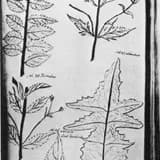
By 1758, Colden completed her Botanic Manuscript, an extensive Linnaean flora of about 340–341 plants from New York’s lower Hudson Valley.
By 1758, Jane Colden had completed her substantial botanical manuscript, now known as Flora Nov-Eboracensis or the Botanic Manuscript, documenting the flora of the lower Hudson Valley.[2][4] The manuscript, produced between 1753 and 1758, contains detailed descriptions, ink drawings, and leaf impressions for approximately 340–341 plant species from the Coldengham region.[2][11][14] Although the precise completion day is unknown, the year marks the culmination of one of the most comprehensive regional floras compiled in colonial North America.
Colden’s manuscript stands out for its methodical use of Linnaeus’s classification system shortly after it was introduced, making her one of the earliest documented students of Linnaean nomenclature in the Atlantic world and arguably “the first lady on either side of the Atlantic” to master it, according to later accounts.[14] She organized species by genera, recorded local names and uses, and noted habitats, producing a work that functions as a field guide and a scientific catalogue. Historians regard the Botanic Manuscript as possibly the most extensive botanical study of a single area undertaken at that time.[14][16]
The completion of the manuscript is historically significant for several reasons. It provided what is now considered the earliest record of New York flora in English, preserving information about plant diversity, ecology, and Indigenous and settler uses before widespread urbanization and agricultural change.[2][18][20] It also demonstrates that a colonial woman, working largely from home yet connected through correspondence, could achieve a level of scientific rigor comparable to that of her male contemporaries. Although never published in her lifetime, the manuscript survived in archives and has since been digitized and studied, reshaping modern understanding of women’s roles in eighteenth-century science and of the environmental history of the Hudson Valley.