← All women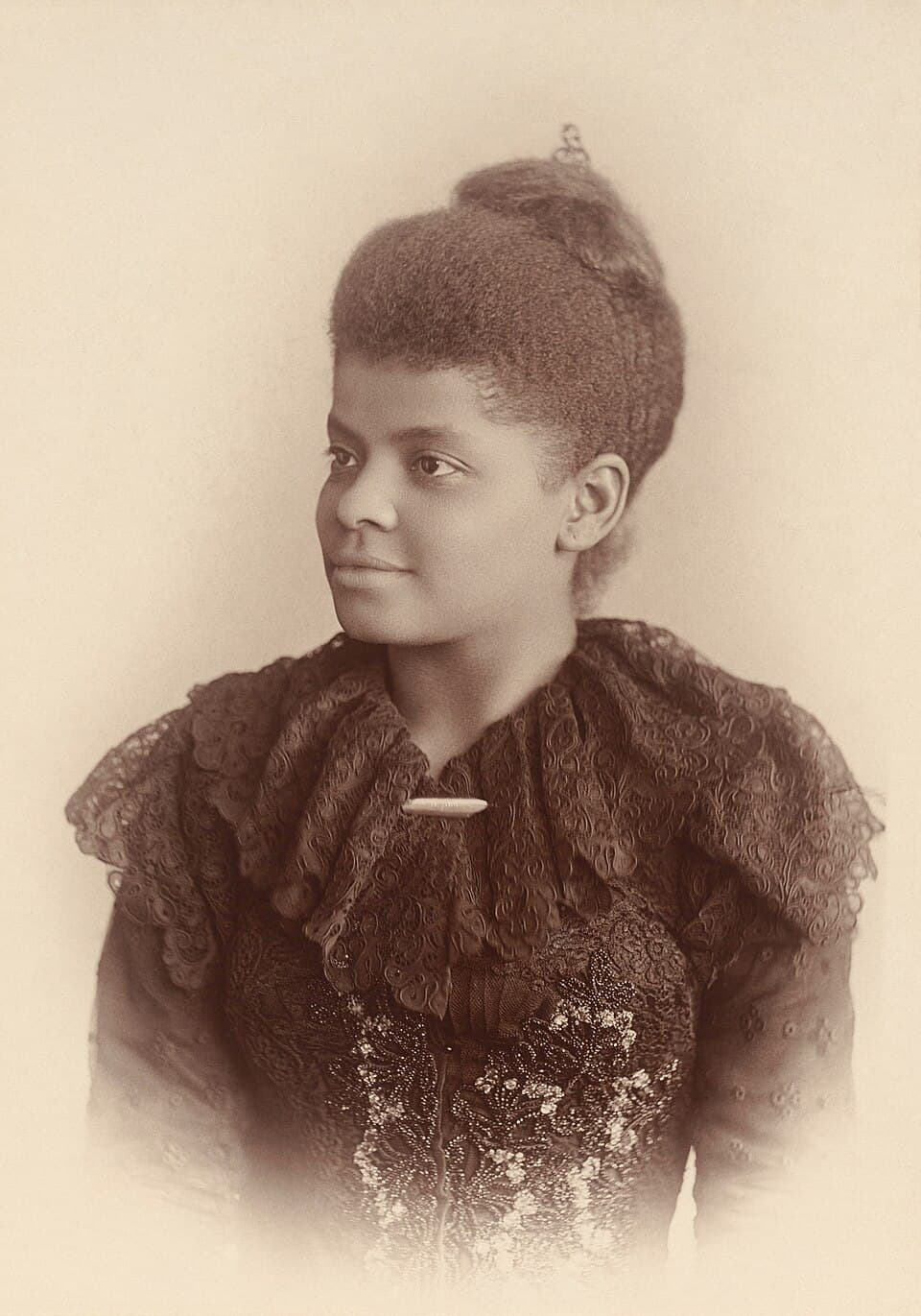
American · Activism · Politics · Literature · Law
Ida B. Wells-Barnett
July 16, 1862 – March 25, 1931
Early Life and Background
Ida Bell Wells, later known as Ida B. Wells-Barnett, was born on July 16, 1862, in Holly Springs, Mississippi, during the American Civil War.[1][6] Her parents, James Wells and Elizabeth (Lizzie) Wells, were enslaved at the time of her birth, and she spent her early childhood in bondage.[1][10] Following the war and the Emancipation Proclamation, the Wells family was freed and became part of the emerging Black community that sought to build institutions and assert political rights during Reconstruction.[1][16]
Her father worked as a carpenter and became active in Republican Party politics, while her mother was deeply involved in church life and community support.[1][18] The Wells family valued education; Ida attended Rust College (then called Rust University), a school in Holly Springs established in 1866 for formerly enslaved people.[1][8] Although she was eventually expelled for a disciplinary incident, her time at Rust exposed her to Black intellectual life and reinforced the importance of schooling as a route to autonomy.
In 1878, when Ida was a teenager, a yellow fever epidemic struck Holly Springs, killing both her parents and a younger sibling.[5][9] As the eldest of several children, she took on the responsibility for her surviving siblings, refusing to allow them to be separated or placed in foster homes. To support the family, she found work as a teacher in rural Mississippi, an experience that began her lifelong engagement with education and community leadership.[1][18]
Career Beginnings and Development
Seeking better opportunities, Wells moved with her sisters to Memphis, Tennessee, in the early 1880s.[5][18] There she secured a position as a teacher in the segregated public schools, teaching from about 1884 to 1891.[3] Wells quickly became dissatisfied with the unequal conditions she observed: Black schools were underfunded, overcrowded, and poorly resourced compared to those serving white children. This injustice first drew her toward journalism.
While continuing to teach, Wells began writing for Black newspapers, including Living Way and later the Memphis Free Speech and Headlight, often under the pen name Iola.[5][8] Her articles criticized the poor state of Black education and challenged racial discrimination. In time, she became editor of the Memphis Free Speech and purchased a share in the paper, making her one of the earliest women to co-own a newspaper in a major American city.[4][8]
Her development as an activist accelerated after a pivotal incident on May 4, 1884, when Wells was forcibly removed from the first-class ladies’ car of a railroad after refusing to give up her seat to move to a segregated car.[2][18] She sued the Chesapeake, Ohio and Southwestern Railroad and, on December 24, 1884, initially won damages in a local Tennessee court.[2][18] The case was appealed, and on April 12, 1887 the Tennessee Supreme Court reversed the decision, ruling in favor of the railroad.[2][18] This reversal, noted as the first post–Civil Rights Act separate-coach case brought by a Black plaintiff before a state supreme court, highlighted both Wells’s courage and the hardening of Jim Crow law.[2]
Disillusioned with the courts but emboldened by her experiences, Wells turned more fully to the power of the press. She used her editorial position to address racial violence, economic exploitation, and political disenfranchisement. By the early 1890s, she had become a widely read voice within the Southern Black press.[1][5]
Anti-Lynching Campaign and Major Works
Wells’s most enduring contributions came through her crusade against lynching. On March 9, 1892, three Black businessmen in Memphis—Thomas Moss, a friend of Wells, and his partners Calvin McDowell and Henry Stewart—were lynched by a white mob after their successful grocery business challenged a white-owned store.[1][5] In response, Wells launched an intensified anti-lynching campaign in the Memphis Free Speech, writing editorials that condemned the killings and urged Black residents to boycott white businesses and leave Memphis.[1]
Around May 21, 1892, she published an especially forceful editorial challenging the common claim that lynching protected white women from Black rapists. Drawing on reported cases, she argued that many lynching allegations were fabricated to conceal economic competition, racial hatred, and white men’s sexual exploitation of Black women.[1][17] While Wells traveled out of town, white mobs attacked and destroyed the offices of the Memphis Free Speech, threatened her life, and forced her into exile from the city.[1][17] She relocated to the North, principally Chicago, and never again lived in Memphis.
From this point, Wells’s campaign against lynching became national and international. In 1892, she published the pamphlet Southern Horrors: Lynch Law in All Its Phases, which systematically documented lynching cases and exposed the falsehoods surrounding them.[1][5] In 1895, she expanded her work with A Red Record, one of the first statistical and investigative accounts of lynching in the United States, drawing on newspapers, court records, and other sources to catalog hundreds of cases.[1][4] These publications were groundbreaking in their use of data and investigative methods to confront racial terror.
Wells also carried her message abroad. She traveled to Britain in the mid-1890s to speak about lynching at public meetings and to build international support for anti-lynching efforts.[5][18] British audiences, shocked by her descriptions, formed committees and petitioned U.S. authorities, contributing to the global pressure for change.
Her pamphlet The Reason Why the Colored American Is Not in the World’s Columbian Exposition, distributed in Chicago on June 25, 1893, connected the anti-lynching cause with protests against Black exclusion from the World’s Fair.[1][17] Co-written with Frederick Douglass and others, it criticized the fair’s failure to represent Black achievements and linked racial violence to institutionalized discrimination more broadly.
Organizational Leadership and the Club Movement
Beyond writing, Wells was deeply involved in organizational activism. In the mid-1890s, she settled in Chicago and continued to publish articles in newspapers such as the Chicago Conservator, The New York Age, and later the Chicago Defender.[8] She became a central figure in the burgeoning Black women’s club movement.
In 1896, Wells helped found the National Association of Colored Women (NACW), joining with leaders such as Mary Church Terrell and Josephine St. Pierre Ruffin to create a national federation of Black women’s clubs.[1][18] The NACW addressed lynching, education, child welfare, and temperance, operating under the motto "Lifting as We Climb." Wells’s investigative work and speaking tours informed the association’s campaigns, even when internal politics sometimes limited her formal roles.
In 1910, she founded the Negro Fellowship League in Chicago, an organization that provided lodging, educational programs, and social services for Black migrants arriving from the South.[1][18] Located near the city’s rail lines, the League offered a safe space, job assistance, and community support during an era of intense discrimination and volatile labor conditions.
Wells also played a part in the formation of the National Association for the Advancement of Colored People (NAACP). She participated in the 1909 meeting that led to the organization’s creation and is recognized as one of its co-founders.[5][6][17] Although her role was later downplayed in some accounts and she eventually distanced herself from the NAACP over strategic and personal disagreements, her investigative anti-lynching work significantly shaped the organization’s early agenda.
Suffrage, Electoral Politics, and the Alpha Suffrage Club
Wells’s activism also extended to women’s suffrage and electoral politics. She believed that the vote was essential for Black women to protect their families, influence public policy, and combat racial violence. Around January 30, 1913, she founded the Alpha Suffrage Club in Chicago, widely regarded as the city’s first Black women’s suffrage organization.[15][4] The club focused on educating Black women about voting, registering them, and mobilizing them to support candidates sympathetic to Black interests.
The Alpha Suffrage Club quickly became an influential political force. Its members canvassed neighborhoods, held meetings, and used newspapers to encourage civic engagement. The club played a key role in electing reform-minded aldermen and in strengthening Black women’s political presence in Chicago.[4][15]
On March 3, 1913, Wells-Barnett traveled to Washington, D.C., to participate in the Woman Suffrage Procession organized by Alice Paul and the Congressional Union.[15] When white organizers suggested that Black women march at the back to appease Southern delegations, Wells-Barnett rejected the demand. She initially stepped aside but then rejoined the Illinois delegation mid-parade, walking with white suffragists from her state.[15] Her defiant action became an enduring symbol of Black women’s insistence on full inclusion within the suffrage movement.
Wells continued to link suffrage to broader civil rights causes. After Illinois granted women partial voting rights and, later, full suffrage, the Alpha Suffrage Club worked to influence local elections and policy debates. Wells believed that political representation was crucial to address issues such as lynching, housing discrimination, and school inequality.[4][15]
Response to Racial Violence and World War I–Era Activism
Wells’s commitment to combating racial violence persisted into the 1910s. The East St. Louis massacre of 1917, in which white mobs killed large numbers of Black residents and destroyed homes and businesses, profoundly alarmed her. She helped organize and lead protests in response.[17]
On July 28, 1917, Wells-Barnett participated in the Silent Protest Parade in New York City, where thousands of African Americans marched quietly down Fifth Avenue behind drummers, carrying signs that denounced lynching and mob violence.[17] The demonstration, organized by the NAACP and allies, was one of the earliest large-scale civil rights marches in the United States. Wells’s presence lent the weight of her decades-long anti-lynching work to the protest and highlighted the continuity between her earlier campaigns and newer mass-action strategies.
Throughout World War I and the subsequent Red Summer of 1919, Wells investigated racial outbreaks, produced reports, and pressed for federal anti-lynching legislation.[1][17] She continued to speak publicly, write articles, and organize at the local level, even as younger leaders and new organizations emerged on the national scene.
Personal Life
On June 27, 1895, Wells married Ferdinand Lee Barnett, a Chicago attorney, editor, and prominent activist.[18][2] Barnett had founded and edited the Black newspaper The Conservator and was active in Chicago politics and law. Wells adopted the hyphenated surname Wells-Barnett, an unusual step at the time that signaled her desire to maintain her public identity while acknowledging her marriage.
The couple had several children and raised their family in Chicago.[5][18] Wells-Barnett continued her activism after marriage and motherhood, organizing meetings at home, traveling for lectures, and writing articles. She sometimes brought her children along on speaking engagements or balanced childcare with late-night writing. Her life thus challenged prevailing norms that assumed married women, particularly mothers, should withdraw from public work.
Within the family, political discussion and community involvement were common. Descendants have later described Wells-Barnett as both a devoted parent and an uncompromising advocate, who expected her children to understand the significance of racial inequality and civic responsibility.[16] Her domestic life was not separate from her activism; rather, the household functioned as a base for organizing and intellectual exchange.
Later Life, Autobiography, and Electoral Ambitions
In the 1920s, Wells-Barnett remained active in Chicago’s civic affairs, although some national organizations, including the NAACP, did not always recognize her leadership as fully as earlier in her career.[5][17] She continued to write, speak, and investigate, and turned toward documenting her own life and the movements she had helped shape.
In 1928, she completed an autobiography, later edited and published posthumously under the title Crusade for Justice.[9][5] In this work, Wells-Barnett recounted her experiences from her youth in Mississippi through the Memphis railroad case, the anti-lynching campaigns, her organizing in Chicago, and her critiques of both white supremacy and shortcomings within Black leadership. The manuscript provides an invaluable firsthand account of her motivations, strategies, and reflections.
Near the end of her life, Wells-Barnett sought direct political office. On February 25, 1930, she announced her candidacy for the Illinois state senate, becoming the first Black woman to run for a state senate seat in Illinois.[15][16] Although her campaign was unsuccessful, it exemplified her conviction that structural change required participation in electoral politics as well as activism. Her run drew upon the networks and experience she had developed through the Alpha Suffrage Club and other civic efforts.
Death
Ida B. Wells-Barnett died of uremia, associated with kidney disease, on March 25, 1931, in Chicago, Illinois.[2][6][8] She was 68 years old. Her passing came just one year after her historic state senate campaign, underscoring that she remained engaged in public affairs into her final years.[16]
At the time of her death, Wells-Barnett was widely respected within Black communities and among reformers, though some of her contributions, particularly to the NAACP, were not fully acknowledged in mainstream narratives. Over the following decades, historians and activists would gradually restore her central place in the history of American civil rights and feminist movements.
Legacy and Historical Impact
Ida B. Wells-Barnett’s legacy spans journalism, civil rights, women’s suffrage, and political organizing. As an investigative journalist, she pioneered the use of data, case studies, and on-the-ground reporting to expose lynching and racial violence.[1][4] Her works Southern Horrors and A Red Record remain foundational texts for understanding lynching as an instrument of racial control rather than as a response to alleged crime.
Her insistence on factual evidence challenged widely accepted myths and forced both American and international audiences to confront the realities of mob violence. Wells-Barnett helped establish investigative journalism as a tool of social reform, influencing later generations of reporters who used documentary methods to uncover injustices.[4][17]
In the realm of women’s activism, Wells-Barnett’s founding of the Alpha Suffrage Club and her courageous participation in the 1913 Woman Suffrage Procession demonstrated that Black women were central actors in the struggle for the vote.[15] She insisted that racial justice and gender equality were inseparable, a perspective that resonates strongly with contemporary notions of intersectionality.
Her organizational work with the NACW, NAACP, and local Chicago groups helped build enduring institutions that would carry the civil rights struggle forward into the mid-twentieth century. Even when she clashed with other leaders, her presence and advocacy shaped debates over strategy, priorities, and accountability.
In recent decades, Wells-Barnett has received growing posthumous recognition. Scholars have produced biographies and studies of her journalism and activism, and her autobiography Crusade for Justice has become a key primary source in African American history.[9] Institutions such as the Ida B. Wells Society for Investigative Reporting honor her by promoting rigorous journalism focused on injustice.[17] Museums and public history projects, including the National Women’s History Museum and the Smithsonian’s women’s history initiatives, highlight her contributions.[1][16]
Commemorative markers, public statues, and even coin designs celebrate her as a symbol of resistance to racial terror and as an early architect of the civil rights movement.[16] Her life story continues to inspire activists who challenge police violence, systemic racism, and gender inequality, and informs debates about the responsibilities of the press in confronting abuses of power.
Ida B. Wells-Barnett’s impact lies not only in the specific campaigns she led but in the model she offered of fearless, evidence-based advocacy. From her birth in slavery to her campaigns in courtrooms, newspapers, streets, and electoral politics, she embodied a commitment to "crusading for justice" that has shaped American political and intellectual life long after her death.
Dated achievements
13 indexed.
- Jul161862Activism
Birth of Ida B. Wells
Ida B. Wells was born on July 16, 1862, into slavery in Holly Springs, Mississippi.
View details National Women's History Museum Biography - Dec241884Law
Initial Court Victory in Railroad Segregation Case
Ida B. Wells won a local court case against railroad segregation on December 24, 1884.