← All women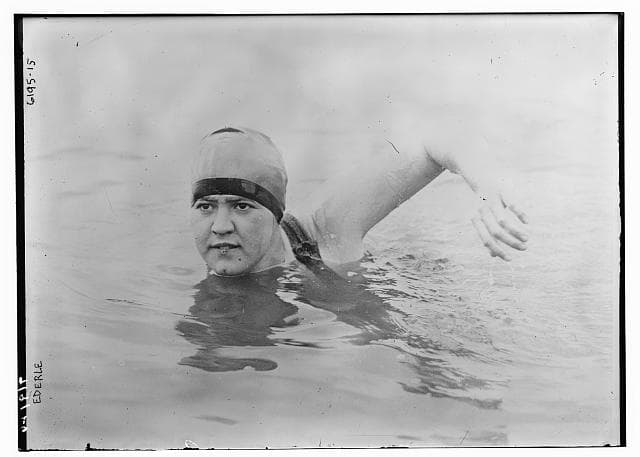
American · Sports
Gertrude Ederle
October 23, 1905 – November 30, 2003
Early life and family background
Gertrude Caroline Ederle was born on October 23, 1905, in New York City to German immigrant parents. She grew up in a large working-class family in Manhattan, and the practical, urban world of her childhood shaped both her independence and her later public image. Her father operated a butcher shop, and family life was rooted in the rhythms of immigrant labor, neighborhood ties, and the everyday ambitions of upward mobility. In the early twentieth century, New York offered new opportunities for girls, but athletic life for women remained constrained by social expectations that often discouraged competitive sport.
Ederle learned to swim as a child, and water soon became the medium in which she distinguished herself. Her early swimming instruction is often linked to family support and to the broader culture of New York beaches, pools, and waterfront recreation. She was not born into the sporting elite; rather, she emerged from the expanding urban world that made modern amateur athletics possible. That background is important because her later fame depended not only on exceptional physical talent, but on access to the growing institutions of women’s sport that were beginning to take shape in the 1910s and 1920s.
Training and rise as a competitive swimmer
Ederle began competing while still young and quickly proved unusually versatile. By the early 1920s, she was developing into one of the most accomplished American swimmers of her generation. Institutional profiles credit her with setting multiple world records, and her early successes made her a standout at a time when women’s competitive swimming was still building credibility. In 1921, she became a world-record holder in the 880-yard freestyle, and in 1922 she set seven world records in a single 500-meter swim at Brighton Beach. Those achievements announced her as more than a promising athlete: they marked her as a dominant performer in an emerging women’s sport.
The significance of these records lies partly in the context. Women athletes in this period still faced doubts about endurance, training intensity, and the legitimacy of competition. Ederle’s performances answered those doubts in the water. She developed a reputation for speed, stamina, and consistency across distances, and her record-setting career helped make women’s swimming more visible to the American public. Even before her best-known feat, she had already become one of the country’s most prominent female athletes.
Paris Olympics and international recognition
Ederle’s breakthrough on the international stage came at the 1924 Paris Olympics. There she won gold as part of the United States women’s 4x100-meter freestyle relay and earned bronze medals in the women’s 100-meter freestyle and 400-meter freestyle. Collecting three medals in a single Olympiad established her as one of the top swimmers in the world. It also demonstrated that her talent translated from domestic competition to the highest level of sport.
The 1924 Olympics were an important moment in the history of women’s athletics. Women’s swimming had only recently gained a place in the Olympic program, and female competitors were still struggling against assumptions that serious competition was unsuited to them. Ederle’s success in Paris helped normalize the idea of women as elite athletes. Her Olympic medals also gave her broader public recognition and positioned her for the even larger stage that would soon define her career.
Open-water challenge and the English Channel
After Paris, Ederle turned toward open-water endurance swimming. In June 1925, she became the first woman to swim the length of New York Bay, a notable milestone that demonstrated her capacity for long-distance open-water competition. On August 18, 1925, she made her first attempt to swim the English Channel. Though she did not finish, the attempt was a crucial step in her development and an early sign of the determination that would define her legacy.
On August 6, 1926, after a second attempt, Ederle achieved her signature triumph: she became the first woman to swim the English Channel. The crossing took roughly 14 hours and 31 minutes, though contemporary and later reporting varies somewhat on the exact time. What does not vary is the historical meaning of the feat. The Channel had long been one of the world’s most daunting swims, combining distance, cold, tides, and exposure. Ederle’s performance was therefore a test not just of athletic skill but of endurance, strategy, and courage.
Her accomplishment resonated far beyond sports. In the 1920s, women’s physical capabilities were still frequently underestimated in public discourse. Ederle’s swim became a vivid rebuttal to those assumptions, and her success transformed her into a cultural celebrity. She was celebrated in newspapers, public appearances, and popular memory as an emblem of modern womanhood. The crossing also broke a barrier in international sport by showing that a woman could complete one of the most grueling athletic challenges in the world.
Public fame, honors, and later work
Ederle’s English Channel crossing brought a wave of acclaim. She became one of the best-known American sports figures of the decade, and her fame extended well beyond swimming circles. She was celebrated as a national heroine and a symbol of women’s expanding possibilities. Her achievement also helped elevate marathon swimming and open-water competition as serious athletic disciplines.
After her competitive career, Ederle moved into other work. Sources note that she pursued fashion design and later devoted significant energy to teaching swimming, including instruction for deaf children in New York City. That later work is an important part of her life story because it shows that her public legacy was not limited to a single famous swim. She continued to use her skills in ways that served others, especially children who faced barriers of their own.
Her life has been recognized by institutional honors and historical retrospectives over the decades. She is profiled by major sports and historical organizations, including the International Swimming Hall of Fame and the Women of the Hall, both of which emphasize her record-setting career and her place in women’s sports history. Those recognitions reflect not just admiration for a dramatic athletic victory, but acknowledgment of a career that expanded the meaning of women’s competitive achievement.
Personal life
Unlike some public athletes of her era, Ederle did not build a public identity around marriage or family life. Reference works generally describe her as never married and without children. Her later years were marked more by private life, teaching, and the continuing afterlife of her sporting reputation than by the conventional domestic biography often emphasized for women of her generation.
She also lived with the physical consequences of her Channel swim, including damage to her hearing. This detail underscores the cost of the feat and the physical seriousness of the endeavor. In the public imagination, the swim was heroic; in lived reality, it involved real bodily sacrifice. That tension between acclaim and cost is one reason her story remains historically compelling.
Later life, death, and legacy
Gertrude Ederle died on November 30, 2003, in Wyckoff, New Jersey, at the age of 98. By then, her name had become permanently attached to one of the signature women’s sporting firsts of the twentieth century. Her death prompted renewed reflection on her place in athletic history and on the broader changes in women’s sport that followed in her wake.
Her legacy rests on several intertwined achievements. She was an Olympic medalist, a world-record holder, and the first woman to swim the English Channel. She also helped alter public perceptions of what women athletes could endure and accomplish. In an era when female athleticism was still routinely questioned, she made endurance, strength, and competitive excellence impossible to dismiss.
Ederle’s story continues to matter because it sits at the intersection of sport, gender history, and modern celebrity. She was part of the generation that turned women’s athletics into a public spectacle and a legitimate arena of achievement. Her Channel crossing remains one of the most famous barrier-breaking feats by a woman in sporting history, and her name endures as a symbol of persistence, skill, and the widening horizon of women’s possibilities.
Dated achievements
9 indexed.
- Oct231905Sports
Birth of Gertrude Ederle in New York City
Gertrude Caroline Ederle was born on October 23, 1905, in New York City, the daughter of German immigrants.
View details Gertrude Ederle - Wikipedia - Jul131924Sports
Olympic gold medal, 4x100m freestyle relay, Paris 1924
Ederle won Olympic gold as part of the U.S. women's 4x100m freestyle relay team at the 1924 Paris Olympics.