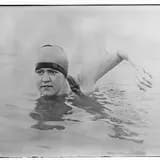
Ederle's August 6, 1926 Channel swim beat the existing men's record time by nearly two hours, setting a new benchmark that stood for decades.
Beyond being the first woman to swim the English Channel, Gertrude Ederle's crossing on August 6, 1926, was also a record-breaking performance in absolute terms. Her time of roughly 14 hours and 31 minutes beat the existing men's Channel swimming record by nearly two hours, a stunning margin that silenced skeptics who doubted women's capacity for extreme endurance sport.
This benchmark time stood as a point of reference for Channel swimmers, male and female, for years afterward, and it dramatically altered expectations about what was physically achievable in Channel crossings. Prior to Ederle's swim, the men's record had inched forward only gradually since Captain Matthew Webb's pioneering 1875 crossing; Ederle's swim represented a leap forward in performance that surprised even veteran observers of Channel swimming.
The scale of the achievement was amplified by the conditions she faced — choppy seas and strong currents forced her to swim a far longer actual distance than the shortest theoretical crossing route. Contemporary and later accounts have noted that she swam an estimated 35 miles of actual distance to cover the roughly 21-mile-wide Channel due to tidal drift.
Her record-setting swim was covered extensively by international media and cemented her legacy not just as a pioneer for women, but as one of the greatest marathon swimmers of any gender in the sport's history.