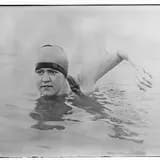
In June 1925, Ederle became the first woman to swim the length of New York Bay, from Manhattan's Battery to Sandy Hook, New Jersey.
In June 1925, Gertrude Ederle became the first woman to swim the length of New York Bay, completing the roughly 17-mile route from the Battery in Manhattan to Sandy Hook, New Jersey, in 7 hours and 11 minutes.
This grueling open-water swim served as a crucial proving ground for Ederle's ambitions to conquer the English Channel. Long-distance open-water swimming at the time was viewed as an almost exclusively male pursuit, requiring not only physical strength but also tactical knowledge of currents, tides, and cold-water endurance. Ederle's successful crossing of New York Bay demonstrated that a woman could match — and in her case exceed — the achievements of male marathon swimmers in treacherous open water.
The swim generated significant press attention and public excitement, elevating Ederle's profile beyond her Olympic accomplishments and establishing her as America's leading distance swimmer. It also gave her invaluable experience managing fatigue, temperature, and pacing over many hours in open water — skills she would draw upon just over a year later during her historic English Channel crossing. The achievement is frequently cited as a pivotal turning point that transformed Ederle from an Olympic medalist into a pioneering distance swimmer.