← All women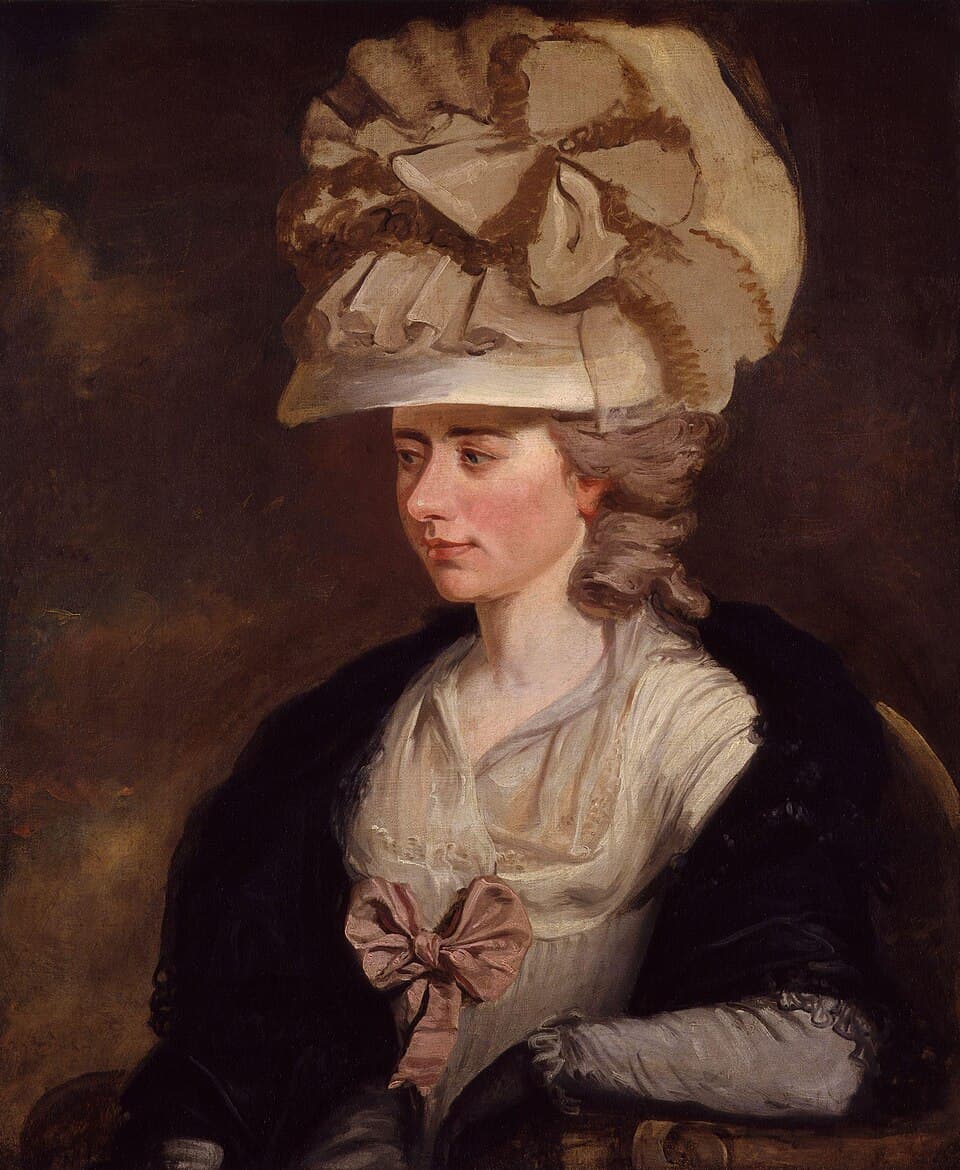
British · Literature
Fanny Burney
June 13, 1752 – January 6, 1840
Early Life and Background
Frances "Fanny" Burney was born on 13 June 1752 in Lynn Regis, now King’s Lynn, Norfolk, England.[2][4][7] She was the third of the six surviving children of Dr. Charles Burney, a prominent musician, composer, and later an influential music historian, and his first wife, Esther Sleepe Burney, herself musically trained and the daughter of the leader of the Lord Mayor’s Band.[7][10] The Burney household was sociable and intellectually vibrant; Charles’s ambitions and connections drew the family increasingly toward London’s cultural life.[4][7]
When Fanny was ten, her mother died, a loss that profoundly shaped her emotional world.[9][10] She became closely attached to her father, whose charisma and social circle exposed her to leading figures in music and letters. Among her siblings and half‑siblings were future writers and professionals, including James Burney, a naval officer, and Sarah Harriet Burney, later a novelist.[4][10] This environment fostered high expectations of talent, though formal schooling for girls was limited.
Unlike her brothers, Fanny received little systematic education and was, in large part, self‑educated.[3][17] She reportedly struggled with reading as a child but became an avid reader, teaching herself through books, observation, and conversation.[4][3] The absence of formal schooling became a central element of her later self‑presentation: she portrayed her achievements as arising from natural genius and perseverance rather than institutional training, a narrative resonant with broader patterns in women’s intellectual history.
The family moved to London, where Charles Burney’s rising status as England’s first significant musicologist brought eminent visitors into their home.[9] Fanny’s exposure to fashionable society, theatre, and musical performance sharpened her eye for character and manners—qualities that would define her fiction and diaries.
Early Writing and the Journals
Burney began writing at a young age, composing stories and reflections from around the age of ten.[17] By her mid‑teens she had drafted a full‑length novel, The History of Caroline Evelyn, and kept notebooks of sketches and journals.[3][10] Yet she internalized prevailing anxieties about female authorship and reputation. On 13 June 1767, her fifteenth birthday, she famously burned the manuscript of Caroline Evelyn and many other early writings in a bonfire at her father’s house in Poland Street, London, fearing their unworthiness and impropriety.[3][10] This dramatic act encapsulates the pressure on genteel women to hide or downplay literary ambition.
Despite the bonfire, Burney did not abandon writing. From 1768, she began a series of journal‑letters addressed to her sister Susan and other family members, a practice she would continue, in various forms, throughout her life.[4][10] These journals combined intimate self‑reflection with acute observation of social scenes, often written with the idea that future readers might include a wider circle than the immediate recipients. Over time, they expanded into what would become some twenty‑five volumes of Journals and Letters, now a major source for historians of 18th‑century Britain.[3][4]
During the 1770s, Burney’s father’s house became a hub for cultural exchange. Charles Burney’s friendships with figures such as Samuel Johnson, David Garrick, and Hester Lynch Thrale brought Fanny into contact with leading literary and theatrical personalities.[4][7] Observing their conversation and mannerisms, she developed a sophisticated sense of dialogue and comic characterization, even as she remained officially a modest daughter rather than a professional writer.
In 1779, Burney wrote the comedy The Witlings, a satirical play targeting literary pretension and female "bluestockings".[4][10] Her father and friends, including Hester Thrale, advised against staging or publishing the work, fearing it might give offense or damage her reputation. The manuscript remained unpublished, illustrating how social gatekeeping could block women’s more daring or critical projects.
Breakthrough: Evelina and the Novel of Manners
Burney’s major breakthrough came with the novel Evelina, or A Young Lady’s Entrance into the World. Drawing in part on the destroyed Caroline Evelyn, she crafted an epistolary narrative about the illegitimate daughter of a nobleman navigating London’s public spaces and social hazards.[4][10] Determined to avoid scandal, Burney kept the project secret from most of her family.
On 29 January 1778, Evelina was published anonymously in three volumes by the London bookseller Thomas Lowndes.[4][2] The novel quickly attracted readers with its vivid depiction of assemblies, pleasure gardens, and theatres, and its sharp comic episodes featuring vulgar characters like the Branghtons and Captain Mirvan. Its double focus on entertainment and the moral education of a young woman resonated deeply with contemporary concerns.
Initially, speculation about the author’s identity abounded. When Burney was revealed as the writer, she received a surge of recognition and was welcomed into fashionable literary circles.[4][5] Samuel Johnson praised her work; Hester Thrale celebrated her talent; and critics hailed Evelina as a landmark in the emerging novel of manners, a genre centered on social behavior, class codes, and domestic realities.[2][6]
Evelina is now regarded as one of the foundational texts of that genre and an important precursor to the work of Jane Austen.[2][13] It presents a nuanced critique of male irresponsibility and female vulnerability, highlighting how women’s safety and reputation depend on guardianship, economic security, and male conduct—issues central to later women’s fiction.
Cecilia and Camilla: Consolidating Literary Fame
Burney’s second novel, Cecilia, or Memoirs of an Heiress, appeared in 1782, published in five volumes by T. Payne and Cadell.[4][11] The narrative follows Cecilia Beverley, a rich orphan encumbered by a complicated inheritance that stipulates she must marry a man who will take her surname. Through this plot, Burney examines the intersection of legal and financial structures with women’s marital choices.
Cecilia deepened Burney’s reputation as a serious novelist of manners. The work includes incisive portrayals of social climbers, philanthropists, and eccentrics, showing her range beyond pure comedy to concern with moral psychology. The novel’s influence is evident in Jane Austen’s Pride and Prejudice; Austen appears to have borrowed the phrase "pride and prejudice" from a passage in Cecilia, and her narrative techniques bear traces of Burney’s innovations.[6][13]
In 1796, Burney published her third major novel, Camilla, or A Picture of Youth, in five volumes with T. Payne, Cadell & W. Davies.[11][10] The publishers paid her £1,000 for the rights, a significant sum reflecting both her established readership and the growing profitability of the novel form for successful authors.[10] Camilla follows several young protagonists—Camilla, her sister, and their cousin—through misjudgments, romantic entanglements, and financial distress, again foregrounding the "difficulties" youth and particularly young women face under social expectations.
For Camilla, Burney employed a subscription model, securing subscribers from high society, including the Prince of Wales.[14] This strategy demonstrates her astute engagement with the book market and the ways elite patronage could support women’s writing. Together, Evelina, Cecilia, and Camilla established Burney as one of the foremost English novelists of her generation.[2][7]
The Court of George III: Keeper of the Robes
Despite her literary success, economic security was not assured. In 1786, Burney accepted the post of Second Keeper of the Robes to Queen Charlotte, serving at the court of George III until 1791.[5][10] This salaried position involved attending the queen, overseeing aspects of her wardrobe, and participating in daily ceremonial duties at Windsor and Kew.
Burney’s journals from this period, though sometimes constrained by the need for discretion, provide a remarkable insider account of royal life. She observed the king’s episodes of mental illness and the strains they placed on the royal family, as well as the rigid hierarchies and routines of the household.[4][11] The court offered her prestige and contact with powerful figures, but it also imposed exhausting hours and limited her opportunities for writing.
Her eventual resignation in 1791 reflected both health concerns and a desire to regain creative independence. Burney later described her court years with ambivalence, acknowledging their importance while lamenting the personal sacrifices they demanded.[10] For historians, this service illustrates one of the few respectable professional pathways open to middle‑class women, even those with literary acclaim.
Marriage, Plays, and Life in France
Following her departure from court, Burney spent time with her close friend Hester Thrale Piozzi and continued to write. In the 1790s, she composed the tragedies Edwy and Elgiva and Hubert de Vere, although these remained unpublished during her lifetime.[3][4] The plays show her interest in historical and political themes, but the theatre world was again difficult for a woman writer to penetrate, especially with serious drama.
Burney’s personal life took a decisive turn when she married Alexandre d’Arblay, a French émigré and former aide‑de‑camp to Lafayette, in 1793Alexander, born on 18 December 1794.[10] Burney’s journals record both her domestic happiness and the financial anxieties they faced.
From 1802 to 1812, Burney lived for extended periods in France, including during Napoleon’s rule.[4][11] These years were marked by political tension, war, and the challenges of being an Englishwoman married to a French officer in changing regimes. Her experiences of travel, exile, and the realities of imperial power would later inform her final novel, The Wanderer.
Burney also endured serious health problems. In 1811, she underwent a terrifying mastectomy without anesthesia, later describing the operation in a detailed letter often cited in histories of medicine.[4][12] The account reveals her extraordinary courage and provides rare documentation of surgical practice and women’s bodily experience in the early 19th century, though the exact date of the operation is not consistently cited across general biographical sources.
The Wanderer and Later Writing
On 28 March 1814, Burney published her fourth and final novel, The Wanderer, or Female Difficulties, with Longman, Hurst, Rees, Orme and Brown, receiving £1,500 for the rights.[11][10] The novel, partly set during the French Revolution’s Reign of Terror, follows a mysterious heroine, Juliet, who attempts to support herself in England while concealing her identity and past. Through Juliet’s struggles, Burney examines women’s economic precarity, the stigmas attached to female labor, and the constraints imposed by class and gender.
Although contemporary critical reception was mixed—some readers found the plot convoluted—the novel has attracted renewed scholarly interest as an ambitious engagement with political and feminist themes. Its explicit subtitle, Female Difficulties, signals Burney’s intent to foreground systemic obstacles women face, from work and mobility to marriage and respectability.[11][10]
Beyond her novels, Burney wrote eight plays, a biography, and vast quantities of journals and letters.[3][4] The biography, Memoirs of Dr. Burney, celebrated her father’s musical career and reinforced his reputation as a foundational music historian. Her journals document interactions with leading figures such as Johnson, Garrick, Edmund Burke, and Joshua Reynolds, as well as everyday scenes of London, Bath, and court life.
During the decades following 1814, Burney continued to revise and organize her papers while living primarily in England.[4][11] Various selections from her diaries and letters circulated in manuscript among family and friends and were later edited and published, though precise first-edition day‑and‑month dates are not firmly established in standard reference sources.[3][4]
Awards, Honours, and Contemporary Reputation
In Burney’s lifetime, there were few formal literary prizes of the kind established in later centuries. Her recognition came through patronage, subscriptions, and critical notice. Contemporary reviewers and prominent intellectuals repeatedly praised her work. Anna Letitia Barbauld wrote that "scarcely any name, if any, stands higher in the list of novel-writers than that of Miss Burney," underscoring her high ranking among late‑18th‑century authors.[7]
Her successful negotiation of substantial payments for Camilla and The Wanderer counts as a form of professional recognition, signalling that publishers and readers valued her work at levels unusual for women writers at the time.[10][11] Her appointment as Second Keeper of the Robes likewise reflected royal acknowledgment of her character and accomplishments, even if not explicitly tied to her literary output.[5][10]
Later critics have continued this line of esteem. In 1918, Virginia Woolf famously described Burney as "the Mother of English fiction," acknowledging her foundational role in shaping the novel of manners and domestic realism.[7][6] Modern reference works such as Encyclopedia.com and Britannica consistently emphasize her significance among early women novelists and diarists.[2][10]
Personal Life and Character
Burney’s personal writings reveal a complex character: deeply affectionate, morally conscientious, and often torn between ambition and modesty. Her marriage to Alexandre d’Arblay appears to have been loving and mutually supportive, despite financial struggles and the uncertainties of émigré life.[10][14] She was devoted to their son, Alexander, whose education and prospects were a recurring concern in her letters.
Religion and sensibility played important roles in her worldview. Burney valued virtue and self‑control and frequently framed her narratives in terms of moral development. At the same time, her sharp wit and willingness to expose hypocrisy gave her fiction and diaries a distinctively satirical edge. Her ambivalence about publication—expressed particularly in the preface to The Wanderer, where she associated authorship with "degradation"—reflects the tension between creative drive and the era’s gendered stigma attached to public literary identity.[7][10]
Her health experiences, including the mastectomy and episodes of nervous illness, contributed to a sensibility attuned to bodily and emotional vulnerability, visible in the physical and psychological trials faced by her heroines.
Legacy and Historical Impact
Burney’s legacy spans several domains. As a novelist, she is central to the evolution of the novel of manners. Works such as Evelina, Cecilia, and Camilla helped define a fictional mode attentive to social etiquette, class dynamics, and the moral formation of young protagonists.[2][6] Her influence on Jane Austen and later writers establishes her as a crucial link between mid‑18th‑century fiction and the classic 19th‑century novel.[6][13]
As a diarist and letter writer, Burney left one of the richest personal archives of the period. Her twenty‑plus volumes of journals offer invaluable documentation of Georgian and Regency society: from the daily life of London to the inner workings of the royal court and the experience of living in revolutionary and Napoleonic France.[3][4][11] Historians, literary scholars, and feminist critics have mined these texts to understand women’s perspectives on politics, medicine, family, and culture.
Burney also helped elevate the status of women’s writing. Her success demonstrated that female authors could command large readerships, secure substantial payments, and be taken seriously by leading male critics. Her career opened pathways for other women novelists and contributed to the 20th‑century feminist recovery of earlier women’s literature.[10][12][14]
In the later 20th century, the feminist literary revival brought renewed attention to Burney’s novels and plays, emphasizing their critique of gender norms and their representation of women’s emotional and economic struggles.[12] Institutions such as the Burney Centre at McGill University have further cemented her importance by editing and publishing scholarly editions of her journals and letters.[11]
Later Life and Death
In her later years, Burney lived mainly in Britain, including a long period in Bath, a spa town associated with health and genteel society.[4][14] She devoted considerable energy to organizing her papers, corresponding with relatives, and reflecting on the dramatic historical changes she had witnessed—from the Seven Years’ War era of her childhood through the French Revolution, Napoleonic Wars, and the beginnings of the Victorian age.
Burney outlived both her husband and their son Alexander, enduring the losses with the fortitude and religious faith often expressed in her writings.[10][14] Her continued revision of journals and letters helped shape the image of herself that would reach posterity.
On 6 January 1840, Burney died in London at the age of eighty‑seven.[2][4][10] She was later buried in Walcot cemetery, Bath, Somerset, alongside her husband and son, a location that symbolically joins her personal and literary geographies.[12] After her death, edited selections of her journals and letters were published by family members and later by scholars, significantly enhancing her reputation.
Today, Burney is widely recognized as one of the most important English women writers of the late 18th and early 19th centuries. Her novels, plays, biography, and voluminous life‑writing continue to inform our understanding of the period and to illuminate the challenges and achievements of women navigating the literary marketplace and social expectations in Georgian and Regency Britain.[2][3][10][11]
Dated achievements
8 indexed.
- Jun131752Literature
Birth of Fanny Burney
Frances (Fanny) Burney was born at Lynn Regis (now King's Lynn), Norfolk, England, the third child of musician Dr. Charles Burney.
View details Frances Burney - Wikipedia - Jun131767Literature
Bonfire of Early Manuscripts
On her 15th birthday, Fanny Burney burned the manuscript of her first novel, 'The History of Caroline Evelyn,' and other early writings.