← All women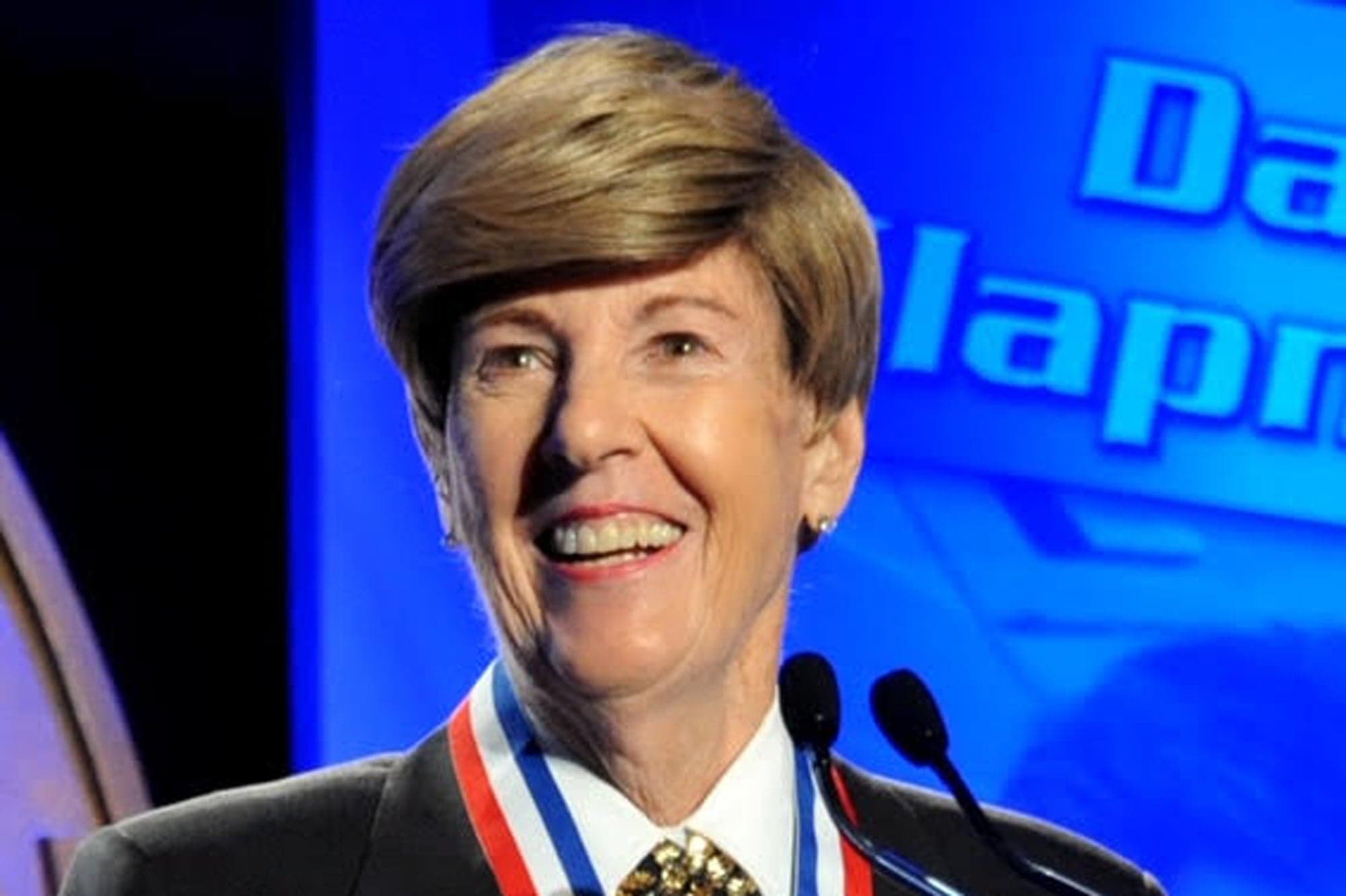
American · Aviation
Emily Howell Warner
October 30, 1939 – July 3, 2020
Early Life and Background
Emily Joyce Hanrahan—later known as Emily Howell Warner—was born on October 30, 1939, in Denver, Colorado, U.S., to John and Emily Hanrahan.[1][2][11] She was one of six children, with four brothers and a twin sister, Eileen.[2] Her father worked "in a railroad capacity," and her mother was a mezzo‑soprano associated with the Denver opera community, giving Emily a childhood shaped by both working‑class discipline and exposure to performance and public presence.[17] Growing up in mid‑century Denver, she would have seen trains and planes as symbols of mobility and modernity, though professional piloting for women was virtually unheard of.
As a girl, Emily initially aspired to become a flight attendant, influenced by the glamorous image of stewardesses in the 1950s, even before she had ever flown on an airplane.[8][15] Airline advertisements of the era presented women almost exclusively in cabin service roles, subject to strict rules about age, marital status, weight, and appearance, while cockpit positions were reserved for men. That gendered division of labor framed the world she was born into and the expectations that surrounded her.
Her life’s course changed dramatically at age 17 or 18, when she took her first airplane flight, a trip from Denver to Gunnison, Colorado.[5][7][10] That flight profoundly impressed her; she later recalled deciding during the journey that she wanted to become a pilot rather than a flight attendant.[5][7] The experience crystallized her fascination with aviation and set her on a path that would eventually challenge the gender boundaries of commercial flying.
Flight Training and Career Beginnings
After high school, Warner began taking flying lessons at Clinton Aviation, a Denver flight school and charter operation.[5][9][10] She supported herself by working as a receptionist there while trading labor for flight time, volunteering for parts runs and other "gopher" tasks that allowed her to accumulate hours in the air.[10] Observing male instructors using Clinton as a springboard to airline careers, she resolved that she could follow the same path.[10]
Warner earned her private pilot’s license around age 20, in 1961, according to biographical summaries.[5][9][13] She subsequently obtained a commercial pilot’s license, instrument rating, multi‑engine rating, and a flight instructor certificate.[5] By the early 1960s she was teaching full‑time, becoming a flight instructor at Clinton Aviation by age 21.[10] Over the next decade she built extensive experience as a charter pilot, flight school manager, and chief pilot, logging thousands of hours in a variety of aircraft.[5][9]
Her work at Clinton Aviation also included serving as a flight dispatcher and managing the United Airlines contract training program, where she oversaw training for United pilots and interacted regularly with airline standards.[5] Despite such responsibilities, airline hiring departments largely overlooked her applications, reflecting a widespread belief that airline cockpits were an exclusively male domain.
In 1967, at age 28, Warner became the Federal Aviation Administration’s first female designated pilot examiner, a position that authorized her to administer practical tests and issue pilot certificates.[4][10] This role signaled her high level of technical competence and judgment and made her an authority figure in flight training at a time when few women were recognized in such capacities. Over the next fifteen years she accrued more than 7,000 flight hours, along with numerous FAA certificates and ratings, strengthening her case for an airline career.[5]
Breaking Barriers in Airline Hiring
The path from accomplished instructor and examiner to airline pilot was not straightforward. Throughout the late 1960s and early 1970s, Warner repeatedly applied to major U.S. airlines, but her applications were frequently rejected or allowed to languish, sometimes with explanations that women were not being considered for cockpit roles.[10][19] At that time, regulatory and union norms were still shaped by decades in which almost no women had flown for scheduled airlines, and earlier precedents like Helen Richey’s brief co‑pilot service in the 1930s had ended under union pressure.[3][6][15]
A turning point came when Frontier Airlines, a Denver‑based carrier, agreed to interview her. In January 1973, Warner underwent a rigorous simulator evaluation and cockpit assessment at Frontier.[4][19] Impressed by her skills and extensive logbook, the airline decided to hire her as a second officer on its Boeing 737 fleet.
On January 29, 1973, Frontier Airlines formally hired Emily Howell Warner as a pilot.[1][3][9] This made her the first woman pilot hired as a permanent flight‑crew member by a U.S. scheduled passenger airline in the modern jet age.[1][7][15] Unlike earlier, short‑term appointments, her position placed her on the same seniority list and advancement track as male pilots. Biographical sources describe her as the first female pilot for a scheduled U.S. carrier and emphasize that her employment was permanent rather than experimental.[5][7]
Shortly thereafter, on February 6, 1973, Warner flew her first trip as second officer on a Frontier Boeing 737, making her the first woman to fly jets on a permanent basis for a U.S. airline.[1][3] This early line flight symbolized the normalization of women’s presence in jet airliner cockpits. Passengers and some colleagues were initially surprised or uncertain about a woman on the flight deck, but Warner’s professional performance helped dispel doubts.
Union Membership and Professional Recognition
Warner’s hiring reshaped not only airline practices but also union structures. In 1974, she became the first woman member of the Air Line Pilots Association (ALPA), the principal union representing U.S. airline pilots.[1][5][15] ALPA membership conferred full status within the collective bargaining and safety advocacy systems that governed airline pilots’ working lives. Her admission marked the end of an era in which union halls and seniority lists had been entirely male.
Throughout the mid‑1970s, Warner continued to advance through Frontier’s ranks. She logged additional flight hours, qualified on multiple aircraft types, and built a reputation for technical competence and calm cockpit leadership.[7][9] Her presence on the seniority list paved the way for other women to pursue similar paths, gradually eroding the perception that female pilots were anomalies or publicity stunts.
First Woman U.S. Airline Captain
Warner’s most famous barrier‑breaking accomplishment came in 1976June 6, 1976, Frontier Airlines promoted her to captain, assigning her to command a de Havilland Canada DHC‑6 Twin Otter.[4][10][11] With this promotion she became the first woman captain of a scheduled U.S. airline and, more broadly, the first woman captain of a U.S. airline.[1][3][11]
Captaincy transformed her role from subordinate crew member to the ultimate authority on the flight deck. She now bore responsibility for flight safety, operational decisions, and crew management. Frontier’s decision to entrust this authority to a woman challenged entrenched assumptions about who could lead in high‑stakes technical settings.
Her pioneering status drew national attention. Passengers sometimes expressed surprise when they realized the aircraft was commanded by a woman, but Warner’s professionalism and uneventful flights helped normalize the idea. Her captain’s uniform was later acquired by the Smithsonian National Air and Space Museum, where it illustrates the history of women in the cockpit and the changes in airline employment practices.[6][8]
All‑Female Crews and Continental Airlines
Warner’s trailblazing continued into the 1980s. On June 16, 1984, as a captain for Frontier Airlines, she commanded the airline’s first all‑female flight deck crew, flying with First Officer Barbara Cook.[17] For the first time at Frontier, both pilot seats were occupied by women, an arrangement that visually and practically defied longstanding gender norms in airline operations.
When Frontier Airlines was later absorbed by other carriers, Warner transitioned to Continental Airlines.[5][9] In 1986, she commanded Continental’s first all‑female commercial flight crew and is widely credited as the commander of the first all‑women commercial flight crew in U.S. airline history.[5][15][18] On that flight, women staffed both cockpit and cabin positions, demonstrating that a major‑airline operation could be conducted entirely by female professionals.
These all‑female crews were more than symbolic. They showcased the breadth of women’s skills across flight operations, reduced the novelty of seeing women in command positions, and provided media and educational institutions with vivid examples of gender integration in a previously male‑dominated field.
Later Career and FAA Roles
Warner accumulated an extraordinary amount of flight experience over her career. Biographical sources consistently credit her with more than 21,000 flight hours, a total often described as more than any other woman pilot in the world at the time of certain honors.[7][9][10][12] Her airline flying included service with Frontier, Continental, and later United Parcel Service (UPS), where she flew cargo operations.[10][12]
After retiring from airline line flying—sources differ on the precise year, with some citing 1986 for her departure from Continental and others 2002 for her final retirement from aviation after a 42‑year career—Warner continued to contribute to the industry through the Federal Aviation Administration (FAA).[7][9][12] She served as an Aircrew Program Manager assigned to United Airlines’ Boeing 737 fleet and as the FAA representative for United’s Flight Safety Action Program.[7] In these roles she helped oversee training, safety oversight, and incident reporting programs, influencing the operational standards applied to thousands of flights.
Her post‑airline work underscored that her expertise extended beyond flying to regulatory oversight and safety culture. It also allowed her to mentor younger pilots and participate in broader efforts to improve flight safety and crew resource management.
Awards, Honors, and Recognition
Warner’s pioneering achievements earned her numerous honors. She was inducted into the National Women’s Hall of Fame, which highlights her status as the first female pilot for a scheduled U.S. carrier, the first female captain, the first commander of an all‑female flight crew in the U.S., and the first woman member of ALPA.[5] The Hall of Fame emphasizes her role in "pioneering the way" for women pilots.
She was also named a laureate in the Colorado Aviation Historical Society’s Heritage Hall, which celebrates her Denver roots and her achievements as the first woman airline captain in the United States.[11] The Colorado Women’s Hall of Fame features her story as one of "Great Colorado Women," highlighting her more than 21,000 flight hours and her work as an FAA Aircrew Program Manager.[7][17]
In 2014, Warner was inducted into the National Aviation Hall of Fame, becoming the fifteenth woman among 225 honorees recognized for exceptional contributions to aviation.[10] Her Frontier uniform’s inclusion in the Smithsonian’s National Air and Space Museum further cements her place in the institutional memory of aviation history.[6][8]
Internationally, her career has been documented in English, Spanish, and Finnish‑language biographies, reflecting her global significance as a symbol of women’s advancement in airline piloting.[3][6] Her story is frequently used in educational materials, including Civil Air Patrol lessons, to teach young people about perseverance, technical skill, and the importance of challenging barriers.[16]
Personal Life
Biographical sources identify her as Emily Joyce Howell Warner (née Hanrahan), indicating that she married and adopted the surname Howell before becoming widely known under her full married name.[1][3][6] Details about her husband’s biography and the timing of their marriage are not extensively documented in major public sources, reflecting a focus on her professional rather than domestic life.
Obituaries and museum narratives emphasize that her intense career in aviation required navigating not only institutional barriers but also the practical demands of balancing personal commitments with unpredictable flight schedules and training responsibilities. However, the available sources concentrate on her public role as a pilot, instructor, examiner, and FAA official rather than on her family life, and there is limited published information about any children or extended family beyond her siblings.[2][18]
Legacy and Historical Impact
Emily Howell Warner’s legacy rests on a series of "firsts" that collectively transformed the landscape of U.S. commercial aviation. She was the first woman permanently hired as a pilot by a major American airline, the first woman captain of a scheduled U.S. airline, the first woman member of ALPA, and the commander of pioneering all‑female flight crews.[1][5][15][18] Each of these achievements broke a specific barrier: hiring practices, promotion rules, union membership, and crew composition.
Her accomplishments challenged assumptions about women’s physical, technical, and leadership capabilities in high‑risk, high‑responsibility roles. By performing effectively in the cockpit and in regulatory settings, she demonstrated that safety and professionalism were independent of gender. This, in turn, helped alter the attitudes of airline executives, union leaders, regulators, and passengers.
Warner’s story is frequently cited in discussions of the "glass ceiling" in aviation. The New York Times obituary described her as a pioneering aviator who "broke a sky‑high glass ceiling" by becoming the first woman to lead the cockpit of a commercial aircraft in the United States.[18] Museums and educational programs use her narrative to illustrate the interplay between individual persistence and institutional change.
Her influence is also felt in the numbers: since her hiring in 1973, the proportion of women in airline cockpits has steadily, if slowly, increased. Although women still represent a minority among airline pilots, Warner’s success removed one of the most visible obstacles to their participation and inspired many to pursue similar careers.[8][15]
Later Life and Death
In her later years, Warner lived in Colorado, close to the airports and aviation institutions that had shaped her career. She continued to be involved in aviation events, speaking engagements, and mentorship initiatives, sharing her experiences with younger pilots and aviation enthusiasts.[7][9]
On July 3, 2020, Emily Howell Warner died at a nursing facility in Littleton, Colorado, at age 80.[3][7][18] The New York Times reported that her death followed complications from a fall and Alzheimer’s disease.[18] Her passing prompted tributes from aviation organizations, women’s history institutions, and former colleagues, all of whom highlighted her role in changing the face of airline cockpits.
The National Portrait Gallery of the Smithsonian Institution published an "In Memoriam" feature emphasizing that Warner, born Emily Joyce Hanrahan in Denver, had become the first woman hired as a permanent pilot by a U.S. scheduled commercial airline and later the first woman promoted to captain by a major U.S. airline.[15] The piece noted her 1986 all‑women commercial flight crew and framed her life as a series of breakthroughs in an industry still heavily dominated by men.
By the time of her death, Warner’s image, uniform, and biography were embedded in halls of fame, museum exhibits, and educational curricula. Her story continues to serve as a reference point in debates about diversity, equity, and inclusion in aviation and other technical fields. The barriers she overcame remain part of the historical record, while the opportunities she helped create continue to shape the careers of pilots who follow in her path.
Dated achievements
8 indexed.
- Oct301939Aviation
Birth of Emily Joyce Hanrahan (Emily Howell Warner)
Birth of Emily Joyce Hanrahan (later Emily Howell Warner), future pioneering U.S. airline captain, in Denver, Colorado.
View details Wikipedia: Emily Howell Warner - Jan291973Aviation
First woman pilot hired as permanent flight‑crew member by a U.S. scheduled airline
Frontier Airlines hires Emily Howell Warner as a pilot, making her the first woman permanently hired as flight‑crew by a U.S. scheduled passenger airline.