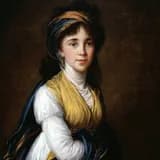
Vigée Le Brun completed her first major official oil portrait of Queen Marie Antoinette, 'Marie Antoinette in Court Dress,' securing her role as court favorite.
In 1778, Vigée Le Brun was summoned to the Palace of Versailles to paint Queen Marie Antoinette, producing the first of what would become more than thirty portraits of the queen over the following decade. The resulting canvas, Marie Antoinette in Court Dress, was sent to the queen's mother, Empress Maria Theresa of Austria, as an official state gift, and its success elevated Vigée Le Brun instantly into the highest ranks of French court painters.
This commission was pivotal: it transformed a talented but institutionally marginalized young woman painter into the queen's preferred portraitist, granting her access to royal patronage, high commission fees, and the protection of the crown against a hostile, male-dominated painters' guild. The portrait itself established the visual template — grand, formal, richly detailed in fabric and pose — that would define Vigée Le Brun's court portraiture throughout the 1780s.
Her close association with Marie Antoinette gave her extraordinary status but would later prove perilous, as the Revolution's hostility toward the queen placed Vigée Le Brun at personal risk, ultimately prompting her flight into exile in 1789. Nonetheless, the 1778 portrait remains a landmark in her career, cementing her reputation and paving the way for her eventual admission to the Académie Royale de Peinture et de Sculpture in 1783, one of only a handful of women ever admitted.