← All women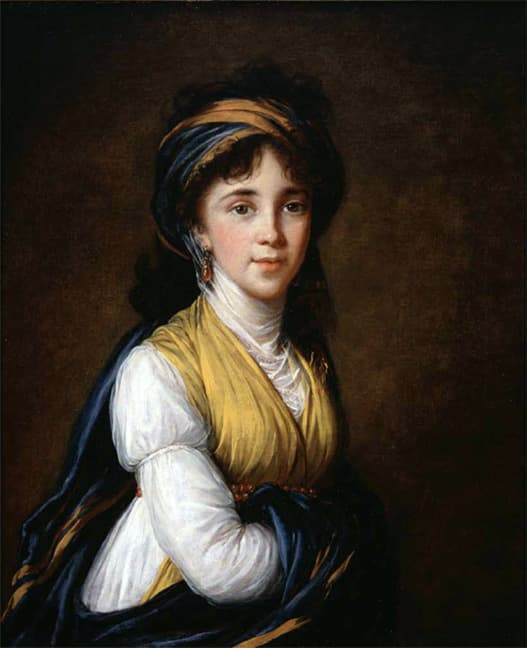
French · Arts
Elisabeth Lousie Vigee Le Burn
April 16, 1755 – March 30, 1842
Early Life and Background
Élisabeth Louise Vigée Le Brun, born Élisabeth Louise Vigée on 16 April 1755 in Paris, grew up in a milieu that combined modest social origins with close proximity to the professional art world.[4][9] Her father, Louis Vigée, was a successful portraitist and pastellist and a member of the Académie de Saint‑Luc, an important Parisian artists’ guild outside the official Royal Academy.[3][5] Her mother, Jeanne Maissin, came from a rural, working‑class background and worked as a hairdresser, bringing the family into contact with a broad spectrum of Parisian society from artisans to the aristocracy.[3][9]
Élisabeth was sent to a convent school—the Couvent de la Trinité in the Faubourg Saint‑Antoine—around the age of six or seven, where she received a basic education.[5][9] Formal artistic training at the Royal Academy was effectively closed to girls, but at home she drew incessantly in her father’s studio, copying prints and observing his sitters. Louis Vigée recognized her talent early and encouraged her to develop it; he is often described as her first and most formative teacher.[3][5][14]
In 1767, when she was about twelve, her father died suddenly, a loss that deeply affected her personally and professionally.[8][14] After his death, her mother remarried the jeweler Jacques‑François Le Sèvre, a union that Élisabeth later portrayed ambivalently in her memoirs, recalling tensions in the household and limited support for her artistic ambitions.[4][9] Largely self‑taught after her father’s death, she continued to study by copying Old Master paintings in private collections and in spaces where she could gain access, since women were barred from the life‑drawing classes considered essential for history painting.[4][13]
Despite these obstacles, by her mid‑teens she had already developed a personal style and a small clientele. The lack of academic training pushed her toward portraiture rather than large‑scale historical or mythological scenes, but portraiture also offered unique professional and social opportunities, especially within the elite circles of Ancien Régime Paris.
Career Beginnings and Development
By about fifteen, Vigée was earning income from portrait commissions, enough to help support her widowed mother and younger brother.[8][13] Working first in pastel and then in oil, she cultivated a clientele among lawyers, financiers, and minor aristocrats who valued her ability to render sitters with a flattering combination of elegance and apparent spontaneity.[12][13] Around 1774 she opened her own studio—at first unofficially—and soon attracted the attention of established artists and critics.
Because she was practicing without formal guild or academy status, the police temporarily closed her studio for operating without a license, prompting her to seek admission to the Académie de Saint‑Luc.[4][13] She was accepted in 1774 or 1775, giving her a recognized professional standing and the right to exhibit publicly under the academy’s auspices.[13] This affiliation helped her expand her network among Parisian collectors and gained her exposure in exhibitions that functioned as important showcases parallel to the official Salon.
On the personal front, she married Jean‑Baptiste‑Pierre Le Brun in 1776, an artist and prominent art dealer.[4][9][13] The marriage gave her increased access to aristocratic patrons and to Old Master paintings, which she studied closely in her husband’s stock. Jean‑Baptiste promoted her work and helped secure commissions, but the relationship was also complicated by his financial instability and gambling. Vigée Le Brun later wrote critically of his debts and their impact on her earnings, which were sometimes used to cover his obligations.[4][9]
During these formative years, she developed her characteristic approach: luminous skin tones, soft modeling, and a warm palette that combined elements of late Rococo with a growing Neoclassical clarity.[10][14] She often posed her sitters in relaxed, seemingly intimate attitudes, with half‑smiles and direct gazes, in contrast to the stiff formality of much earlier court portraiture. This combination of accessibility and refinement would eventually appeal strongly to Marie Antoinette and the high aristocracy.
Rise to Prominence and Work for Marie Antoinette
Vigée Le Brun’s career took a decisive turn in 1778, when she was summoned to Versailles to paint Queen Marie Antoinette for the first time.[5][10] The resulting work, often referred to as Marie Antoinette in Court Dress, was intended as a diplomatic portrait for Empress Maria Theresa of Austria, the queen’s mother. The painting presents Marie Antoinette in full regalia, richly dressed in silk and jewels, standing in a formal yet feminine pose.[5][10] Its success established Vigée Le Brun as the queen’s favored portraitist and paved the way for an extraordinary series of commissions.
Over the next decade, Vigée Le Brun painted Marie Antoinette approximately thirty times, in formats ranging from official state portraits to more intimate representations of the queen with her children.[8][17] One of the most famous is Marie Antoinette and Her Children (1787), which depicts the queen in a simple gown, surrounded by her offspring in a composition that evokes maternal virtue and dynastic continuity.[4][10] The painting was conceived in part as a response to growing public criticism of the queen’s perceived frivolity, and its emphasis on “maternal tenderness” aligned with broader Enlightenment discourses valorizing motherhood.[10]
Vigée Le Brun’s royal portraits helped shape the public image of Marie Antoinette both in France and abroad. She alternately highlighted the queen’s luxury and her domestic role, using costume, gesture, and setting to negotiate competing expectations of monarchy and femininity. At the same time, working so closely with the queen placed the artist in a politically exposed position: her identification with the royal family would later make her a target during the Revolution.
Her success at Versailles extended beyond the queen. She painted members of the royal family, including the king’s sisters Mesdames Adélaïde and Victoire, as well as leading courtiers and diplomats.[4][5] Each commission expanded her network and confirmed her status as one of the leading portraitists of the late Ancien Régime, rivaling male contemporaries such as Quentin de La Tour and Jean‑Baptiste Greuze.[3][10]
Académie Royale and Professional Recognition
In 1783, after considerable debate, Vigée Le Brun was admitted to the Académie Royale de Peinture et de Sculpture, the most prestigious artistic institution in France.[4][13] Officially, her membership was justified under the category of “history painter” based on a submission that included Peace Bringing Back Abundance, an allegorical work intended to demonstrate intellectual as well as technical ability.[4] Unofficially, her close association with Marie Antoinette was crucial to overcoming resistance within the academy, where some members opposed her admission on the grounds that her husband was an art dealer and that she specialized in portraiture, a genre considered inferior to history painting.[4][13]
Even with royal backing, her acceptance was controversial; the academy maintained a strict limit on the number of women, and she became one of only a handful of female members admitted in the 18th century.[4][13] Membership granted her the right to exhibit at the official Salon, where her works were widely discussed in the press. Critics often praised her virtuoso rendering of fabrics and flesh, though some also commented on what they perceived as feminine softness in her style.
Her 1783 Salon contributions included self‑portraits that presented her as both a fashionable woman and a professional artist, palette and brushes in hand.[4] These images strategically asserted her legitimacy in a field dominated by men, aligning her with the tradition of celebrated male portraitists while emphasizing her gender and social polish. The combination of artistic ambition and careful self‑fashioning would remain a hallmark of her public persona.
Exile During the French Revolution
The outbreak of the French Revolution in 1789 transformed Vigée Le Brun’s circumstances almost overnight. Because of her close ties to the royal family, she was suspected of royalist sympathies and subjected to hostile rumors and political attacks.[4][9][13] Facing increasing danger, she left France in 1789 with her young daughter, beginning an extended period of voluntary exile that would last more than a decade.[4][13]
Her first major destination was Italy, where she worked in Rome, Naples, and other cities, painting members of the local aristocracy and foreign visitors on the Grand Tour.[4][9] In Rome she was received into artistic circles and admired for her portraits that combined French elegance with an appreciation of Italian classicism. She also studied works by Raphael, Guido Reni, and other Old Masters, reinforcing the Neoclassical tendencies already present in her art.[4][14]
From Italy she traveled to Vienna, where she painted members of the Habsburg court, and then to St. Petersburg and Moscow, where she spent several highly productive years.[4][9] In Russia, she was patronized by Catherine the Great’s circle and painted numerous portraits of the imperial family and the Russian nobility.[4] Her ability to adapt her style to local tastes while maintaining a distinctive French sensibility made her highly sought‑after across Europe.
During these years of travel, Vigée Le Brun consolidated an international reputation unusual for any artist, and especially rare for a woman. She also gained financial independence, as her portrait fees were substantial and often paid in hard currency or jewelry. Meanwhile, revolutionary authorities in France listed her as an émigré, and her property was at risk, though friends and relatives helped safeguard much of her work and belongings.[4][9]
Publications and Memoirs
While abroad, Vigée Le Brun began to write travel letters describing her experiences, encounters with patrons, and observations about art and society. The first volume of these writings, later incorporated into her multivolume Souvenirs, appeared in print in the mid‑1790s.[4][9] These texts combine autobiography, anecdote, and artistic commentary, offering rare insight into the professional life of a woman painter navigating the courts of Europe.
After her eventual return to France, she expanded and revised these materials into a more comprehensive set of memoirs. The complete version of her Souvenirs was published in 1835, providing posterity with vivid portraits of figures ranging from Marie Antoinette to Catherine the Great and with reflections on the upheavals of the Revolutionary era.[4][9] The memoirs are sometimes selective and self‑protective, but they remain a crucial source for scholars studying women artists, court culture, and the transnational networks of the late 18th and early 19th centuries.
Return to France and Later Career
Vigée Le Brun returned to Paris in 1805, by which time Napoleon was Emperor and the political landscape had radically changed.[4][9] Although she remained personally attached to memories of the Ancien Régime, she adapted pragmatically to the new order, painting portraits of members of the imperial and post‑imperial elites as well as foreign visitors. Her style by this time had evolved toward a more sober Neoclassicism, with simplified backgrounds and a restrained color palette, while preserving the warmth and immediacy that had always distinguished her portraiture.[4][10]
She spent her later years dividing her time between her Paris residence and a country house at Louveciennes, near the Seine, where she maintained a celebrated salon.[3][13][16] Artists, writers, musicians, and aristocrats gathered there, making her home a small but influential cultural hub. Guests included both French and foreign figures, testifying to the lasting breadth of her network long after her court days.
Although younger generations of artists and critics began to favor new styles, her work continued to be collected and admired, particularly among conservative patrons who valued the refinement and grace of pre‑Revolutionary portraiture. She continued painting well into old age, producing self‑portraits and likenesses of friends, though at a slower pace.
Major Works and Artistic Accomplishments
Vigée Le Brun’s oeuvre is estimated at more than 600 paintings, the majority of them portraits, though she also produced some history and genre scenes.[13] Among her most significant works are:
- Marie Antoinette in Court Dress (c. 1778), her first major official portrait of the queen, which established her role at Versailles.[5][10]
- Marie Antoinette and Her Children (1787), a large allegorical family portrait intended to rehabilitate the queen’s public image by emphasizing her role as a devoted mother.[4][10]
- Self‑Portrait with Her Daughter, Julie (1786 and variants), which presents the artist in an affectionate embrace with her child, embodying the theme of “maternal tenderness” that became associated with her work.[4][10]
- Numerous portraits of European aristocrats and intellectuals, including Germaine de Staël as Corinne, Prince Henry Lubomirski, and members of the Russian imperial family.[4][9]
Her portraits are characterized by luminous skin tones; the delicate rendering of fabrics, lace, and jewelry; and a distinctive sense of animation in the sitter’s expression and gaze.[10][14] She often used slightly informal poses—a turned head, a hand to the chest, a half‑smile—to suggest intimacy and individuality, while still conforming to the conventions of aristocratic display.
Stylistically, her work bridges Rococo and Neoclassicism. Early works show the soft color harmonies and decorative elegance associated with Rococo, while later portraits adopt a more structured composition and classical simplicity in line with the taste of the 1780s and Napoleonic period.[10][11] Throughout, she exploited the expressive possibilities of costume, from simple white muslin dresses inspired by classical antiquity to elaborate silk gowns laden with political symbolism.
Awards, Honors, and Institutional Recognition
Although women faced severe institutional barriers, Vigée Le Brun achieved honors rare for a female artist of her era. Her 1783 admission to the Académie Royale de Peinture et de Sculpture placed her among a very small group of women recognized by the French state’s official art establishment.[4][13] She also became a member of foreign academies and artistic societies during her exile years, including institutions in Rome and St. Petersburg, where her portraits of local elites earned her high prestige.[4][9]
While formal awards such as modern medals or prizes were less central to 18th‑century artistic careers than institutional patronage and commissions, her repeated selection as portraitist to sovereigns and noble families across Europe functioned as a de facto system of honors. Royal and imperial commissions from France, Austria, Russia, Poland, and other courts attested to her international reputation and to the respect accorded to her technical skill and social finesse.[4][9]
Personal Life and Relationships
Vigée Le Brun’s marriage to Jean‑Baptiste‑Pierre Le Brun in 1776 was both a professional partnership and a personal challenge.[4][9][13] As an art dealer, Le Brun introduced her to collectors, arranged sales, and helped her study Old Master paintings. However, his financial speculations and gambling created instability, and she later portrayed their marriage as strained. Although they never formally divorced, they lived largely separate lives after the Revolution.[4][9]
Their only child, Jeanne Lucie Louise, known as Julie, was born in 1780.[9] Julie became both an emotional focus and a frequent model for her mother’s work, most famously in the tender self‑portraits showing mother and daughter in affectionate embrace.[4] Their relationship was intense and sometimes difficult; during their years in Russia, Julie married a Russian officer, Gaétan Bernard Nigris, a union that Vigée Le Brun viewed with ambivalence, and the two women experienced periods of estrangement before Julie’s early death in 1819.[4][9]
Beyond family, Vigée Le Brun cultivated relationships with writers, musicians, and aristocrats who moved through the salons of Paris, Rome, Vienna, and St. Petersburg. She counted among her acquaintances figures such as Germaine de Staël and other leading intellectuals of the age.[4][9] These networks were essential not only for commissions but also for the exchange of ideas about art, politics, and gender.
Legacy and Historical Impact
Élisabeth Louise Vigée Le Brun occupies a central place in the history of women’s art and in the visual culture of late 18th‑century Europe. She demonstrated that a woman could achieve a highly visible, financially successful career as a professional painter, even in the face of institutional exclusion from academic training and skepticism about women’s intellectual capacity.[4][13] Her admission to the Académie Royale, service as favored portraitist to Marie Antoinette, and international practice across several courts challenged prevailing norms about the proper sphere of female activity.
Her representations of women were particularly influential. She frequently depicted female sitters as intelligent, emotionally complex individuals rather than as mere decorative objects, and her recurrent theme of affectionate motherhood contributed to evolving Enlightenment and early Romantic conceptions of domesticity.[10] At the same time, her portraits of queens and noblewomen reveal how female power was negotiated through clothing, gesture, and setting, a subject that continues to attract feminist and cultural‑historical analysis.
After her death, Vigée Le Brun’s reputation went through periods of relative eclipse, especially as 19th‑century critics dismissed Rococo and courtly art in favor of new styles. However, she remained known in specialist circles, and her memoirs kept her name alive.[4][9] The 20th and 21st centuries saw a significant reevaluation of her work, driven by feminist art history and by major exhibitions in Europe and North America that placed her alongside male contemporaries as a key figure in the transition from Rococo to Neoclassicism.[2][8][13]
Today her paintings are held in major museums, including the Louvre, the National Gallery in London, the Metropolitan Museum of Art, and the Hermitage, and she is widely recognized as one of the most important portraitists of her time.[2][8][13] Her life and career continue to serve as a case study in the ways women artists have navigated patronage systems, political upheaval, and cultural expectations to leave a lasting impact on visual culture.
Later Life and Death
In the final decades of her life, Vigée Le Brun enjoyed a measure of stability and respect uncommon for an artist who had lived through such turbulent times. She divided her time between her Paris home on Rue Saint‑Lazare and her residence in Louveciennes, where she tended her garden, received visitors, and continued to paint select commissions and personal works.[3][13][16] Her salons attracted a mix of old aristocratic acquaintances and younger artists and writers, making her a living link to the world of pre‑Revolutionary France.
Her health gradually declined, but she remained mentally active, revising her Souvenirs and corresponding with friends and admirers.[4][9] On 30 March 1842, she died at 99 Rue Saint‑Lazare in Paris, at the age of 86.[4][5] She was buried with honors, and a commemorative monument in Louveciennes marks her resting place and her connection to the region.[11][16]
By the time of her death, she had witnessed the fall of the Bourbon monarchy, the rise and fall of Napoleon, and the restoration of the Bourbons and their successors. Her life encapsulated the dramatic political and cultural changes of her era, while her body of work offers a continuous visual record of the elite society that both shaped and was shaped by those transformations. Her death closed a long chapter in European portraiture, but it also inaugurated a legacy that would be rediscovered and celebrated by later generations of historians, curators, and artists.
Dated achievements
3 indexed.
- Apr161755Arts
Birth of Élisabeth Louise Vigée in Paris
Élisabeth Louise Vigée, future celebrated portraitist, was born in Paris, France, on 16 April 1755.
View details Élisabeth Vigée Le Brun - Wikipedia - Jan011778Arts
First major official portrait of Marie Antoinette
Vigée Le Brun completed her first major official oil portrait of Queen Marie Antoinette, 'Marie Antoinette in Court Dress,' securing her role as court favorite.