← All women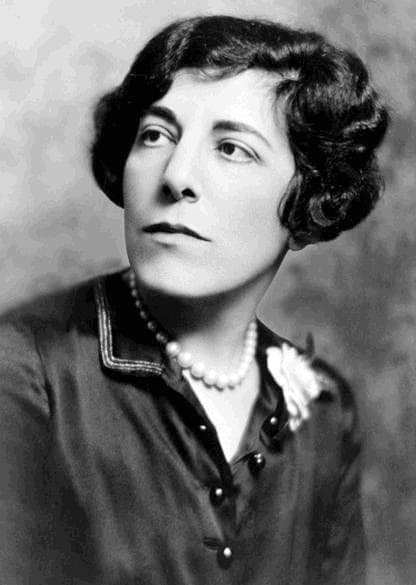
American · Literature
Edna Ferber
August 15, 1885 – April 16, 1968
Early life and background
Edna Ferber was born on 15 August 1885, in Kalamazoo, Michigan, to Jewish parents Jacob Charles Ferber, a Hungarian immigrant shopkeeper, and Julia Neumann Ferber, who had grown up in Milwaukee.[1][2][10] Some reference works and catalogues give 1887 as her birth year, but major authorities such as Encyclopædia Britannica and most national and international encyclopedias affirm 1885.[1][2][6][19] She had one sister, Fannie, and the family’s economic fortunes and health problems led them to move repeatedly during her childhood.
When Ferber was still young, the family relocated from Michigan to several Midwestern towns, including Ottumwa, Iowa, where her father ran a general store called “Ferber’s Great Fair.”[3][17] In Ottumwa and other communities, the family encountered antisemitism and social exclusion, experiences that left a deep impression on Ferber and later informed her sensitivity to outsiders and minority groups in her fiction.[3][5] After further moves, the family finally settled in Appleton, Wisconsin, when Edna was about twelve.[3]
In Appleton, Ferber attended local schools and showed an early talent for writing and performance. She briefly studied acting, and for a time imagined a theatrical career, but turned increasingly toward writing as a way to make sense of the world she observed.[2][12] Her parents’ small‑business struggles, her father’s ill health, and the family’s precarious social position as Jews in predominantly Christian communities all sharpened her awareness of economic and cultural vulnerability—central themes in her later work.[1][5]
Education and formative influences
Ferber completed high school in Appleton, but her formal education ended there. According to biographical accounts, she left school around age seventeen to help support her family, a decision that led directly to her first job in journalism.[3][5][6] She was an avid reader, absorbing both popular fiction and the classics, and she closely followed the work of contemporary American realists and humorists.
Crucially, Ferber’s Jewish upbringing and her family’s outsider status in small Midwestern towns shaped her moral and artistic outlook. Later essays and memoirs reveal that she carried strong memories of slurs, social snubs, and religious prejudice from Iowa and Wisconsin.[5][16] These experiences deepened her commitment to depicting marginalized characters—immigrants, working women, racial minorities—and to criticizing myths of American harmony that obscured inequality. Her early exposure to the world of retail trade and small‑town commerce also gave her an eye for the details of business life, which she would later translate into fictional departments stores, land offices, oil companies, and showboats.
Career beginnings in journalism
As a teenager, Ferber accepted a position at the Appleton Daily Crescent, becoming, by several accounts, the paper’s first female reporter.[3][6] She covered local news, courts, and human‑interest stories, learning how to interview, write quickly, and observe everyday people. Her work attracted notice, and after a period she moved to the Milwaukee Journal, where she continued as a reporter and feature writer.[2][4][6]
Journalism was both a practical livelihood and a training ground. It forced Ferber to move through different social environments, from factories to parlors, and to adopt the concise, vivid style that became a hallmark of her fiction. During these early years she also began writing short stories. Illness forced her to return home for a period of convalescence, and it was during such a break that she wrote her first published story, “The Homely Heroine” (1910), drawing on Appleton settings and characters.[3][4]
Although she had initially hoped to pursue acting, the combination of necessity and opportunity in the newsroom directed her firmly toward writing. Later, she would credit her newspaper years with giving her a deep knowledge of American middle‑class life and particularly of working women’s experience—a recurring focus of her most successful works.[2][6][15]
Transition to fiction and early literary success
Ferber’s breakthrough into national literary attention came with the publication of her first novel, Dawn O’Hara: The Girl Who Laughed, in 1911.[2][4][6] The book, which grew out of her illness‑induced hiatus from journalism, blended humor and sentiment in the story of a newspaperwoman in Milwaukee. It drew closely on Ferber’s own experiences in the newsroom and showcased the brisk pacing and sharp dialogue that would characterize her later fiction.
The early 1910s also saw the development of Ferber’s Emma McChesney stories, about a divorced traveling saleswoman who balances motherhood and career.[15] Originally published in magazines, these tales were later collected in volumes such as Roast Beef, Medium. They proved immensely popular, resonating with readers during a period when women were entering paid work in increasing numbers yet were rarely portrayed sympathetically as professionals and single parents in mainstream fiction. Emma McChesney’s competence and wit helped challenge conventional depictions of women as confined to domestic roles.
In 1912, Ferber moved to New York City to pursue writing full‑time.[3] There she joined a vibrant circle of journalists, novelists, theater people, and critics, many of them women. New York provided both a larger market and a more cosmopolitan milieu, even as Ferber remained deeply attached to Midwestern settings and sensibilities.
Major novels of the 1910s and early 1920s
Throughout the 1910s, Ferber consolidated her reputation with novels and story collections that often highlighted women’s work and Jewish identity. Fanny Herself, published in 1917, is frequently cited as one of the first significant American novels centered on a Jewish woman protagonist.[6][14] The book follows Fanny Brandeis, a young Jewish woman from a small Midwestern town who seeks success in Chicago’s commercial world. Many critics and scholars have read the novel as semi‑autobiographical, reflecting Ferber’s own negotiation of small‑town origins, Jewishness, and ambition.
During this period, Ferber’s work often appeared in popular magazines, bringing her income and a broad readership. She demonstrated a keen sense for topical subjects and for the rhythms of ordinary speech. Her characters included shopgirls, saleswomen, farmers, and theater people, reflecting the range of her journalistic acquaintance and her own sense of America as a nation of strivers.[2][6][15]
By the early 1920s, she was recognized as a major popular writer, known for her ability to blend entertainment with social observation, and to create strong, often unconventional female protagonists.
“So Big” and the Pulitzer Prize
Ferber’s career reached a new level with the publication of the novel So Big in 1924.[1][2] Set in the Dutch‑American farming community of High Prairie outside Chicago, the book tells the story of Selina Peake DeJong, a widowed schoolteacher who runs a farm and raises her son, nicknamed “So Big,” under difficult conditions. The narrative celebrates hard work, the nurturing of beauty and imagination, and the moral complexities of success versus integrity.
The novel became a bestseller and, on 14 April 1924, Ferber was awarded the Pulitzer Prize for Novel for So Big.[2] This recognition confirmed her as one of the foremost American authors of her generation. The prize was notable not only because relatively few women had received it at that time, but also because the book focused on a rural woman’s life and values at a moment when urban modernity often dominated literary prestige.[1][5]
So Big helped solidify Ferber’s artistic method: using extended, regionally grounded narratives to explore American ideals and contradictions. It also increased publishers’ and producers’ interest in adapting her work for stage and screen.
“Show Boat,” race, and popular culture
Building on this success, Ferber published Show Boat in 1926, a novel set on a Mississippi River showboat over several decades.[1][2] The story follows Magnolia Hawks, her parents, and fellow performers, as well as the mixed‑race character Julie, in a world shaped by Jim Crow laws and riverine culture. Ferber undertook significant research, including travel and interviews, to capture the milieu of floating theaters and Southern racial dynamics.[1]
In 1927, the novel became the basis for the Jerome Kern and Oscar Hammerstein II stage musical, which premiered on Broadway and is widely credited with helping transform the American musical into a more integrated, dramatically serious form.[1][2] Ferber’s plot, characterizations, and themes—particularly the focus on interracial relationships and the legacy of slavery—gave the musical its narrative spine.
The novel and its adaptations have been both celebrated and criticized. They brought issues of race and segregation to mass audiences, but later commentators have interrogated their stereotypes and limitations. Nonetheless, Show Boat exemplifies Ferber’s importance as a woman novelist whose work left a profound mark on mainstream American popular culture across multiple media.[1][5]
“Cimarron” and the American West
Ferber turned her attention to the American West in Cimarron, published in 1930.[1][2] The novel centers on the Oklahoma land rush of 1889 and the subsequent development of the fictional town of Osage. Through the lives of Yancey and Sabra Cravat, Ferber confronts the violence and dispossession underlying white settlement, the exploitation of oil wealth, and the tensions between idealism and opportunism.
Cimarron was quickly adapted into a film released in 1931, which won the Academy Award for Best Picture—one of the earliest such honors for a movie based on a woman’s novel.[1][2] The film’s success expanded Ferber’s already substantial influence in Hollywood, confirming the adaptability of her large‑canvas narratives to the screen.
The book is historically important for its attempt to criticize aspects of frontier myth at a time when many popular westerns glorified expansion. Ferber depicted Native Americans, African Americans, and other marginalized groups within a framework that, while reflecting some limitations of its era, questioned triumphalist narratives of American progress.[1][20]
Collaboration with George S. Kaufman and work for the stage
Alongside her novels, Ferber became a notable figure in American theater through collaborations with playwright and director George S. Kaufman. Together they wrote a series of successful plays, including Minnick (1924), The Royal Family (1927), a satire loosely based on the Barrymore acting dynasty, and Stage Door (1936), about aspiring actresses in New York.[2][6]
These plays were praised for their witty dialogue, sharp characterizations, and insider’s view of theatrical life. Several were adapted into films, further amplifying Ferber’s impact on American entertainment. Her stage work demonstrated her versatility: she could craft both sweeping historical novels and crisp contemporary comedies.
For women’s history, Ferber’s prominence as a playwright—often in a male‑dominated Broadway world—illustrates the increasing, though still contested, presence of women as creators in commercial theater during the interwar years.[2][6]
“Giant,” oil, and the Southwest
After World War II, Ferber turned to the Southwest in Giant, published in 1952.[1][2][20] The novel examines a wealthy Texas ranching family, the Benedicts, and the outsider Leslie Lynnton Benedict, whose arrival from Virginia exposes the region’s entrenched social hierarchies. Ferber explores conflicts over cattle versus oil wealth, the treatment of Mexican American workers, and evolving gender expectations.
Giant was adapted into a 1956 film directed by George Stevens, starring Rock Hudson, Elizabeth Taylor, and James Dean.[2][20] The movie was a major critical and commercial success, and remains a touchstone in cinematic depictions of Texas. Both the novel and the film challenged romanticized images of the state by highlighting racial injustice and class tensions.
Ferber’s Texas research and her willingness to address segregation and inequality during the early civil rights era underscore her ongoing commitment to social critique. Through Giant, she again used popular fiction to interrogate myths of American prosperity and exceptionalism, particularly as they played out in a region often celebrated for rugged individualism.[1][5]
“Ice Palace” and Alaska
In Ice Palace (published 1958), Ferber turned to Alaska, at that time a U.S. territory on the brink of statehood.[1][2][6] The novel traces several generations of Alaskans, juxtaposing local residents and powerful outside business interests. It examines debates over development, environmental exploitation, and governance, anticipating issues that would become central after Alaska gained statehood in 1959.
The book was adapted into a film released in 1960, bringing Ferber’s Alaskan vision to cinema audiences.[1][2] Although not as celebrated as Show Boat, Cimarron, or Giant, Ice Palace represents a culmination of her regional epic method: she used family sagas and romantic plots to illuminate large‑scale political and economic struggles.
Final work: “A Kind of Magic”
Ferber’s last book, A Kind of Magic, appeared in 1963.[6][12] More reflective and autobiographical than her earlier work, it gathered reminiscences about her career, colleagues, and travels. She looked back on her path from Midwestern reporter to Pulitzer Prize–winning novelist and Broadway collaborator, and offered candid assessments of the literary and theatrical worlds.
This final work allowed Ferber to shape her own legacy and to explain the moral and social convictions behind her fiction. It also positioned her within a broader history of 20th‑century American letters, emphasizing her interactions with other influential writers, actors, and producers.
Awards, honors, and recognition
Ferber’s most prominent contemporary honor was the Pulitzer Prize for Novel, awarded in 1925 for So Big (for work published in 1924).[1][2][6] During her lifetime she also enjoyed extraordinary commercial success: many of her books were bestsellers, and adaptations of her work brought her stories to Broadway and Hollywood.
Posthumously, Ferber has been recognized in various institutional ways. She was inducted into the Michigan Women’s Hall of Fame in 1984 for her achievements in literature, and the Chicago Literary Hall of Fame honored her in 2013 for her contributions to the city’s and nation’s letters.[8][10] In 1994, she appeared on a United States postage stamp in the Literary Arts series, symbolizing her standing as a writer of national significance.[11]
Many obituaries, including those in Wisconsin and national outlets, hailed her as one of the greatest American women novelists of her time, praising the vigor of her storytelling and her ability to translate American regional experiences into widely accessible narratives.[3][5]
Personal life
Ferber never married and had no children.[2][6][5] She lived for many years in New York City, maintaining close relationships with fellow writers, journalists, and theater figures. Her friends and collaborators included George S. Kaufman and members of the Algonquin Round Table, among others.
Though private about her intimate life, Ferber was outspoken on public issues. She identified strongly as Jewish and wrote about Jewish characters at a time when antisemitism was pervasive in American culture.[5][16] Essays and later commentaries emphasize that her Jewish convictions informed her commitment to justice and her sympathetic portrayals of outsiders and minorities.[5][16] She often voiced skepticism toward chauvinistic nationalism and empty boosterism, preferring to highlight the complexity and diversity of American society.
Ferber’s independence—financial, professional, and personal—has drawn interest from feminist scholars, who see in her life a model of an early 20th‑century woman who chose a public career and artistic vocation over marriage, and who navigated male‑dominated industries on her own terms.[5][6]
Later life and death
In her later decades, Ferber continued to write and to follow developments in theater and film, though newer literary fashions and the rise of different media meant that she was no longer at the center of American letters. Still, revivals of Show Boat and continuing interest in film adaptations of her novels kept her work visible.
Ferber died on 16 April 1968 in New York City, reportedly of stomach cancer, at the age of 82.[1][2][12][18] She had remained active into old age, and her death was widely noted in obituaries that praised her as a pioneering American woman novelist and chronicler of national life.
Legacy and historical impact
Edna Ferber’s legacy rests on several intertwined contributions to American culture. As a novelist, she produced a series of large‑scale, regionally grounded narratives—So Big, Show Boat, Cimarron, Giant, Ice Palace—that sought to capture the social and economic forces shaping the United States across different places and eras.[1][2][15] She brought the Midwest, the Mississippi River, Oklahoma, Texas, and Alaska into the center of popular fiction, insisting that stories of farmers, salespeople, entertainers, and oil workers were as worthy of attention as those of urban elites.
As a woman writer, Ferber played a significant role in expanding the representation of women in mainstream American literature. Her protagonists are often strong, industrious, and morally complex women who navigate work, family, prejudice, and changing gender expectations. The Emma McChesney stories, Fanny Herself, and Selina DeJong of So Big offered models of female agency at a time when many popular narratives confined women to romantic or domestic arcs.[5][6][15]
As a Jewish American, Ferber contributed to early 20th‑century depictions of Jewish life and identity, especially in Fanny Herself and in various short stories. Later commentators have emphasized that her Jewish convictions—her awareness of prejudice, her identification with outsiders, and her ethical concern for justice—pervade her work even when characters are not explicitly Jewish.[5][16]
Her influence also extends to theater and film. Several of her works became major Broadway plays and Hollywood films, shaping visual as well as literary understandings of American regions and history. Show Boat helped transform the musical theater genre; Cimarron and Giant became canonical films about the West and Southwest; and Ice Palace introduced many viewers to Alaska’s political and environmental issues.[1][2]
Critics and scholars have debated aspects of Ferber’s portrayals, particularly her representations of race and ethnicity, which both challenged and sometimes reproduced the stereotypes of her era. Nonetheless, contemporary assessments increasingly recognize her work as an important bridge between popular fiction and social critique, and as a key chapter in women’s literary and cultural history.
Today, Ferber’s novels continue to be read and studied, her plays are revived, and her life story—of a Jewish Midwestern woman who rose to national prominence through talent, persistence, and a keen eye for American contradictions—remains a compelling part of the history of women in literature.
Dated achievements
9 indexed.
- Aug151885Literature
Birth of Edna Ferber in Kalamazoo, Michigan
Edna Ferber was born on August 15, 1885, in Kalamazoo, Michigan, to Jacob Charles Ferber and Julia Neumann Ferber.
View details Edna Ferber - Britannica - Jan011911Literature
Publication of first novel Dawn O'Hara
Ferber's debut novel, Dawn O'Hara: The Girl Who Laughed, was published, launching her career as a nationally recognized fiction writer.