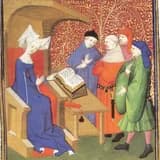
By 1410, Christine had authored over a dozen books and personally directed the illumination and production of her manuscripts, unusual control for any author.
By the early 1410s, Christine de Pizan had authored at least twelve major books and ten verse works, an extraordinarily prolific output for any medieval writer. What set her apart further was her direct, hands-on involvement in the physical production of her manuscripts.
Christine worked closely with scribes and illuminators to oversee the copying, decoration, and compilation of presentation copies of her works for royal and aristocratic patrons. This level of authorial control over book production — including choices about illustration and layout — was unusual for any medieval author, and especially rare for a woman in a profession almost entirely dominated by monastic and male scriptoria.
Some manuscripts believed to be associated with her personal workshop or supervision, such as the deluxe presentation copies made for Queen Isabeau of Bavaria and other patrons, reflect a carefully curated visual and textual program that reinforced Christine's authorial identity and her messages about women's dignity and capability.
This degree of authorial-artisanal control anticipates later developments in authorship and publishing, and scholars view it as part of Christine's broader project of self-fashioning as a serious, professional author — asserting ownership over both the content and physical form of her intellectual work in a way rarely afforded to women of her era.