← All women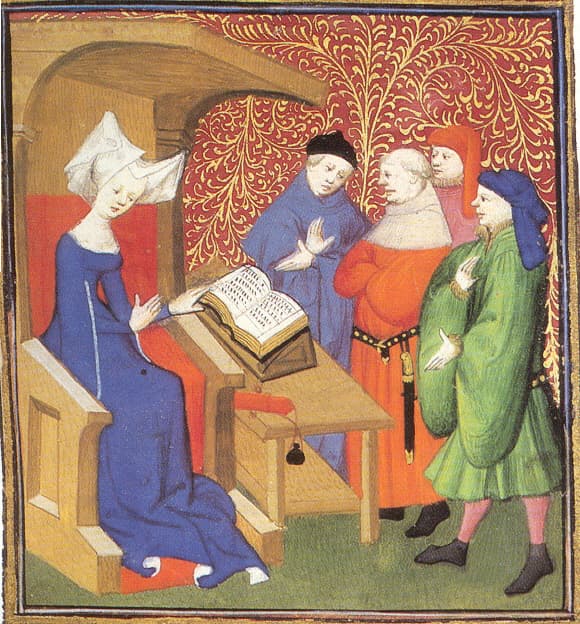
Italian, French · Literature
Chritine de Pizan
September 1, 1364 – January 1, 1430
Early Life and Background
Christine de Pizan (also spelled Pisan), born Cristina da Pizzano, came into the world in 1364 in Venice, then a powerful maritime republic and cosmopolitan trading center.[2][1][12] Her father, Tommaso di Benvenuto da Pizzano (Thomas de Pizan), was a physician, astrologer, and scholar who served as adviser in the Venetian government before being invited to the French court.[2][11][12] Her mother’s name is not recorded in the surviving sources.[15]
In the 1370s, when Christine was still a child, Tommaso accepted a position as court astrologer to King Charles V of France, and the family relocated from Venice to Paris.[2][3][4] This move placed Christine at the heart of late medieval French political and intellectual life. Charles V was known for his patronage of learning and his extensive royal library; growing up in this environment exposed Christine to books, scholars, and court ceremony at an early age.[2][9]
Unlike most girls of her time, Christine benefited from her father’s enthusiasm for education. Contemporary accounts and later scholarship agree that Tommaso encouraged his daughter’s studies, providing access to texts and instruction in Latin, philosophy, literature, and astronomy alongside vernacular reading and writing.[12][13][16] Although she did not receive university training, Christine’s education far exceeded that of most aristocratic women and furnished her with the intellectual tools she later deployed as a poet, moralist, and political thinker.
Christine’s childhood in Paris coincided with the final years of Charles V’s stable and relatively peaceful reign. The king’s death in 1380 and the accession of his son Charles VI would soon transform the political landscape, but in her early years Christine experienced the court as a space of learning, patronage, and royal prestige—conditions that formed the backdrop for her eventual career as a court writer.[2][7]
Marriage, Widowhood, and Turn to Writing
Around 1380, at about the age of fifteen, Christine married Étienne du Castel, a royal secretary in the service of the French court.[2][15][14] The marriage is generally described as affectionate and companionate rather than purely arranged; Étienne appears to have supported Christine’s intellectual interests.[15] The couple had at least three children: two sons, including Jean, and a daughter who would later become a nun at the convent of Poissy.[15][14]
For nearly a decade, Christine lived the life of a respectable court wife, occupied with household management, childrearing, and social obligations. Her literary activity during this period is not documented in detail, but later she would recall this time as one of relative security and happiness.[15] That stability collapsed in a series of losses at the end of the 1380s.
Between about 1389 and 1392, Christine’s husband Étienne died, likely of illness contracted during a plague outbreak; shortly thereafter her father Tommaso also died, and the royal patron Charles V had already passed away in 1380.[3][10][15] These deaths deprived her not only of emotional support but also of financial security and patronage networks. Christine, still in her twenties, suddenly found herself responsible for supporting her mother, children, and a niece.[3][10]
Legal disputes over her late husband’s unpaid salary and estate further complicated her situation. As a woman, her ability to plead in courts and secure her rights was constrained, but sources indicate that she engaged in lengthy litigation to recover what was owed.[3][15] Facing economic precarity, Christine first earned money by working as a scribe and copyist, producing texts for the book trade.[7][4] Over time, she began to compose original poetry for patrons, gradually discovering that her writing could provide a livelihood.
Career Beginnings and Development as a Court Writer
By the late fourteenth century, Christine had begun producing courtly love poetry and other commissioned works for members of the French royal household and aristocracy.[2][3][6] She wrote ballades, rondeaux, and other lyric forms that appealed to courtly tastes, often addressing themes of love, fortune, and moral reflection. These early compositions attracted patronage from powerful figures, including Louis of Orléans and various ducal households.[2][9]
Her breakthrough as an independent author came in the 1390s, when she increasingly crafted works that blended personal experience with broader moral and philosophical commentary. Around 1399, she composed L’Épistre au Dieu d’amours (Letter to the God of Loves), a polemical poem that directly criticized the misogyny of widely read texts such as Roman de la Rose.[13][8] In this work, she argued that male authors distorted women’s character and incited immoral behavior under the guise of courtly love. Modern scholars frequently cite the Épistre as one of the first explicitly feminist works in European literature.[13][7]
Christine’s challenge to revered authorities signaled a new, more assertive phase of her career. She participated in the celebrated “Querelle du Roman de la Rose”, a literary controversy over the value and morality of that influential poem.[2][9] In letters exchanged with prominent male intellectuals, she defended women against slander and articulated criteria for ethical literature, insisting that authors bore responsibility for the social effects of their works. This debate elevated her public profile and showed that a woman could be a serious interlocutor in humanist and theological disputes.
By around 1400, Christine was recognized as a distinguished court writer whose manuscripts circulated among the highest noble circles.[2][14] She sustained herself and her family through a combination of dedicated patronage, commissioned works, and the sale or presentation of finely produced manuscripts, thereby becoming, in the judgment of many modern scholars, the first woman in France—and perhaps in Europe—known to earn her living solely by writing.[7][9][16]
Major Works and Intellectual Contributions
Political and Historical Writings
Alongside love poetry and moral allegory, Christine developed a significant body of political and historical writing. Around 1404, she composed the Livre des fais et bonnes meurs du sage roy Charles V (The Book of the Deeds and Good Manners of the Wise King Charles V).[2][6] Commissioned by Charles V’s brother, this biography portrays the late king as an ideal Christian monarch, emphasizing his prudence, piety, patronage of learning, and just governance.
The work is notable for its careful use of sources and for Christine’s claim to eyewitness insight as someone who had lived at court during Charles’s reign.[2][9] It combines narrative with advice on rulership and thus functions both as royal memorial and political mirror-for-princes. By writing a major royal biography, Christine claimed a genre typically dominated by male clerics and chroniclers, further consolidating her authority as a historian and political thinker.
In the early fifteenth century, she also wrote the Livre des fais d’armes et de chevalerie (Book of Deeds of Arms and of Chivalry), a treatise on warfare, chivalric practice, and the laws of war.[3][9] Drawing on classical and contemporary military authorities, she discussed legitimate and illegitimate causes for war, the treatment of prisoners, and the conduct of soldiers. Legal scholars and historians of international law later cited this text as an early lay contribution to the development of the law of war and public international law in Europe.[3][9][17]
Defense of Women and Feminist Thought
Christine is best known for her works defending women and theorizing their place in history and society. After L’Épistre au Dieu d’amours, she continued to develop these themes in texts such as Le Livre de la mutacion de fortune (The Book of the Mutation of Fortune) and Le Livre de la paix (The Book of Peace).[2][3] But the culmination of her pro-woman project came in 1405 with two closely related works.
Le livre de la cité des dames (The Book of the City of Ladies), completed around 1405, constructs an allegorical city where exemplary women from history and myth are gathered and honored.[2][10] Guided by the personifications Reason, Rectitude, and Justice, Christine refutes misogynist authors point by point, assembling an encyclopedic catalogue of women famous for wisdom, courage, chastity, learning, and leadership. She insists that women’s apparent inferiority results from lack of education and unjust custom, not from nature. Modern scholars frequently describe the City of Ladies as one of the earliest histories of women in European literature and a foundational text of Western feminist thought.[2][10][18]
Shortly afterward, she composed Le livre des trois vertus (The Book of Three Virtues), also known as Le trésor de la cité des dames.[10][3] This companion piece recasts the same three allegorical ladies as teachers who provide practical guidance to women of different social classes: queens and princesses, noblewomen, bourgeois wives, widows, and working women. Christine offers detailed advice on household management, estate administration, legal prudence, and moral comportment, stressing women’s capacity for wise governance in both domestic and public spheres.
Unlike many medieval conduct books, which emphasized female submission and silence, Christine’s text acknowledges women’s economic responsibilities and encourages them to cultivate skills, virtues, and solidarity. For this reason, scholars consider it one of the first class-specific conduct manuals for women written by a woman in Europe, and a crucial bridge between abstract defense of women and their practical empowerment.[10][3]
Manuscript Production and Authorial Control
An important but sometimes overlooked dimension of Christine’s career was her active role in manuscript production. By the early 1410s, she had written at least twelve books and ten verse works and was directly involved in organizing the production of illuminated manuscripts of her writings.[10][3]
She collaborated with teams of scribes and illuminators to create carefully corrected, lavishly illustrated codices, some of which survive as presentation copies to royal and aristocratic patrons. These manuscripts often contain author portraits depicting Christine at her writing desk, visually asserting her identity as a professional author. Through such projects, she exercised an unusual degree of control over the textual and visual representation of her works, effectively acting as her own editor and publisher within the constraints of the medieval book trade.[10][3]
This level of authorial oversight was rare for any medieval writer and particularly exceptional for a woman excluded from guild structures. It ensured that her texts circulated in authoritative forms and contributed to their preservation. Modern digital initiatives, such as the Christine de Pizan Digital Scriptorium, highlight these manuscripts as key evidence of her self-fashioning and her sophisticated engagement with the technologies of book-making.[10]
"Le Ditié de Jehanne d’Arc" and Late Work
After years of relative silence during the height of civil strife in France, Christine re-emerged around 1429 with her final known work, Le Ditié de Jehanne d’Arc (The Tale of Joan of Arc).[2][18] Written from the convent of Poissy, the poem celebrates the astonishing military successes of Joan of Arc, who had recently lifted the siege of Orléans and escorted Charles VII to his coronation at Reims.
In the Ditié, Christine expresses joy and wonder at Joan’s achievements, interpreting them as a sign of divine favor toward France and as a decisive rebuke to misogynist claims about women’s incapacity for public action. She emphasizes Joan’s virginity, piety, and courage, positioning her as both a religious and national heroine. Scholars often note that this poem is the only contemporary literary work to praise Joan of Arc during her lifetime and the first to articulate her enduring image as a divinely inspired savior of France.[2][18]
The text also reflects back on Christine’s own lifelong defense of women, implicitly suggesting that Joan’s deeds confirm arguments she had advanced decades earlier in the City of Ladies. As such, the Ditié serves as a coda to Christine’s oeuvre, linking the intellectual and the military, the pen and the sword, in a shared project of reevaluating women’s capabilities.
Later Life and Death
The early fifteenth century brought intensified turmoil to France. The mental illness of Charles VI, ongoing phases of the Hundred Years’ War, and civil conflict between the Burgundian and Armagnac factions destabilized the kingdom and made Paris a contested, often violent space. In this context, Christine’s opportunities as a court writer diminished.
By about 1418, as Burgundian forces took control of Paris, Christine appears to have retired to the Dominican convent at Poissy, where her daughter was a nun.[2][3] Poissy enjoyed royal patronage and relative security, making it a logical refuge. There Christine seems to have withdrawn from active public life, though she continued to read and reflect, and eventually composed the Ditié de Jehanne d’Arc there.[2][18]
Christine de Pizan died circa 1430 at Poissy.[2][1][3] The exact date and circumstances of her death are unknown, and sources vary slightly, with some suggesting 1431 or a little later.[15][17] No contemporary tomb or epitaph survives, and her burial place within the convent grounds has not been identified. Nonetheless, her manuscripts, many of which remained in aristocratic collections, ensured that her voice continued to be heard long after her death.
Personal Life and Relationships
Although much of what is known about Christine comes from her writings rather than external documentation, those texts offer glimpses into her personal life. She frequently mentions her emotional attachment to her husband Étienne and the pain of his loss, portraying their marriage as loving and mutually respectful.[15] Her grief at his death and her sense of responsibility for their children and her widowed mother recur as themes in her poetry.
Christine had at least two sons and one daughter. Her eldest son, Jean, pursued a career that took him away from France, possibly into diplomatic or military service, while her daughter entered religious life at Poissy.[15][14] Christine’s concern for their education and moral formation appears in various didactic passages, where she reflects on motherhood, widowhood, and the difficulties of guiding children in turbulent times.
She cultivated relationships with a wide range of patrons and correspondents, including members of the French royal family, high-ranking nobles, and fellow intellectuals. These connections not only provided financial support but also created a network through which her manuscripts circulated. Her participation in the querelle du Roman de la Rose brought her into dialogue with prominent male scholars such as Jean Gerson, demonstrating that she was regarded as a serious moral and literary authority.[2][9]
Awards, Honors, and Posthumous Recognition
In Christine’s own lifetime, formal "awards" in the modern sense did not exist, but the patronage of kings, princes, and high nobles served as a mark of distinction. Her commissions to write the biography of Charles V and to produce political and moral treatises attest to the esteem in which she was held at court.[2][6]
In later centuries, Christine’s reputation fluctuated. Some of her works continued to be copied and read, but she did not maintain the same level of canonical status as major male authors of her era. The rise of feminist scholarship and women’s history in the twentieth century, however, rekindled interest in her writings. She came to be celebrated as a precursor of modern feminism and a vital witness to women’s experiences in the later Middle Ages.[2][10][18]
A striking example of her modern recognition occurred in 1974, when artist Judy Chicago included Christine de Pizan among the 39 women honored with individualized place settings in the feminist installation The Dinner Party, now housed at the Brooklyn Museum.[19] The artwork’s interpretive materials explicitly identify Christine as the first woman in France, and possibly in Europe, to earn her living through writing, underscoring her importance in the history of women’s professional authorship.[19]
Numerous contemporary institutions and projects—such as digital manuscript collections, university seminars, and public-history websites—highlight her life and works as integral to understanding medieval intellectual culture and the long history of women’s rights discourse.[4][7][10][12]
Legacy and Historical Impact
Christine de Pizan’s legacy is multifaceted, spanning literature, political thought, legal theory, and feminist philosophy. She is widely regarded as one of Europe’s first professional women writers and as the first woman of letters in France.[7][9][16] Her career demonstrates that a laywoman could support herself and her dependents through intellectual labor within a courtly and commercial framework.
In terms of ideas, Christine stands at the beginning of what later scholars call the "querelle des femmes", the early modern debate over women’s nature and status. Her works, especially The Book of the City of Ladies and The Book of Three Virtues, offer a sustained, systematic defense of women’s moral and intellectual equality, critique the misogyny of authoritative texts, and propose practical measures for women’s education and self-governance.[2][3][10] For these reasons, she is often described as a precursor of Western feminist thought.[10][18]
Her political and military treatises also left a mark. The Livre des fais et bonnes meurs du sage roy Charles V contributed to the tradition of mirror-for-princes literature and provided a nuanced portrait of kingship that influenced later French political culture.[2][6] The Livre des fais d’armes et de chevalerie introduced lay perspectives into discussions of the laws of war, and scholars of international law have pointed to her as an early, though often overlooked, voice in the development of norms governing armed conflict.[3][9][17]
Modern historians and literary scholars emphasize Christine’s sophisticated understanding of how texts, images, and authority interact. Her participation in manuscript design, her use of allegorical personifications, and her engagement with classical and biblical sources all demonstrate an acute awareness of the power of representation. She interrogated not only the content of misogynist traditions but also the cultural mechanisms by which those traditions maintained their authority.
Today, Christine de Pizan is studied across disciplines—from medieval studies and comparative literature to gender studies, legal history, and political theory. Her life story continues to inspire as an example of resilience: a widowed mother who transformed personal adversity into a groundbreaking intellectual career, and a woman who carved out a voice in a world that largely denied women public authority. Her works remain central texts for understanding the longue durée of debates about women’s rights, education, and participation in public life.
Dated achievements
10 indexed.
- Sep011364Science
Birth in Venice
Christine de Pizan was born in Venice, Italy, on 1 September 1364, later becoming Europe's first known professional woman writer.
View details Christine de Pizan - Wikipedia - Jan011399Science
Composition of L'Épistre au Dieu d'amours, an early feminist text
Christine composed 'L'Épistre au Dieu d'amours' in 1399, considered one of the first explicitly feminist literary works in Europe.