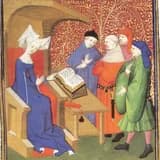
Around 1410, Christine completed an influential treatise on warfare and military tactics later translated across Europe.
Around 1410, Christine de Pizan completed Le Livre des fais d'armes et de chevalerie (The Book of Feats of Arms and Chivalry), a comprehensive treatise addressing military strategy, the laws of war, and the ethical conduct expected of knights and commanders.
Remarkably for a woman writer in the fifteenth century, Christine drew on classical military authorities such as Vegetius, alongside contemporary chivalric codes, to produce a text that was taken seriously by military and political leaders of her time. The book covered practical matters including troop organization, siege tactics, and the treatment of prisoners, blending technical military knowledge with moral and legal reasoning about just warfare.
The treatise's significance lies partly in the fact that a woman, excluded from formal combat and military training, nonetheless produced a work authoritative enough to be translated into English by William Caxton in 1489 and printed for circulation among English readers, and to influence military thought for generations. This made her one of the few women in medieval Europe to author a text in the traditionally male domain of martial theory.
Its lasting influence demonstrates Christine's extraordinary intellectual range, extending far beyond the more commonly cited feminist and courtly works, and reflects the practical urgency of writing about warfare during the ongoing Hundred Years' War between France and England.