← All women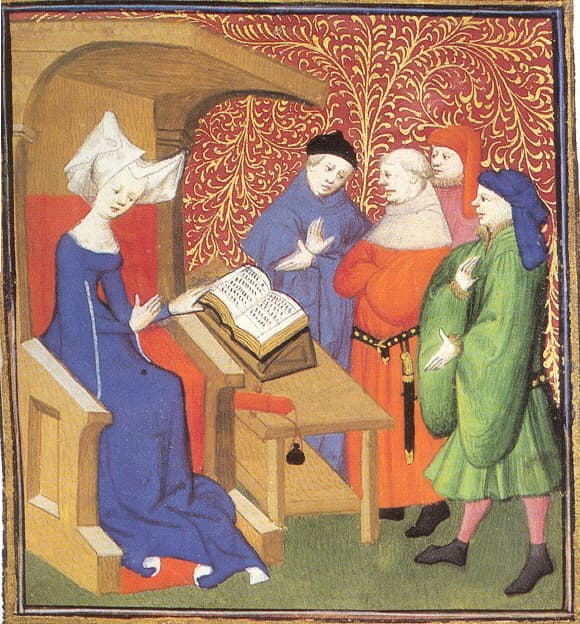
Italian, French · Literature · Politics
Christine De Pizan
September 11, 1364 – 1430
Early Life and Background
Christine de Pizan (also spelled de Pisan), born Cristina da Pizzano, came into the world in Venice in 1364, in the prosperous and cosmopolitan Republic of Venice. Her father, Tommaso di Benvenuto da Pizzano, was a distinguished physician and astrologer, noted for his scholarly work and service to high-ranking patrons.[2][12][19] His reputation led to positions in northern Italian courts and later in France, where he served as court astrologer to King Charles V.
Around 1368, when Christine was still a child, the family moved from Italy to Paris, following Tommaso’s appointment at the French royal court.[2][12][20] This relocation placed Christine at the heart of one of Europe’s major political and cultural centers. At a time when girls were rarely educated beyond basic domestic skills, she grew up amidst royal libraries, scholars, clerics, and administrators.
Sources emphasize that Christine’s intellectual formation was unusual for a woman of her era. Encouraged by her father, she had access to books and learned conversation, absorbing Latin moral and historical texts in translation and the traditions of French courtly poetry.[5][16][18] Though she did not undergo a formal university education, she became literate in Middle French and familiar with philosophical and theological ideas. This exposure would later underpin her confidence in entering literary and political debates dominated by men.
Christine’s mother remains largely unknown in the historical record, but the family’s position at court meant that Christine experienced a blend of Italian humanist influence and French chivalric culture. This dual heritage—Italian birth and French upbringing—shaped her perspective, allowing her to draw on diverse intellectual traditions while writing exclusively in French.[2][13]
Marriage, Widowhood, and Turn to Writing
In 1380, at about fifteen years of age, Christine married Étienne du Castel, a royal secretary in the service of Charles V and later Charles VI.[2][12][13] The marriage appears to have been affectionate and supportive; sources portray Étienne as recognizing and respecting Christine’s intelligence.[6][12] The couple had three children, usually identified as two sons, including the eldest Jean, and a daughter.[10][12]
During the 1380s, Christine lived within the orbit of the French royal court, fulfilling expected roles as wife and mother while observing first-hand the workings of monarchy, bureaucracy, and patronage.[2][11] This experience contributed to the practical political insight evident in her later treatises.
Around 1389–1390, tragedy struck when Étienne du Castel died, leaving Christine a young widow with dependent children and aging relatives.[3][12][13] Soon thereafter, her father also died, and the family became embroiled in legal disputes over unpaid salaries and property.[12][16] These losses placed her in a precarious economic position. Without the typical recourse of remarriage or monastic life, she faced the challenge of finding a means of support.
Christine responded by turning decisively to writing as a livelihood. She began composing poetry around 1390, initially producing ballads that reflected personal grief, the vicissitudes of fortune, and moral reflection.[12][16] Through perseverance and talent, she attracted the attention of patrons at court, who commissioned and rewarded her work. Over time, she achieved what later scholars recognize as a historic milestone: she became one of the first known women in Europe to earn her living solely by writing.[3][8][16][19]
Career Beginnings: Courtly Poetry and Moral Writings
Christine’s early professional phase was marked by collections of lyric poetry. By 1393, she had completed and circulated a set often referred to as One Hundred Ballads, which helped establish her as a court poet among the French nobility.[15] These poems, written in the tradition of courtly love, explore themes of desire, loyalty, and suffering, but they also exhibit Christine’s distinctive moral sensibility and her interest in the instability of fortune.
Her success as a poet led to commissions and gifts from powerful patrons, including members of the royal family and high-ranking nobles like the dukes of Burgundy and Berry.[2][11] In a literary culture that prized eloquence and moral reflection, Christine’s work was valued for both its stylistic refinement and its ethical content.
In the mid-1390s, she expanded beyond love poetry into more explicitly didactic writing. A work often referred to as Moral Lessons, composed around 1395, contributed to her reputation as a moral and political writer.[16][19] These texts reveal her sustained engagement with the philosophical tradition of the Speculum principis (mirror for princes) and the broader medieval concern with virtuous conduct.
Christine’s emerging authorial persona was complex: she was simultaneously a grieving widow, a devoted mother, a professional poet, and a moralist. Her writings from this period lay the groundwork for the more overtly philosophical and proto-feminist works that would follow.
Engagement in Literary Controversy: Roman de la Rose Debate
Toward the turn of the century, Christine entered one of the era’s most significant literary debates surrounding the long allegorical poem Roman de la Rose. This widely read work, completed in the 13th century, offered a sophisticated treatment of love but also included satirical and often misogynistic portrayals of women.
Around 1399, Christine composed L'Épistre au Dieu d’amours (Letter of the God of Love), in which she criticizes the way contemporary writers use the figure of Cupid and courtly conventions to slander women’s reputation and encourage immoral behavior.[16][19] She argues that such texts unjustly depict women as deceitful and licentious, thereby harming both individual women and social order.
Between 1401 and 1403, Christine engaged in an exchange of letters and treatises with prominent male scholars and officials, defending her position against supporters of Roman de la Rose.[13][19] She insisted that authors bear responsibility for the moral effects of their works and that misogynistic literature contributes to the oppression of women. This controversy drew wide attention and firmly established her as a serious intellectual figure.
By 1402, Christine produced Dit de la Rose (The Tale of the Rose), a more extended critique of Roman de la Rose.[3][6][15] In this poem, she systematically responds to specific passages and characters, reinforcing her claim that literary tradition must be reformed to honor, rather than degrade, women.
Christine’s participation in the Roman de la Rose debate was historically significant: she was one of the very few women in medieval Europe known to have taken a public, polemical stance on a major literary work. Her interventions introduced a gendered perspective into discussions of authorship and moral responsibility that would resonate in later centuries.
Major Works and Intellectual Development
L’Épistre d’Othéa à Hector and Early Allegorical Prose
Around 1400, Christine completed L’Épistre d’Othéa à Hector (The Epistle of Othea to Hector).[4][19] This didactic work presents a fictional letter from the goddess Othea to the Trojan hero Hector, offering moral lessons through a series of mythological exempla. Each episode is accompanied by glosses that explain its ethical and theological significance.
The text reflects Christine’s capacity to synthesize classical mythology, Christian doctrine, and contemporary concerns into an accessible allegorical form. It also illustrates her skill in adapting learned material for a lay audience, including noble readers who may not have direct access to Latin scholarship.
1403: Expanding Genres
In 1403, Christine produced several important works, including Le Chemin de long estude (The Path of Long Study), Livre de la mutation de fortune (The Book of the Transformation of Fortune), and La Pastoure.[4][9][19] These texts explore themes of knowledge, fortune, and social justice through allegory and narrative.
Le Chemin de long estude follows Christine on a visionary journey guided by Lady Intelligence, where she seeks wisdom about the governance of the world. Livre de la mutation de fortune reflects on how fortune alters individuals’ circumstances, drawing heavily on Christine’s personal experience of sudden widowhood and economic crisis. La Pastoure presents the story of a shepherdess involved in political prophecy, blending social commentary with visionary elements.
Collectively, these works demonstrate Christine’s move beyond lyric into extended allegorical prose and her deepening interest in political and moral philosophy.
The Book of the Deeds and Good Manners of the Wise King Charles V
In 1404, Christine was commissioned by Philip the Bold, Duke of Burgundy, to write a biography of his deceased brother, King Charles V of France.[11] The result was Le Livre des fais et bonnes meurs du sage roy Charles V (The Book of the Deeds and Good Manners of the Wise King Charles V).[4][8][19]
This work is both a historical chronicle and a mirror for princes, praising Charles V’s prudence, piety, and administrative skill while offering lessons for future rulers. It draws on official documents, eyewitness testimony, and Christine’s own recollections of court life. In portraying Charles as a model king, she also implicitly comments on the shortcomings of his successor, Charles VI.
The biography stands out as one of the earliest royal lives written by a woman and illustrates Christine’s capacity to combine historical method with moral and political reflection.
The Book of the City of Ladies and The Treasure of the City of Ladies
By 1405, Christine reached the pinnacle of her feminist-leaning project with Le Livre de la cité des dames (The Book of the City of Ladies) and its companion, Le Livre des trois vertus (The Treasure of the City of Ladies or Book of the Three Virtues).[3][8][16][19]
In The Book of the City of Ladies, Christine constructs an allegorical city populated by exemplary women drawn from history, myth, and scripture—ranging from biblical heroines and saints to queens, scholars, and warriors.[2][8] Guided by Reason, Rectitude, and Justice, she refutes misogynistic claims circulated by male writers and argues that women are capable of virtue and wisdom equal to men when given opportunity and education.
The Treasure of the City of Ladies translates these principles into practical counsel. Addressing women of varied ranks—princesses, noblewomen, bourgeois wives, widows, and servants—Christine offers detailed advice on managing households, navigating marriage and court life, and cultivating moral virtues.[3][16][19] She urges women to act with prudence and restraint, but also recognizes their potential influence within families and communities.
These two works are widely regarded as foundational texts in the history of feminist thought. They provide one of the earliest comprehensive defenses of women’s capabilities and an agenda for their prudent self-governance within existing social structures. Modern scholars often identify them as among the first explicitly feminist writings in European literature.[2][8][19]
Political Theory: The Book of the Body Politic and The Book of Peace
Christine continued her engagement with political philosophy in the following years. In 1407, she wrote Livre du corps de policie (The Book of the Body Politic).[4][9][19] This treatise uses the metaphor of the body to describe the polity, discussing the duties of princes (the head), knights (the arms), and common people (the legs and feet). She outlines principles of just rule, social harmony, and moral responsibility.
By 1413, amid intensifying civil conflict and English aggression, she completed Livre de paix (The Book of Peace).[4][16][19] Addressed to the French royal house, the work laments the suffering caused by war and factionalism and counsels rulers to seek peace through prudence, fairness, and care for the common good. Christine draws on biblical, classical, and medieval authorities to argue that peace is both the highest political goal and a moral obligation.
These texts place Christine firmly within the tradition of medieval political theory. As a woman offering extended reflections on governance, justice, and the structure of society, she occupies a unique position, and her works show that female authors could participate meaningfully in debates about statecraft.
Late Spiritual and Contemplative Works
In 1418, Christine composed Epistre de la prison de vie humaine (Letter of the Prison of Human Life).[4][19] This contemplative work reflects on human suffering, the instability of earthly existence, and the consolation offered by faith. Written during the chaos of the Hundred Years’ War and the internal French civil strife, it reveals Christine’s spiritual depth and her attempt to find meaning amid political and personal hardship.
The work anticipates her partial withdrawal from active courtly engagement and heralds her move towards a quieter, more reflective phase of life.
The Book of Feats of Arms and Chivalry
Around 1410, Christine completed Le livre de fais d’armes et de chevallerie (The Book of Feats of Arms and Chivalry), a comprehensive treatise on warfare and chivalric conduct.[9][17]
Drawing heavily on the Roman military writer Vegetius as well as current practices, Christine discusses topics such as recruiting and training soldiers, organizing armies, conducting sieges, and the laws governing war. She treats warfare both as a technical art and as a moral endeavor, insisting on discipline, justice, and the protection of civilians where possible.
The book was widely copied and later translated into English, influencing military and political thought beyond France.[9][17] It stands as a remarkable example of a woman author addressing a subject closely associated with masculine power and royal authority.
Personal Life and Later Years
Christine’s personal life, though less documented than her writings, remained intertwined with her work. She was a devoted mother, arranging education and careers for her sons, including her eldest Jean, and supporting a daughter who later entered religious life.[10][12]
As political instability grew in France—marked by the mental illness of Charles VI, the Armagnac–Burgundian civil war, and English advances—Christine’s situation became increasingly precarious. Around the late 1410s or early 1420s, she retired to the convent of Poissy, where her daughter had become a nun.[1][8][12] Poissy, a prestigious royal foundation, offered relative safety and spiritual refuge, though Christine remained attentive to national affairs.
During her time at Poissy, she wrote fewer works, focusing on contemplative themes and, eventually, a single major reemergence into public discourse: her poem on Joan of Arc.
Joan of Arc and Christine’s Final Work
In 1429, news reached Poissy that a young woman, Joan of Arc, had led French forces to lift the siege of Orléans and had escorted the Dauphin Charles to Reims for his coronation as King Charles VII. These events, occurring after years of French military setbacks, had profound symbolic and strategic significance.
Moved by Joan’s achievements, Christine broke her long literary silence to compose Ditié de Jehanne d’Arc (The Tale or Ditty of Joan of Arc).[3][12][15] Completed in 1429, this poem is the first known contemporary literary work to celebrate Joan of Arc and the only one written while Joan was still alive.[3][15]
In the poem, Christine praises Joan as a divinely inspired savior of France, marvels at her military prowess, and interprets her victories as evidence that God favors the French cause. Importantly, Christine emphasizes that Joan’s success proves women’s capacity for courage and leadership, directly reinforcing the arguments she had made decades earlier in The Book of the City of Ladies.
Modern scholars view Ditié de Jehanne d’Arc as Christine’s last known work, closing her literary career.[3][12][15] The poem is crucial for understanding contemporary perceptions of Joan and for highlighting how Christine saw Joan as the embodiment of the virtues she had long defended in women.
Awards, Honors, and Recognition
Medieval writers did not receive formal literary awards in the modern sense, but Christine’s career was marked by patronage and commissions that functioned as recognition of her talent and status.
She enjoyed the support of high-ranking patrons, including King Charles VI, members of the royal family, and powerful dukes such as Louis of Orléans and Philip the Bold of Burgundy.[2][11] The commission to write the biography of Charles V in 1404 by the Duke of Burgundy signaled significant trust in her historical judgment and literary skill.[11]
Over time, Christine’s works circulated widely and were copied in lavishly illuminated manuscripts, some produced under her supervision, indicating the esteem in which they were held.[5][18] Though she did not receive formal honors like titles, the breadth and prominence of her patronage effectively constituted recognition of her as a leading intellectual and literary figure of her day.
Death
The exact circumstances of Christine de Pizan’s death are not precisely recorded. Most sources place her death at the convent of Poissy around 1430.[1][2][3][19] Some accounts suggest she died slightly later, between 1430 and 1432 or even up to 1434, but the consensus centers on circa 1430.[5][12]
Her death marked the end of a remarkable life that spanned the reigns of Charles V, Charles VI, and the early years of Charles VII, as well as the height of the Hundred Years’ War. She did not live to witness Joan of Arc’s trial and execution, leaving her final poem as an unqualified celebration of Joan’s triumphs.
Legacy and Historical Impact
Christine de Pizan’s legacy is multifaceted and enduring. She is widely regarded as one of the first professional women writers in Europe, and the first woman of letters in France known to have supported herself and her family primarily through her literary work.[3][8][19]
Her corpus—comprising over forty-one works produced between roughly 1399 and 1429—spans poetry, biography, political theory, moral treatises, allegory, and proto-feminist defense.[13][16] She addressed themes ranging from love and fortune to warfare, governance, and women’s status, consistently insisting on the moral responsibilities of rulers and authors.
In the history of feminist thought, Christine occupies a pivotal place. Works such as The Book of the City of Ladies and The Treasure of the City of Ladies articulate an early, systematic defense of women’s intellectual and moral capacities and propose practical strategies for women’s self-fashioning and survival within patriarchal structures.[2][8][19] She challenged misogynistic texts, argued that women’s supposed inferiority stemmed from lack of education and biased representation, and offered alternative narratives that honored women’s achievements.
Her political writings—The Book of the Body Politic, The Book of the Deeds and Good Manners of the Wise King Charles V, and The Book of Peace—contribute significantly to medieval political theory, presenting a vision of just governance grounded in virtue, service to the common good, and peace.[4][9][11][19] As a woman advising princes and reflecting on war and statecraft, she expanded the perceived scope of female intellectual authority.
Modern scholarship has increasingly recognized Christine’s importance. She has been the subject of extensive academic study, digital manuscript projects, and exhibitions. Institutions such as the Brooklyn Museum include her in installations highlighting historic women, and philosophical directories list her among early women philosophers and political thinkers.[10][19]
Her writings, long available only in manuscript, have been edited and translated into modern languages, allowing contemporary readers to appreciate the richness of her thought and style. Within women’s history, she stands as a key figure who demonstrates that women in the Middle Ages were not merely passive subjects of male discourse but also active creators of intellectual traditions.
Christine de Pizan’s life and works continue to inspire scholars, writers, and activists, offering an early, eloquent voice in the ongoing struggle to recognize women’s equality and contributions in literature, philosophy, and public life.
Dated achievements
11 indexed.
- Sep111364Literature
Birth of Christine de Pizan in Venice
Christine de Pizan was born in Venice, Italy, later becoming France's first professional woman of letters.
View details Directory of Women Philosophers: Christine de Pizan - Jan011393