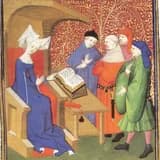
By 1429, Christine had produced her last known composition, The Tale of Joan of Arc, before retiring from public literary life.
By 1429, Christine de Pizan had completed what is generally regarded as her final literary work, the Ditié de Jehanne d'Arc, closing out a professional writing career that had spanned roughly thirty-six years since the completion of her One Hundred Ballads around 1393.
This final composition is notable not only for its subject matter — Joan of Arc's astonishing military triumphs — but for representing the capstone of Christine's decades-long body of work defending and celebrating female achievement and virtue. Having spent years in retirement at the convent of Poissy, likely prompted by the turmoil of war and possibly the presence of her own daughter as a nun there, Christine emerged from relative literary silence to respond to the electrifying news of Joan's victories.
Her decision to end her literary career with a tribute to another extraordinary woman is often read by scholars as a fitting and deliberate conclusion to a lifetime devoted to demonstrating women's capacity for greatness. No further works are attributed to her after this point, and she is believed to have died at Poissy roughly a year later.
This marks the end of one of the most prolific and pioneering literary careers of any woman in medieval Europe, spanning poetry, political treatises, biography, military theory, and proto-feminist philosophy.