← All women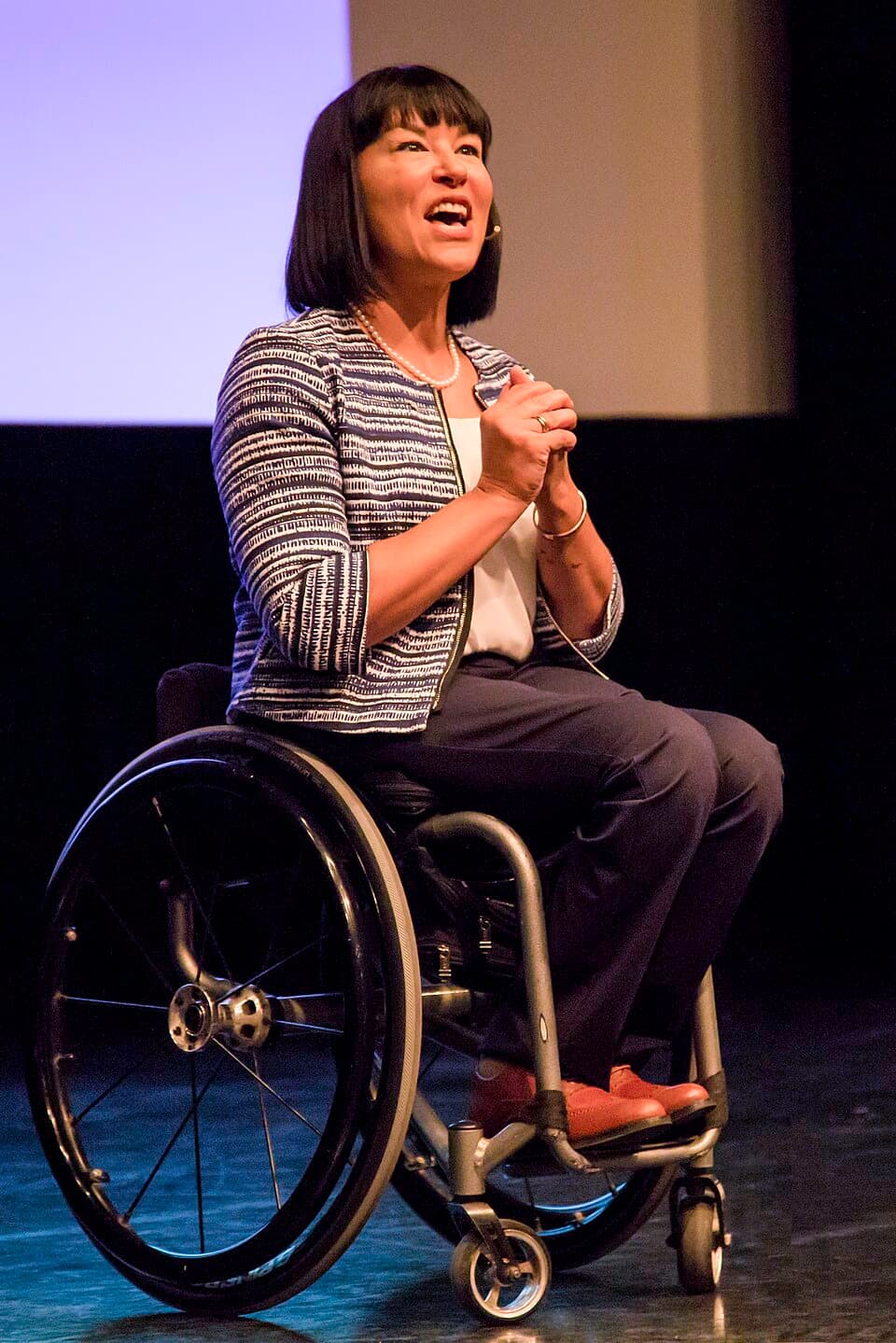
Canadian · Sports · Activism
Chantal Petitclerc
December 15, 1969 – present
Early Life and Background
Chantal Petitclerc was born on 15 December 1969 in Saint‑Marc‑des‑Carrières, Quebec, a small rural community located about 75 kilometres southwest of Quebec City.[1][9][10] She grew up in a Francophone family; her father worked as a building contractor and her mother was a homemaker, and the household did not have particular ties to elite sport.[10] Her early life in rural Quebec would later inform her perspective as both an athlete and a senator representing her home province.
At the age of thirteen, Petitclerc’s life changed dramatically. While playing with friends on a farm near her hometown, a barn door fell on her, causing severe injury to her spinal column and leaving her paraplegic from the waist down.[2][3][4][6] She spent several months in hospital and rehabilitation, adapting to life using a wheelchair. The accident occurred at a time when support systems and visibility for people with disabilities in Canada were still limited, and Paralympic sport had not yet gained broad mainstream recognition.
A key formative influence was a high school physical education teacher who encouraged her to take up swimming as a way to regain confidence and physical strength.[6][8] Through sport she began to rebuild her sense of identity and agency. Around age 17–18, she was introduced to wheelchair racing and participated in her first wheelchair race, discovering a discipline that matched her competitive spirit and resilience.[3][4][5][6] This discovery laid the groundwork for a career that would eventually span five Paralympic Games and bring her international fame.
In addition to her growing athletic commitments, Petitclerc pursued higher education. She undertook studies in history at the University of Alberta
Petitclerc’s competitive career in wheelchair athletics began in her late teens, following her rehabilitation from the accident. She quickly progressed from local races to provincial and national competitions, and Canada’s developing Paralympic program provided opportunities for her to train and compete internationally.[3][5] Her first major global milestone came at the Barcelona 1992 Paralympic Games, her Paralympic debut. On 3 September 1992, she won bronze medals in the women’s 200m 2–3 and 800m 2–3 wheelchair racing events.[1][12] These podium finishes marked the beginning of a Paralympic medal tally that would eventually reach 21. Barcelona also demonstrated to Canadian sporting authorities that a young woman from rural Quebec could compete successfully on the world stage, strengthening support for women’s para‑sport. Petitclerc’s development continued through the mid‑1990s. At the Atlanta 1996 Paralympic Games, she significantly expanded her medal collection. On 19 August 1996 she won gold in the women’s 100m T54 and 200m T54, and silver in the 400m, 800m and 1500m T54.[1] This performance established her as one of the leading wheelchair racers in the world and demonstrated her versatility across sprint and middle‑distance events. She also competed at the Sydney 2000 Paralympic Games, adding further medals and experience, although the exact events and dates are less frequently emphasized than her major sweeps in Athens and Beijing.[1][9][12] During this period she broke numerous Canadian and world records, refining her technique, equipment setup and race strategy in the T54 classification, which includes athletes with spinal cord injuries and similar impairments who compete in seated racing chairs. Petitclerc’s career benefited from a growing infrastructure for Paralympic sport in Canada. She trained with high‑performance coaches, gained support from sponsors, and became associated with organizations promoting disability sport. As her results improved, she began to be seen not only as a Paralympian but as a leading figure in Canadian athletics more broadly.[3][5][11] Over the course of her career, Chantal Petitclerc became one of the most decorated wheelchair racers in history, amassing 21 Paralympic medals—14 gold, five silver and two bronze—across five Games (Barcelona 1992, Atlanta 1996, Sydney 2000, Athens 2004, and Beijing 2008).[1][2][3][12] She also broke at least 26 world records in T54 track events ranging from 100m to 1500m.[3][4][8] Petitclerc’s performance at the Athens 2004 Paralympic Games is widely regarded as one of the most dominant in Paralympic track history. On 26 August 2004 she completed a remarkable sweep, winning five gold medals in the women’s 100m, 200m, 400m, 800m and 1500m wheelchair races.[1][6][12] Her victories required mastery of explosive sprinting, sustained speed, and tactical positioning across varied distances. At Athens she also broke multiple world and Paralympic records, underscoring not only her tactical brilliance but also her raw speed and endurance.[6] This sweep cemented her status as Canada’s most accomplished Paralympian and contributed to her reputation as one of the most decorated female track athletes in history.[3][6] Petitclerc also played a historic role at the Commonwealth Games. At the Manchester 2002 Commonwealth Games, she won gold in the women’s 800m wheelchair race, which was the first wheelchair event whose medals counted towards a country’s official Commonwealth Games medal tally.[3][6][9] Prior to this, wheelchair races had been treated as exhibition events, with results not included in national totals. Her victory thus marked a breakthrough in the recognition of para‑sport within the Commonwealth sporting system, and she became an integral part of Canada’s medal history. At the Melbourne 2006 Commonwealth Games, Petitclerc was chosen as Canada’s flag bearer for the opening ceremony, becoming the first athlete with a disability to carry the Canadian flag at a Commonwealth Games opening ceremony.[3][6] This selection reflected her international stature and also symbolized the increasing integration of Paralympic athletes into mainstream national sporting narratives. During the Athens 2004 Olympic Games, Petitclerc competed in the women’s 800m wheelchair race, held as a demonstration event. On 19 September 2004 she won this race, earning an Olympic gold medal.[4][10] While wheelchair racing was not yet an official medal sport at the Olympics, the event took place in the main stadium and attracted significant attention. Combined with her Paralympic and Commonwealth success, this Olympic demonstration gold made Petitclerc the first Canadian athlete to win gold medals at the Olympic Games, Paralympic Games and Commonwealth Games.[3][7][8] This triple‑Games achievement is unique in Canadian sporting history and underscores her role as a bridge between able‑bodied and Paralympic sport structures. Petitclerc’s final Paralympic appearance came at the Beijing 2008 Paralympic Games. On 17 September 2008 she once again swept the T54 women’s track events, winning gold in the 100m, 200m, 400m, 800m and 1500m, and setting two world records and one Paralympic record in the process.[1][12] Her Beijing performance mirrored her Athens sweep and confirmed her enduring dominance in wheelchair racing. Following Beijing, Petitclerc retired from competition, ending her career with 21 Paralympic medals and numerous world and Paralympic records.[2][5][8][12] She later reflected on her experiences in her book 16 jours à Pékin, which recounts her last Paralympic Games from a personal perspective.[5] Petitclerc’s athletic achievements have been recognized through many national and international honours. In December 2008 she received Canada’s premier athlete distinction, the Northern Star Award (known at the time as the Lou Marsh Trophy) as Canadian athlete of the year, largely in recognition of her five gold medals and record‑setting performance at the Beijing 2008 Paralympic Games.[1][11] That same year she was voted Canadian female athlete of the year by the Canadian Press, the first time a Paralympian had been given this honour.[6] She has been appointed a Companion of the Order of Canada (CC), one of the country’s highest civilian honours, and is also a Chevalière (Knight) of the National Order of Quebec (CQ) and a recipient of the Meritorious Service Medal (MSM).[1][3][13] These honours recognize both her athletic excellence and her contributions to society as an advocate and role model. Petitclerc has received a star on the Canada’s Walk of Fame, further entrenching her status in Canadian popular culture.[3] In 2010 she was inducted into Canada’s Sports Hall of Fame, becoming the first female Paralympian to be honoured in that institution.[4][7] In 2013 she was later inducted into the Panthéon des sports du Québec, acknowledging her impact within her home province’s sporting history.[7] On 13 November 2015 she was inducted into the Canadian Paralympic Hall of Fame in the athlete category, formally celebrating her legacy within Canada’s Paralympic movement.[12] These institutional recognitions ensure that her achievements are preserved within national and provincial archives and museums. Beyond competition, Chantal Petitclerc has been an active advocate for persons with disabilities and for broader social inclusion. She has served as a spokesperson for Défi Sportif in Montréal, an international multi‑sport event for athletes with all types of disabilities, and as an ambassador for the global organization Right To Play, which promotes sport and play as tools for child development.[4] As a public speaker, she shares her story of resilience, adaptation and high‑performance success, frequently addressing corporate, educational and community audiences. Speaker bureaus such as the National Speakers Bureau and Global Speakers Agency highlight her as an Olympic and Paralympic speaker who uses her personal experience to discuss motivation, leadership, and overcoming barriers.[5][11] Petitclerc is also an author. Her book 16 jours à Pékin (16 Days in Beijing) chronicles her final Paralympic experience in 2008, offering insight into the psychological and logistical demands of elite competition for an athlete with a disability.[5] Through writing, she has contributed to the documentation of Paralympic history from an insider’s viewpoint. In early 2016 Petitclerc’s career entered a new phase with her appointment to the Senate of Canada. On 3 February 2016 Prime Minister Justin Trudeau announced her appointment as an independent senator representing Quebec.[14] The selection was part of a new process intended to diversify and depoliticize the Senate by appointing non‑partisan individuals with distinguished records in various fields. Petitclerc was formally summoned to the Senate and took her seat on 18 March 2016.[14] In the Senate, she has sat as a member of the Independent Senators Group, contributing to committees and debates on topics such as health, social policy, accessibility, sport, and gender equality. She has drawn on her lived experience as a woman with a disability and as an elite athlete to inform discussions about infrastructure, inclusion and support for persons with disabilities in Canada.[3][14] Her senatorial work complements her ongoing role as a public speaker and advocate. She has positioned herself as a voice for marginalized communities, emphasizing that accessibility and inclusion benefit society as a whole. Her appointment makes her one of the few Paralympians worldwide to hold a national legislative office, underscoring the growing recognition of athletes as civic leaders. Petitclerc has remained closely involved with the Paralympic movement in leadership roles. On 14 April 2016 the Canadian Paralympic Committee named her Chef de Mission for Team Canada at the Rio 2016 Paralympic Games.[12] As Chef de Mission, she served as the head of the Canadian delegation, responsible for providing guidance and support to athletes and staff, representing Canada at official ceremonies, and acting as a key liaison with organizers. This role allowed her to apply her vast competitive experience to mentor newer Paralympians and to help shape the culture and cohesion of Team Canada. It also reinforced the principle that retired women Paralympians can hold top leadership positions in multi‑sport events, helping to diversify the governance and representation of para‑sport.[12] Chantal Petitclerc maintains an active personal and family life alongside her public responsibilities. She married composer James Duhamel in 2011, and the couple welcomed a son, Elliot, in 2013.[2] Her family has often been mentioned in profiles that highlight the balance she seeks between professional commitments and personal relationships. Petitclerc continues to reside in Canada and remains connected to both Quebec’s cultural milieu and national political and sporting networks. Her bilingualism and rural roots contribute to her perspective on regional and linguistic diversity within Canadian society.[10][14] Chantal Petitclerc’s legacy is multifaceted, spanning sport, disability rights, gender equality and public service. In sport, she is frequently described as one of the most decorated female track athletes in history, and the most medalled Canadian Paralympic athlete.[2][3][12] Her unique status as the first Canadian athlete to win gold medals at the Olympics, Paralympics and Commonwealth Games has become a touchstone in Canadian sports historiography.[3][7][8] Her career has contributed significantly to the visibility of Paralympic athletes, particularly women. By winning mainstream awards such as the Northern Star Award and being inducted into Canada’s Sports Hall of Fame, she challenged traditional boundaries between able‑bodied and para‑sport recognition.[1][4][7] These honours helped normalize the inclusion of athletes with disabilities in narratives of national excellence and inspired subsequent generations of Paralympians. Petitclerc’s advocacy and senatorial work have furthered her impact beyond the track. She has used her platform to promote accessibility, inclusivity and the rights of persons with disabilities, aligning her political work with the values she advanced in sport.[3][4][14] Her leadership roles, such as serving as Chef de Mission for Team Canada in Rio 2016, demonstrate how retired athletes can shape organizational culture and policy. For women’s history, Petitclerc’s story illustrates the intersection of gender and disability in high‑performance sport and politics. She has navigated fields traditionally dominated by men and able‑bodied individuals, leaving a record of firsts—from being the first athlete with a disability to carry Canada’s flag at a Commonwealth Games opening ceremony to becoming the first female Paralympian inducted into Canada’s Sports Hall of Fame.[3][4][6][7] Her achievements highlight how institutional structures have gradually opened to include women with disabilities, often led by pioneering figures like her. Since retiring from competition after the 2008 Paralympic Games, Chantal Petitclerc has continued to exert influence in multiple arenas. She remains active as a senator, speaker, and advocate, and as of the mid‑2020s continues to participate in legislative work while engaging with the media and public on issues related to sport, health, and disability.[14] Her biography continues to be featured in educational and commemorative projects, including profiles by the Government of Canada’s Women and Gender Equality Canada, which lists her among women trailblazers who have shaped the country.[3] Research resources and biographies, such as EBSCO’s Research Starters and various Canadian heritage sites, ensure that her story is accessible to students and scholars.[2][6][9] Petitclerc’s ongoing presence in public life underscores a central aspect of her legacy: that the impact of elite athletes can extend far beyond their competitive years, particularly when they engage with policy, advocacy and education. Her trajectory from rural Quebec to global racetracks and then to the Canadian Senate exemplifies a broadening of the roles available to women with disabilities in contemporary society.Career Beginnings and Development
Major Achievements in Sport
Athens 2004 Paralympic Sweep
Commonwealth Games Milestones
Olympic Demonstration Gold in Athens 2004
Beijing 2008 and Retirement
Awards, Honours, and Recognition
Advocacy, Public Speaking, and Writing
Political Career and Public Service
Chef de Mission and Leadership in Para-Sport
Personal Life
Legacy and Historical Impact
Later Life and Continuing Influence
Dated achievements
14 indexed.
- Dec151969Sports
Birth of Chantal Petitclerc
Chantal Petitclerc was born in Saint-Marc-des-Carrières, Quebec, Canada.
View details Chantal Petitclerc - Wikipedia - Sep031992Sports
First Paralympic medals at Barcelona 1992
Won bronze in women's 200m and 800m wheelchair racing (2–3 class) at the Barcelona 1992 Paralympic Games.