← All women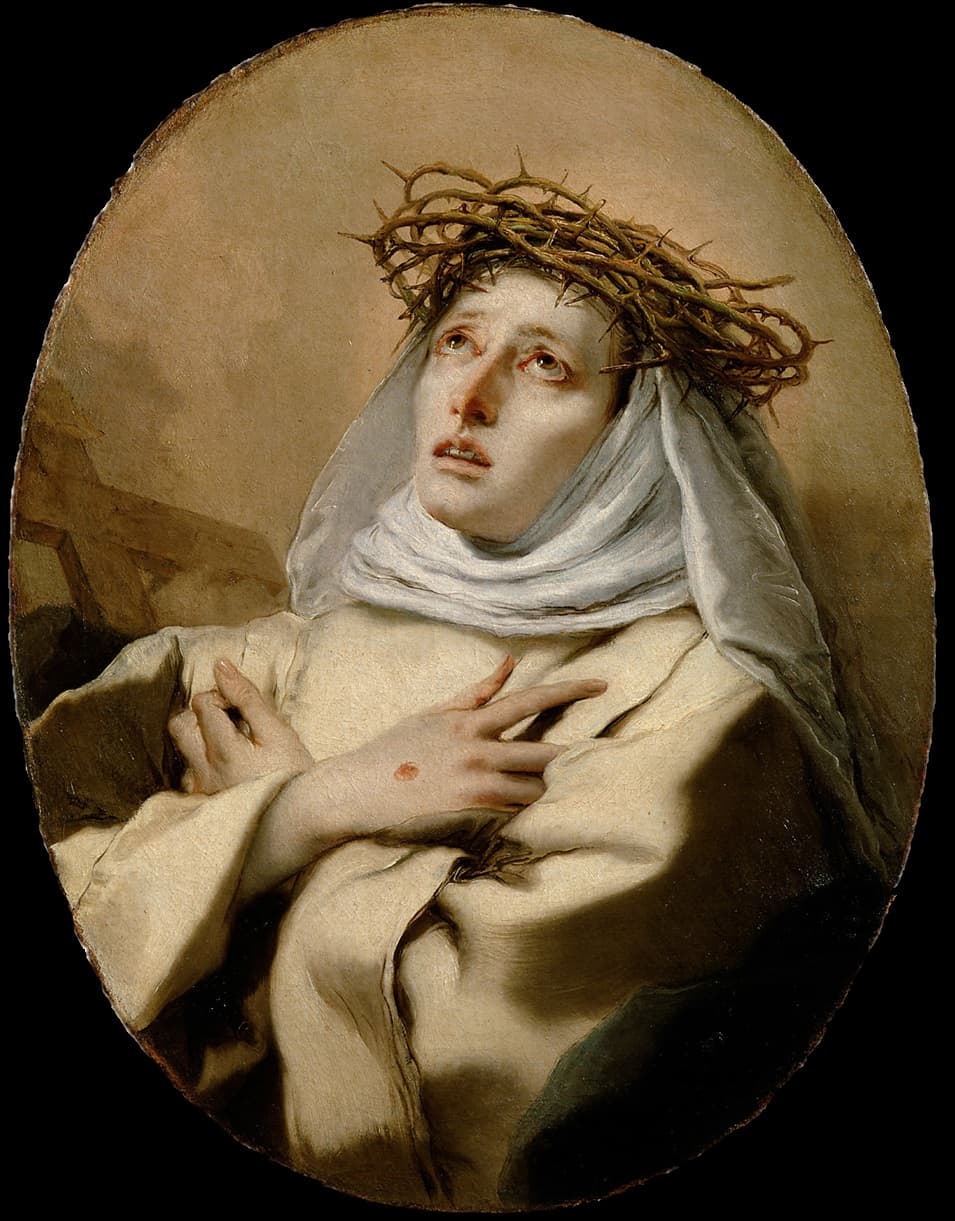
Italian · Literature · Activism · Politics
Catherine of Siena
March 25, 1347 – April 29, 1380
Early Life and Background
Catherine of Siena, born Caterina di Jacopo di Benincasa, entered the world in Siena, Tuscany, traditionally on 25 March 1347, the Feast of the Annunciation.[1][8][11] She was the twenty‑third or twenty‑fourth child in a large family; her father, Jacopo (Giacomo) Benincasa, was a cloth dyer, and her mother, Lapa Piagenti, managed the busy household.[10][11][15] The Benincasas belonged to the urban artisan class, situated between the city’s elites and its poor, in a Siena marked by economic activity, factional politics, and recurrent outbreaks of the Black Death.
Hagiographical sources report that around the age of six, Catherine experienced a vision of Christ accompanied by saints, an encounter that deeply shaped her understanding of herself and God.[10][11] She is said to have vowed virginity at a young age, resisting family expectations that she marry, and cultivated a life of intense prayer and ascetic discipline within her parents’ home. In adolescence she withdrew to a small room in the house, dedicating herself to contemplation while still performing domestic tasks.[11][13]
Catherine grew up amid the turbulence of fourteenth‑century Italy: the Avignon Papacy, during which the popes resided in France; violent conflicts between city‑states and internal factions; and repeated plague epidemics.[14][16] These conditions informed her later emphasis on peace, reform, and fidelity to the Church. Though she lacked formal scholastic education, she absorbed Scripture, preaching, and the spiritual culture of the Dominican tradition, developing a powerful memory and a facility with imagery and metaphor that would later characterize her dictations.
Religious Vocation and Career Beginnings
As a young woman, likely in the 1360s, Catherine joined the Mantellate, the lay Third Order of Saint Dominic in Siena.[1][11] These women, often widows, lived in their own homes while practicing penance, works of mercy, and a disciplined prayer life. Catherine’s entry into this group, while remaining with her family, signaled her desire to bind her contemplative devotion to the Dominican spiritual and intellectual tradition.
Initially, Catherine pursued a strongly eremitical path, spending extended periods in solitude and fasting. Over time, according to early testimonies, she experienced a series of mystical events, including an interior "spiritual marriage" with Christ, and increasingly felt called outward into service of others.[11][13][16] Under the guidance of Dominican confessors and spiritual directors, she began ministering to the poor and sick of Siena, caring for plague victims and prisoners and reconciling individuals divided by personal and political conflicts.[2][10]
Her reputation for holiness and wisdom attracted a circle of followers—lay men and women, clergy, and Dominican friars—who became her spiritual "family". This group accompanied her in travels and served as scribes for her dictations. Catherine did not hold office in a religious order and remained a lay tertiary, yet her authority within this circle and beyond was substantial, rooted in perceived spiritual gifts and unflinching counsel.
Major Works and Spiritual Teaching
Catherine’s lasting influence rests largely on her writings: the Dialogue of Divine Providence, an extensive collection of letters, and a smaller corpus of prayers. She did not write these texts herself; they were dictated in vernacular Italian to scribes who transcribed and sometimes edited them.[8][15]
The Dialogue, composed in the 1370s, is her major theological work.[3][10] Structured as a conversation between the soul and God, it addresses themes such as divine love, providence, human freedom, sin, and reform of the Church. Catherine uses vivid imagery—the "bridge" of Christ, the "cell" of self‑knowledge, the "tree" of charity—to convey complex ideas in accessible metaphor. The text also reflects her deep concern about corruption and lukewarmness among clergy and laity, calling for radical holiness rooted in humility and love.[1][12]
Her letters, written between about 1370 and 1380, survive in a corpus of approximately 382–400 pieces
These writings played a significant role in her later recognition as a Doctor of the Church. Scholars note that Catherine’s letters constitute one of the largest extant epistolary collections by a woman in the Middle Ages and that her Italian prose is an important contribution to the development of Italian spiritual literature.[8][10][15] Her prayers, though fewer in number, offer intense, affective insight into her contemplative life and have been valued for their theology of divine mercy and human transformation. From around 1374 until her death, Catherine became deeply involved in church politics and civic mediation.[3][16] At a Dominican general chapter in Florence in 1374, her activities drew the attention of the Order’s leadership, and she was placed under the spiritual guidance of the theologian Raymond of Capua, who later wrote her first major biography.[11][13] With his support, Catherine undertook journeys to cities such as Pisa, Florence, and Avignon, addressing conflicts and advocating reform. One central focus of her political engagement was the Avignon Papacy, during which the papal court had remained in France for decades, fueling scandal and tension among Italians.[14][16] Catherine wrote repeatedly to Pope Gregory XI, urging him to return to Rome and to pursue bold moral reform, including action against corruption and injustice within the Church.[3][15][16] She framed this appeal as obedience to God’s will and as necessary for the unity and credibility of Christian witness. In 1376, Catherine traveled to Avignon, where she met Gregory XI and argued personally for his return to Rome.[3][11][16] Although the move cannot be attributed solely to her efforts, Gregory did ultimately leave Avignon and re‑establish the papal residence in Rome in 1377, an event for which Catherine has often been credited as a significant moral and spiritual influence. After Gregory’s death and the contested election of Urban VI, the Western Schism began in 1378, with rival claimants to the papal throne.[3][16] Catherine unequivocally supported Urban VI, arguing in her letters and counsel that faithful Christians should adhere to the Roman line. She urged peace among Italian factions and appealed to cardinals and rulers to end divisions for the sake of the Church’s unity. Her involvement in these debates was extraordinary for a laywoman, underscoring the weight her spiritual authority carried. Catherine’s posthumous recognition unfolded over centuries, illustrating the evolving valuation of women’s religious leadership in Catholicism. She died in 1380, and, by the early fifteenth century, her cult was well established in Siena, supported by reports of miracles and the circulation of her life story.[1][11][13] In 1461, Pope Pius II formally canonized Catherine of Siena, recognizing her as a saint of the Church.[11][15] This canonization confirmed her status as one of the most eminent holy women of the Middle Ages and encouraged wider devotion beyond Siena and Italy. Her feast day, celebrated on 29 April, commemorates the date of her death and has become a focal point for honoring her life and teaching.[1][18] In 1866, Pope Pius IX instituted Catherine’s universal feast in the Roman Calendar, extending her liturgical commemoration to the global Church.[11][8] On 18 July 1939, Pope Pius XII proclaimed Catherine of Siena and Francis of Assisi co‑patron saints of Italy, highlighting her enduring national significance.[15][16] This recognition underscored her role as a spiritual and moral model for the Italian people, especially in a time of political tension and impending war. A major milestone came on 4 October 1970, when Pope Paul VI declared Catherine of Siena a Doctor of the Church.[1][12][16] Along with Teresa of Ávila, she was among the first women to receive this title, historically reserved for leading theologians whose writings have had lasting doctrinal impact. This appointment acknowledged the theological depth and authoritative character of Catherine’s Dialogue, letters, and prayers. Finally, on 1 October 1999, Pope John Paul II named Catherine a co‑patron of Europe, alongside Bridget of Sweden and Teresa Benedicta of the Cross.[1][8] This honor recognized her contributions to the spiritual and cultural heritage of Europe and highlighted her as a figure of reconciliation and unity for the continent. Catherine never married and remained a lay Dominican tertiary living principally outside the cloister.[1][11] Her personal life was shaped by intense asceticism—strict fasting, long vigils, and acts of self‑denial—that contemporary observers both admired and sometimes regarded with concern.[11][13] She understood these practices as participation in Christ’s suffering and as a means of intercession for the Church and the world. Her closest relationships were with her spiritual "family": followers who regarded her as a mother and guide. This group included Dominican friars such as Raymond of Capua, as well as lay men and women who accompanied her on missions and served as secretaries.[11][13] Her letters reveal warm affection for many of these companions, combined with demanding exhortations to pursue holiness and service. Catherine’s interactions with popes, cardinals, and civic leaders also formed a crucial aspect of her relational world. She addressed them with a striking combination of humility and fearless critique, often using familial language—calling the pope "sweet Christ on earth"—while insisting he act with courage and justice.[3][10][16] Her ability to navigate these relationships from a position outside formal hierarchy testifies to the perceived authenticity and authority of her spiritual experience. In her final years, Catherine resided partly in Rome, continuing to counsel Pope Urban VI and to work for peace during the Western Schism.[3][16] Her health deteriorated, in part due to severe fasting and the physical strain of her activities. In 1380, she reportedly collapsed and became increasingly weak, spending her last weeks in great suffering yet remaining engaged in prayer and spiritual conversation.[8][11] Catherine died in Rome on 29 April 1380, approximately thirty‑three years old.[1][8][11] She was buried in the Dominican church of Santa Maria sopra Minerva, where her tomb became a site of pilgrimage. Parts of her relics were later translated to Siena, reinforcing her enduring connection to her native city.[11][13] Her death was interpreted by contemporaries and later hagiographers as a consummation of her mystical union with Christ. The powerful impression she left on those around her, combined with the impact of her writings and her highly visible role in church politics, ensured that her memory would continue to shape Christian spirituality long after her passing. Catherine of Siena stands as one of the most influential women in medieval Catholicism.[1][8][13] Her legacy spans spirituality, theology, literature, and the history of church reform. As a lay Dominican tertiary, she demonstrated that charismatic authority rooted in prayer and moral conviction could reach into the highest levels of ecclesiastical and civic life, even without formal office or scholastic training. In mystical theology, Catherine is recognized for her distinctive synthesis of affective devotion and practical concern for church renewal.[1][10] Her Dialogue and letters articulate a vision of the Church as a community called to radical love and truth, where reform begins with self‑knowledge and humility yet must extend to structures and leaders. Her metaphors and narratives continue to be studied in both spiritual and literary contexts. Her letters are valued not only as spiritual texts but as historical documents that illuminate the political and religious landscape of fourteenth‑century Italy and the wider Church.[3][10][15] They reveal a woman who, despite social and gender constraints, addressed popes and rulers with frankness, urged peace among warring factions, and insisted on the necessity of unity under the Roman pontiff during the Western Schism. In Italian literature, Catherine’s vernacular prose is recognized as a significant contribution to the development of religious writing, situating her among important figures in the history of Italian language and spirituality.[1][8] Modern critical editions have made her works more accessible and highlighted their rhetorical and theological sophistication. Her later designation as Doctor of the Church and patron of Italy and Europe underscores her global impact and the Church’s evolving openness to women’s doctrinal authority.[1][12][16] Catherine’s role as one of the first female Doctors has inspired broader recognition of women theologians and mystics and has become a touchstone in discussions of women’s leadership within the Catholic tradition. Contemporary popes and theologians continue to reflect on Catherine’s life and teaching. In 2010, Pope Benedict XVI devoted a General Audience catechesis to her, summarizing her biography, spirituality, and relevance for modern believers, further attesting to her enduring importance.[5] Her example is frequently invoked in discussions of church reform, the integration of contemplation and action, and the role of laypeople—especially women—in ecclesial life. Across more than six centuries, Catherine of Siena remains a compelling figure: a woman of intense prayer and asceticism who nonetheless engaged vigorously with the world, spoke courageously to power, and left a literary and spiritual legacy that continues to shape Christian thought and practice.Political Engagement and Church Reform
Awards, Honors, and Ecclesiastical Recognition
Personal Life and Relationships
Later Life and Death
Legacy and Historical Impact
Dated achievements
7 indexed.
- Mar251347Science
Birth in Siena
Caterina di Jacopo di Benincasa was born in Siena, Tuscany, on the Feast of the Annunciation.
View details Saint Catherine of Siena - Britannica - Apr291380Science
Death in Rome
Catherine died in Rome at about age 33 after a period of severe fasting and illness; her feast is kept on this date.