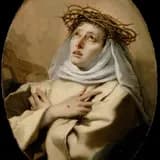
Pope Pius II formally canonized Catherine of Siena as a saint of the Roman Catholic Church.
On 29 June 1461, Pope Pius II, himself a fellow Sienese, formally canonized Catherine of Siena as a saint of the Roman Catholic Church. This act came eighty-one years after her death, following an extensive process of investigation into her life, writings, and reported miracles, a process aided by the biography written by her confessor and spiritual director, Raymond of Capua.
Canonization represented the Church's official recognition of Catherine as a model of heroic virtue and sanctity, elevating her from a locally venerated holy woman to a saint whose cult could be celebrated throughout the universal Church. This was a significant achievement for a laywoman who had never joined a formal religious order in the traditional sense, but had instead lived as a Mantellata, a lay member of the Dominican Third Order, while remaining active in the world.
Pius II's personal connection to Siena undoubtedly added weight and speed to the canonization process, as he had strong incentive to honor a fellow native of his home city who had also served as a fierce advocate for papal authority and Church unity during the Avignon Papacy and the tensions preceding the Western Schism.
This canonization cemented Catherine's legacy as one of the preeminent holy women of the Middle Ages, paving the way for her later, even more extraordinary recognitions, including her eventual naming as a Doctor of the Church in the twentieth century.