← All women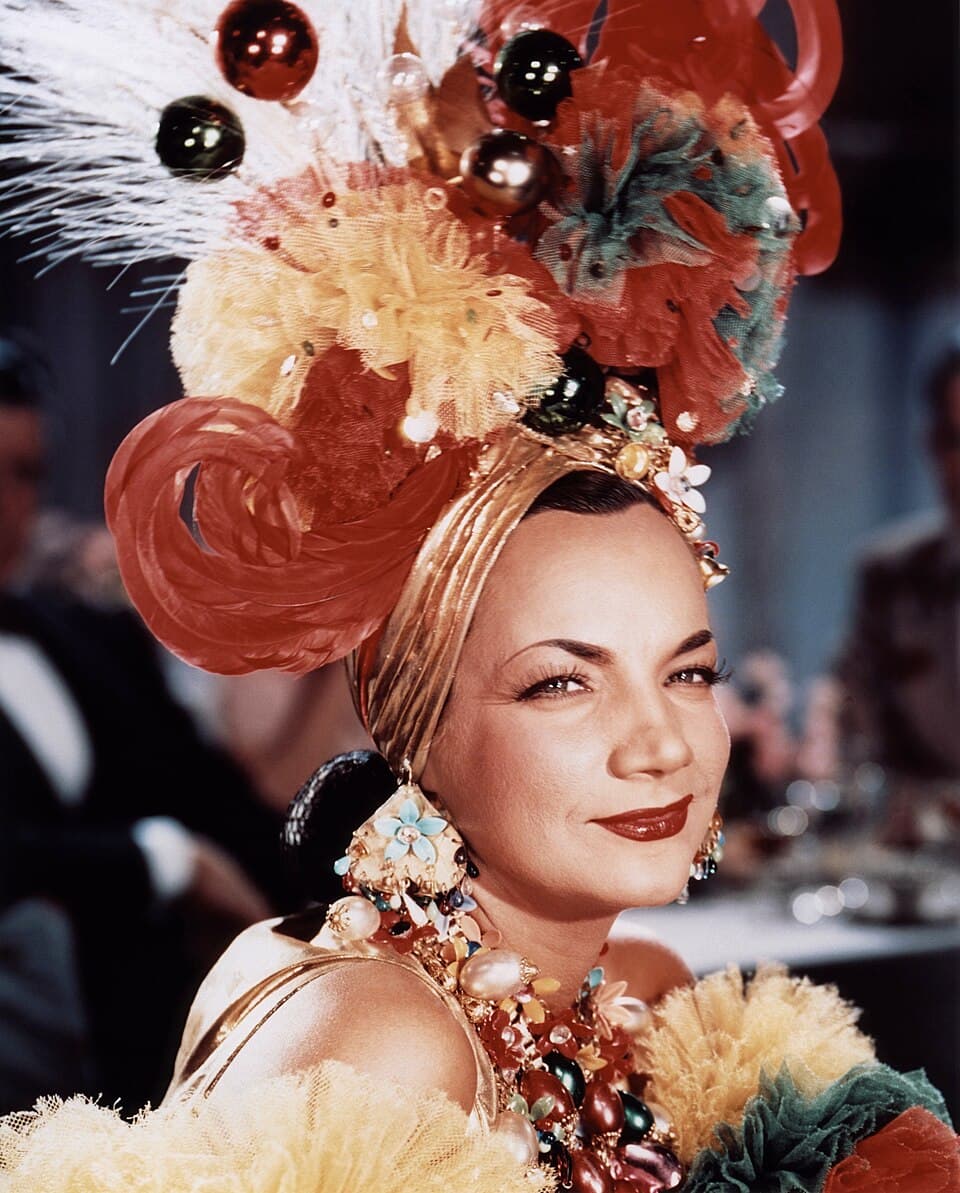
Portuguese, Brazilian · Arts
Carmen Miranda
February 9, 1909 – August 5, 1955
Early life and background
Carmen Miranda was born Maria do Carmo Miranda da Cunha on 9 February 1909 in Marco de Canaveses, Portugal.[1][2] She was still an infant when her family emigrated to Brazil, and she grew up in Rio de Janeiro, the city that shaped her artistic career and public identity.[5][11] Although she would later become one of the most famous Brazilian performers in the world, she was born abroad and spent her formative years in Brazil, a dual heritage that would later become central to her international image.
Miranda’s early life was marked by modest circumstances and by the cultural energy of Rio de Janeiro in the 1910s and 1920s. As a young woman, she entered the world of popular music through a path then open to only a few women: radio performance, nightclub singing, and recording. In an era when women entertainers often faced skepticism about respectability and professional ambition, Miranda developed a public persona that was both playful and highly controlled. Her rise would make her a symbol of Brazilian modern popular culture and a bridge between local samba traditions and global show business.[8][11]
Career beginnings in Brazil
Miranda’s career began in the late 1920s, when she became a radio singer and recording artist in Brazil.[11] In 1929, she recorded her first single, Não vá Simbora, with composer Josué de Barros and Brunswick Records.[2][11] The following year, she achieved a breakthrough with Pra Você Gostar de Mim (“Taí”), which became a major hit and established her as a leading interpreter of samba.[2][11] These recordings helped define the commercial sound of Brazilian popular music in the early sound era and made her one of the best-known female voices in the country.
In 1933, Miranda became the first contract singer in the history of Brazilian radio when she signed an exclusive agreement with Rádio Mayrink Veiga.[4][6][7] That contract represented both artistic validation and a rare institutional recognition of a woman performer. Radio was becoming a mass medium with national influence, and Miranda’s position within it gave her a level of visibility and professionalism that few female singers had achieved. In the same year, she made her film debut in A voz do carnaval, moving from the microphone to the screen.[2][11]
During the mid-1930s, Miranda appeared in Brazilian musical films such as Alô, Alô, Brasil!, Estudantes, and Alô, Alô, Carnaval!, consolidating her reputation as a film star at home.[2][11] These productions helped create the visual style associated with her early career, including comic timing, elaborate musical numbers, and a strong performative identity. By the end of the decade, she was already a national celebrity, and in 1939 she made her Broadway debut in The Streets of Paris, produced by Lee Shubert.[2][11] That appearance brought her to the attention of U.S. audiences and opened the path to Hollywood.
Hollywood breakthrough and international fame
Miranda’s U.S. film debut came with Down Argentine Way, released on 11 October 1940.[1][2] The film introduced her to American moviegoers and established the “Brazilian Bombshell” persona that would become her trademark.[1][2] From there, she moved quickly into a string of Fox musicals, including That Night in Rio (released 7 March 1941), Weekend in Havana (released 7 November 1941), Springtime in the Rockies, and The Gang’s All Here (released 18 February 1943).[2] These films made her one of the most recognizable performers of the wartime era.
In Hollywood, Miranda was often presented through highly stylized imagery, especially fruit-laden hats and brightly colored costumes. That visual signature became inseparable from her star image, even as it reflected the limitations imposed by the studio system’s approach to Latin American identity. She became one of the highest-paid women in the United States during the 1940s and was one of the few female performers of her era to command such a global brand.[4][8][11] Although Hollywood often packaged her as an exotic spectacle, she also controlled a sophisticated performance style that combined samba, comedy, rhythm, and theatrical timing.
Her success brought important public recognition. On 9 December 1941, Miranda became the first Latin American star honored with handprints and footprints at Grauman’s Chinese Theatre in Hollywood.[2][7] That honor marked a rare institutional acknowledgment of Latin American stardom within the symbolic center of American film celebrity. She continued appearing in studio musicals throughout the 1940s, including Greenwich Village (released 28 July 1944), A Date with Judy (released 5 July 1948), and Nancy Goes to Rio (released 9 June 1950).[2][11]
Stage, recordings, and television
Miranda’s career was not limited to film. She had already been a major radio and recording star in Brazil before moving to the United States, and she continued to perform across media throughout her career.[5][11] Her Broadway debut in 1939 was especially important because it introduced her to English-speaking stage audiences and demonstrated that her appeal extended beyond recorded music and film.[2][11] In the 1950s, she also continued to appear on radio and television variety programs, including The Jimmy Durante Show, keeping her presence alive even as her health declined.[6]
Her adaptability across media was crucial to her longevity. In the early and mid-20th century, women entertainers often had to reinvent themselves repeatedly to remain commercially viable, and Miranda’s career shows how a performer could move from local music circuits to national broadcasting, then to stage and film, and finally to television. Her success in these arenas made her not only a celebrity but also a model of cross-platform entertainment at a time when such careers were still relatively new.
Personal life
Miranda’s personal life was complicated and at times difficult. Historical accounts note an abusive marriage and recurring health problems, both of which shaped the later years of her life.[8] She was married to Dave Sebastian, and that relationship has been documented in later biographical sources.[13] As with many women celebrities of her generation, her professional image was far more public than her private struggles, which were often overshadowed by studio publicity and fan fascination.
Her life also reflected the pressures faced by women stars who were expected to be endlessly energetic and glamorous. The highly demanding performance schedule that supported her public persona contributed to a life of strain, even as she remained a fixture of entertainment news and popular memory. Her ability to sustain fame across countries and media was remarkable, but it came with significant personal costs.
Honors and recognition
Miranda’s honors began during her lifetime and continued long after her death. The Grauman’s Chinese Theatre handprint ceremony in 1941 marked her as an international star, and later retrospectives and museum projects preserved her image as a foundational figure in Brazilian and Latin American cultural history.[2][7] In 2011, the United States Postal Service honored her on a Latin Music Legends commemorative stamp, confirming her enduring place in U.S. cultural memory.[5]
She is also remembered in institutional and popular-historical tributes such as the Hollywood Walk of Fame and major biographical reference works.[4][11] These recognitions matter because they show how her reputation evolved from 1940s spectacle to a more nuanced historical legacy that includes her contributions to music, film, transnational celebrity, and the representation of Latin American women in global entertainment.
Legacy
Carmen Miranda remains one of the most distinctive women in 20th-century popular culture. She was a Brazilian-born, Portuguese-raised performer who became an international star and helped shape the image of Latin American entertainment for audiences across the Americas and beyond.[1][2][11] Her style was both celebrated and criticized: celebrated for its exuberance, musicality, and originality, and criticized for the stereotypes attached to Hollywood’s use of her image. That tension is central to her historical importance.
For women’s history, Miranda represents a figure who achieved extraordinary visibility in an industry that often controlled women’s bodies, voices, and images. She crossed from radio to recording, from Brazilian film to Broadway, from Hollywood cinema to television, and in each medium she negotiated the demands of popularity and performance. Her career demonstrates the possibility—and cost—of becoming an international woman star in the mid-20th century.
Her death on 5 August 1955 ended a brief life but not her public presence.[1][2][6] Decades later, she still appears in film history, museum exhibitions, postage stamps, and cultural studies as a woman whose flamboyant artistry helped define an era. In that sense, Carmen Miranda’s legacy is both glamorous and instructive: she was a performer who turned visibility into power, even while working within systems that frequently tried to contain it.
Dated achievements
14 indexed.
- Feb091909Arts
Born in Marco de Canaveses, Portugal
Birth of Maria do Carmo Miranda da Cunha, later Carmen Miranda, in Marco de Canaveses, Portugal.
View details Britannica: Carmen Miranda - Jan011933Arts
First exclusive radio contract singer in Brazil
She became the first contract singer in Brazilian radio history with Rádio Mayrink Veiga.