← All women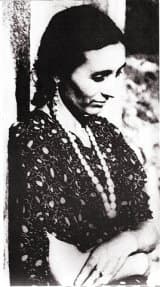
Polish, Romani · Arts · Literature
Bronislawa Wajs "Papusza"
August 17, 1908 – February 8, 1987
Early life and background
Bronisława Wajs, better known by the Romani name Papusza (“doll”), was born on 17 August 1908 in Sitaniec, Poland, although some biographical accounts vary on the exact birthplace and, in some cases, the birth year. She belonged to the Polska Roma, the lowland Polish Roma community, and grew up in a nomadic environment shaped by mobility, oral culture, and the traditions of the traveling camp. In later retellings, she is sometimes associated with Lublin because of the routes and stopping places of her family’s caravan, but the most commonly cited source date for her birth is 17 August 1908.
Her childhood was formed within a world in which women’s education was limited and Roma families faced persistent discrimination from the surrounding society. Like many Roma girls of her generation, she did not receive a formal literary education. Instead, she absorbed songs, stories, and forms of speech from the oral culture of the camp. This background became the foundation of her poetry: the cadence, imagery, and emotional directness of her writing are inseparable from the traditions of Roma song and memory.
The nickname Papusza was associated with her unusual beauty and became the name under which she was later known across Poland and beyond. Her early life was also shaped by the upheavals of the first half of the twentieth century, including war, displacement, and the changing conditions of Roma life in a modernizing and often hostile state. These experiences later entered her poetry and prose, giving her work a documentary as well as lyrical power.
Career beginnings and the move from oral tradition to print
Papusza did not begin her literary life through formal schooling or a conventional publishing path. Instead, her poems first circulated in oral form, in a Roma milieu where performance and memory were central. Her rise into the literary record is closely associated with the writer and ethnographer Jerzy Ficowski, who collected, transcribed, and helped introduce her work to a wider Polish audience in the late 1940s and early 1950s.
By 1949, her writing had begun to move beyond oral circulation. That year marks the beginning of the broader public history of her poetry, even though the exact first publication date is not securely documented in the sources available here. This transition was historically important because it made a Romani woman’s voice visible in print culture at a time when Roma authors were rarely published under their own names. Papusza is widely described as the first Romani poet in Poland to publish under her own name, a milestone that made her a pioneer in both Polish and Roma literary history.
In 1950, her poems appeared in Nowa Kultura, extending her audience beyond the Roma community. This was not a simple act of literary discovery; it also involved translation, transcription, and mediation, since Papusza wrote in Romani and her poetry had to be rendered for Polish readers. Her case therefore illustrates both the possibilities and the ambiguities of cultural translation. On one hand, Ficowski’s work helped preserve and publicize her poems. On the other, the process exposed the unequal power relations between a marginalized Romani poet and the Polish intellectual institutions that brought her voice to print.
Major works and historical significance
Among Papusza’s best-known texts is Tears of Blood, written down in 1952. The poem stands as one of the most important literary testimonies of the Roma Holocaust, sometimes referred to as the Porajmos. In it, Papusza gave expression to the devastation suffered by Roma communities during the Second World War. Because Roma persecution was long underrepresented in mainstream historical memory, the poem has become crucial not only as literature but also as witness literature and historical testimony.
Papusza’s poetry and prose often preserve scenes of camp life, movement through landscapes, women’s labor, family memory, and the emotional texture of nomadic existence. Her writing also reflects loss: the dissolution of the traveling world, wartime destruction, and the pressures of settlement and assimilation in postwar Poland. Although only a relatively small number of her texts survive, the body of work that remains is valued for its authenticity, lyrical force, and cultural specificity. It is one of the most important written records of twentieth-century Roma experience in Poland.
In 1956, the collection Pieśni Papuszy was published with a preface by Jerzy Ficowski. This publication further закрепed, in public memory, her status as a poet rather than merely an informant of folklore. For scholars of women’s history, it is especially important that Papusza’s work entered print through the combination of her own artistic voice and the editorial structures of a male-dominated literary world. Her case reveals both the opportunities and the constraints faced by minority women writers in mid-century Europe.
Community conflict, recognition, and awards
Papusza’s growing public visibility came at a painful personal cost. The circulation of her poems and the interest of outside scholars created tension within some Roma circles, where she was accused of revealing community secrets. This conflict contributed to her isolation and remains one of the tragic dimensions of her biography. Her story is therefore not simply one of literary breakthrough, but also of the social risks that often accompany visibility for marginalized women.
Despite these hardships, her literary importance gradually received formal recognition. She was awarded the Lubuska Nagroda Kulturalna in 1958, a sign that her work was gaining institutional legitimacy. In 1978, she received several further honors, including the Minister of Culture Award, the Nadodrza Cultural Award, and the Gorzów Award. These awards reflected a late but real shift in the official valuation of her poetry and helped secure her place in Polish cultural memory.
Her recognition also had broader symbolic significance. Papusza became a reference point for later Roma writers, translators, and cultural advocates who sought to recover Roma women’s contributions to European literature. She is now widely described as a pioneer of Romani poetry, the first Polish Roma poet to publish under her own name, and one of the most famous Roma poets of the twentieth century.
Personal life
Papusza’s personal life was closely intertwined with the itinerant and family-centered life of the Roma camp. Sources emphasize the centrality of kinship, movement, and the hardships of survival. She married within the Roma community, and her life was marked by the practical demands of camp life as well as by the emotional costs of recognition and estrangement. The available sources note that by later life she was living under the care of her sister Janina in Inowrocław, indicating the importance of family support in her final years.
Her private life cannot be separated from the social context in which she lived. As a Roma woman, she was subject to gendered expectations within her community and ethnic prejudice from the wider society. As a poet, she occupied a rare and difficult position: visible enough to be celebrated, but vulnerable enough to be blamed for the very attention that made her famous. This tension is central to any historically responsible account of her biography.
Later life and death
By 1981, Papusza was living in Inowrocław under her sister’s care. This final period was marked by declining health and increasing dependence, far removed from the public recognition she had gradually received. Nevertheless, her reputation continued to grow among readers, scholars, and cultural institutions interested in Roma history and literature.
She died in Inowrocław on 8 February 1987. While one source in the research set gives a conflicting February 17 date, the majority of biographical sources agree on 8 February. Her death ended a life that had spanned the collapse of the old caravan world, the catastrophes of war, and the slow emergence of Roma women’s writing into public literary culture.
Legacy
Papusza’s legacy is now central to the history of Roma literature in Poland. She is remembered as the first Romani poet in Poland to publish under her own name and as a major voice in the written record of Roma life. Her work is valued for preserving the language, memory, and emotional world of a community that had often been excluded from the institutions of national culture.
Her importance also extends beyond literature. Papusza has become a symbol of Roma women’s cultural authorship, of the costs of visibility, and of the fragility of minority memory in the face of assimilation and prejudice. Later biographies, scholarly studies, museum and archive collections, and cultural tributes have continued to reframe her as a foundational figure. In women’s history, she stands as an example of how artistic achievement can emerge from social marginality and how a woman’s voice, once mediated and contested, can become indispensable to cultural memory.
Dated achievements
11 indexed.
- Aug171908Literature
Birth of Bronisława Wajs (Papusza)
Bronisława Wajs, later known by her Romani name Papusza, was born on 17 August 1908 into a nomadic Polish Roma family.
View details Wikipedia: Bronisława Wajs - Jan011949Literature
Poetry begins circulating beyond Romani oral tradition
Papusza's songs and poems began reaching wider Polish audiences through ethnographer Jerzy Ficowski, who transcribed her oral compositions.