← All women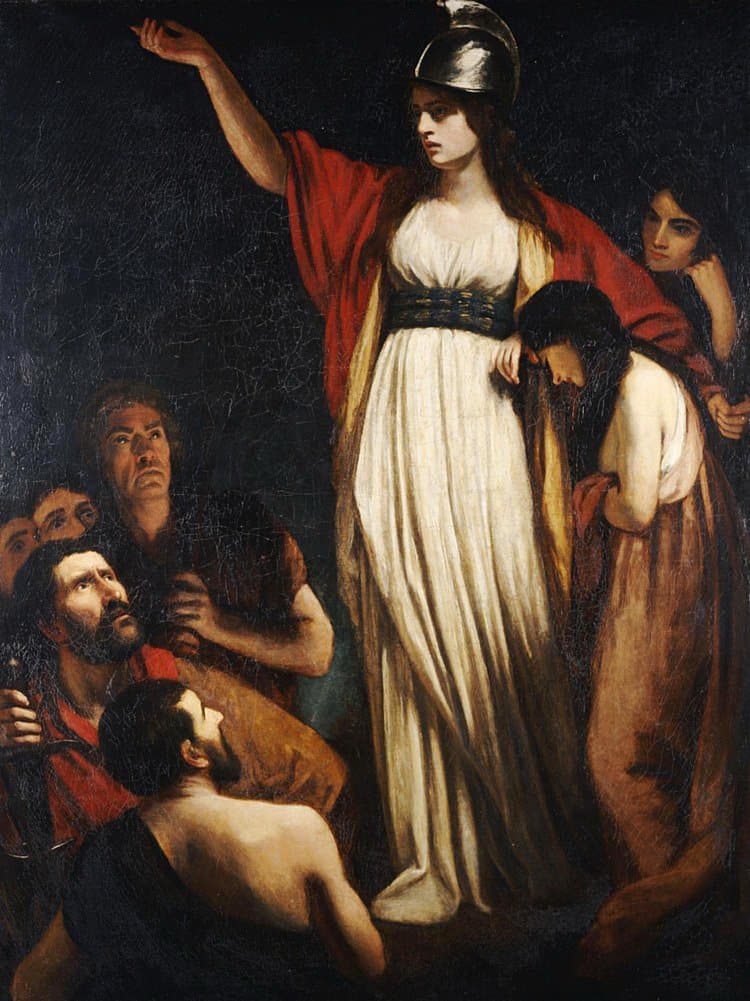
British · Politics · Activism
Boudica
Unknown – present
Overview
Boudica (also spelled Boudicca, Boadicea or Boudicea) was a queen of the Iceni, a Celtic people of eastern Britain, who led one of the most famous revolts against Roman rule in the province of Britannia around 60–61 CE.[1][5][11][12] Almost everything known about her comes from Roman literary sources, especially the historian Tacitus and the later writer Cassius Dio, which means that modern reconstructions of her life are heavily dependent on hostile or sensationalized accounts written by members of the empire she opposed.[1][5][11][12] Despite the scarcity and bias of the evidence, Boudica has become a powerful symbol of resistance to oppression, British national identity, and women’s leadership in war.[1][5][6][12][13]
Early Life and Background
No ancient source records Boudica’s birth date, place, or parents. Modern historians infer that she was likely born into a high-status family of the Iceni, a tribal group occupying what is now East Anglia in eastern England, before the Roman conquest of Britain in 43 CE.[1][5][11][12] Some modern summaries suggest she may have been born around 30 CE, perhaps near Camulodunum (modern Colchester), the first Roman colonia in Britain, but this is an informed conjecture rather than a documented fact.[11] As with most Iron Age Britons, especially women, direct evidence for her childhood does not survive.
Archaeological and ethnographic studies of Celtic societies suggest that elite girls like Boudica might have been raised in a warrior aristocracy where status was demonstrated through feasting, gift-exchange, and prowess in war or leadership.[12] Tacitus’ description of her later public speeches and her presence in battle implies that she was trained or accustomed to speaking before warriors and to participating in ritual or military gatherings.[1][11] The use of chariots by the Iceni and other British tribes indicates a culture in which high-ranking individuals could fight from or at least appear in chariots during warfare and ceremonial processions, a context that might explain later depictions of Boudica in a chariot.[1][12]
The etymology of her name is typically linked to the Celtic root *boudi-, meaning “victory,” so that Boudica is often interpreted as “Victorious Woman” or “She Who Brings Victory.”[1][5][12] This may have been a meaningful theophoric or symbolic name in her own time, though the Roman authors may also have emphasized the meaning for rhetorical purposes.
Marriage, Family, and Position as Queen
Tacitus describes Boudica as the wife of Prasutagus, king of the Iceni.[1][5] By the time the Romans invaded Britain under Emperor Claudius in 43 CE, Prasutagus was an established ruler who initially became a client king of Rome—allowed to retain his throne and some autonomy in exchange for cooperation and tribute.[1][5][12] This arrangement mirrored Roman practice elsewhere in the empire, where client kings served as intermediaries in newly conquered regions.
Boudica and Prasutagus had at least two daughters; Tacitus notes that she was flogged and her daughters raped during the crisis that triggered the revolt.[1][5][11][12] Their names are not recorded in Roman texts. Boudica’s status as queen likely arose from her marriage to Prasutagus, but some scholars suggest that British tribal customs may have allowed royal women to exercise significant authority in their own right, especially in the absence of adult male heirs.[12][14]
During Prasutagus’ reign, the Iceni initially retained a measure of independence and even allied with the Romans against other tribes. Archaeological evidence of Roman goods in Iceni territory supports a period of negotiated coexistence, although there were also tensions and earlier disturbances such as an Iceni revolt in 47 CE under a different leader.[1][12]
Roman Rule and the Crisis after Prasutagus’ Death
The immediate cause of Boudica’s revolt, according to Tacitus, was the Roman treatment of the Iceni after Prasutagus’ death, which he places shortly before 60–61 CE.[1][5][11] Prasutagus had attempted to secure his dynasty and kingdom by naming the Roman emperor co-heir alongside his two daughters in his will, hoping to preserve his line and autonomy under Roman protection.[1][5] Instead, Roman officials treated his death as an opportunity to annex the kingdom completely.
Tacitus reports that Roman centurions and slaves seized Iceni lands, confiscated property from leading men, and treated the royal family brutally.[1][5][11] Boudica herself was scourged (flogged), and her daughters were raped by Roman soldiers.[1][5][11][12] This combination of political dispossession, economic exploitation, and personal humiliation, especially sexual violence against royal women, was a direct affront to both Roman client-state norms and Celtic expectations of kingly protection.
Beyond the Iceni, other tribes suffered from heavy taxation, land confiscations, and the activities of Roman financiers. The historian notes that Roman moneylenders, including the philosopher Seneca, had recalled large loans made to British elites, intensifying resentment.[1][12] The concentration of Roman veterans in colonies such as Camulodunum, where they reportedly abused locals and built a large temple to the deified Claudius at public expense, became a focal point for anti-Roman anger.[1][11][12]
Outbreak of the Boudican Revolt
In 60 or 61 CE, while the Roman governor Gaius Suetonius Paulinus was campaigning in Wales against the island stronghold of Mona (Anglesey), Boudica led the Iceni in open revolt.[1][5][11][12] Tacitus explicitly names her as the leader of the rebels and emphasizes her role as a woman commanding a large force, something that shocked Roman sensibilities but may have been more acceptable in some Celtic societies.[1][11][12]
Boudica managed to unite the Iceni with neighboring tribes, most notably the Trinovantes, who had also suffered Roman abuses.[1][12] This coalition rapidly grew into a massive army; ancient sources give figures of 100,000 or more warriors, numbers that modern historians treat cautiously but accept as evidence of a very large uprising.[1][11][12] The revolt was timed to exploit the temporary absence of the governor and the dispersion of Roman troops.
The first major target was Camulodunum, the Roman colonia in former Trinovantian territory.[1][5][11][12] The town had become a symbol of Roman dominance, with land given to retired soldiers and the construction of the temple to Claudius that locals resented paying for. The Roman authorities there reportedly ignored warnings of unrest and had inadequate defences.[1][11][12]
The Destruction of Camulodunum
Boudica’s forces attacked Camulodunum and overwhelmed the small garrison, which could not withstand the large rebel army.[1][11][12] According to Tacitus, the rebels destroyed the town, besieged the temple of Claudius for two days, and massacred inhabitants and refugees alike.[1][5][11] A Roman detachment sent to relieve the colony was defeated.[1][11] Archaeological layers of burnt debris at Colchester are often associated with this event and support the literary accounts of a catastrophic destruction.[12]
Ancient sources stress the brutality of the killings, including torture and ritual slaughter, though such descriptions may reflect Roman efforts to portray the rebels as barbaric.[1][11][12] Nonetheless, the annihilation of a Roman colony and the sacrilegious destruction of an imperial cult temple were serious blows to Roman prestige. Boudica’s attack demonstrated that provincial Britons could organize and execute a large-scale, coordinated assault on Roman urban centres.
The Sack of Londinium and Verulamium
After Camulodunum, Boudica’s army moved south toward Londinium (modern London), then a growing commercial hub but not yet the provincial capital.[1][11][12] Governor Suetonius Paulinus, marching back from Wales with a limited force, reached Londinium but, judging his army too small to defend the town, chose to withdraw and evacuate those who could flee.[1][5][11][12] Boudica’s forces entered the undefended settlement, burned it, and killed many of its inhabitants.[1][5][11][12]
The rebels then turned on Verulamium (modern St Albans), another Romanized town, and subjected it to similar destruction.[1][11][12] Tacitus claims that in the course of the revolt, Boudica’s forces killed as many as 70,000–80,000 Romans and Romanized Britons in these three cities, a figure that modern historians regard as an exaggeration but nevertheless indicative of large-scale slaughter.[1][5][11][12] The burning of these towns left a distinctive layer of ash and charcoal in the archaeological record of southeastern Britain.[12]
The rapid succession of these victories represents the high point of Boudica’s campaign. For a brief period, Roman control over much of the province seemed on the verge of collapse, and the fear of losing Britain entirely was real in Roman political circles.[5][11][12] The revolt also revealed the vulnerability of Roman urban settlements when not supported by substantial military forces.
The Final Battle and Defeat
Despite these setbacks, Suetonius Paulinus regrouped his forces—about 10,000 men, including the 14th Legion, detachments from the 20th Legion, and auxiliary troops.[1][5][11][12] He chose a battlefield advantageous to the Romans, described by Tacitus as a narrow defile with a forest behind and open ground in front, limiting the ability of the larger British force to envelop his troops and negating the effectiveness of their chariots.[1][11][12]
Boudica’s army, though far more numerous, appears to have been less disciplined and heavily burdened; according to Tacitus, many families brought wagons and parked them in a semicircle behind the army to watch the battle, which later impeded their retreat.[1][11][12] Before the engagement, both sides are said to have addressed their troops. Tacitus records a speech in which Boudica, wearing a tunic of many colours with a gold torque and long red hair falling below her waist, invoked the justice of their cause, appealing to the wrongs done to her and her daughters and urging her followers to choose between liberty and slavery.[1][11][12] While the exact words are literary, the speech reflects how Roman authors imagined a barbarian queen rallying her people.
In the ensuing battle, Roman tactics, armor, and discipline prevailed. The Roman soldiers formed a tight wedge and advanced, hurling volleys of pila (javelins) before engaging in close combat.[1][5][11][12] The Britons, crowded together and constrained by the wagons behind them, were unable to maneuver effectively. Tacitus reports that the Romans inflicted a devastating defeat, killing many thousands of rebels, while suffering relatively few losses themselves.[1][5][11][12] The battlefield location remains uncertain, though various sites in the English Midlands have been proposed.
Boudica’s Death
The precise details and date of Boudica’s death are unknown. Tacitus states that after the defeat she either took poison and died or fell ill and died; he is not explicit.[1][5] Cassius Dio, writing later and with more rhetorical flourish, claims that she fell sick and died and was buried, after which the Britons quietly ended the war.[1][5][12] Both agree that she did not survive long after the failure of the revolt in 60 or 61 CE.
No archaeological evidence has yet been convincingly identified as Boudica’s grave, and her place of burial, if she was buried at all, remains a matter of speculation. Later folklore has suggested various locations, including beneath modern London landmarks, but such claims are unsubstantiated. Historically, all that can be said is that Boudica died in the immediate aftermath of the suppression of her revolt, likely in 60–61 CE, without further written record.[1][5][12]
Consequences of the Revolt
The Boudican uprising forced the Roman administration to reconsider its policies in Britain. Suetonius Paulinus engaged in harsh reprisals against remaining pockets of resistance, which led to concerns in Rome that excessive severity might fuel further unrest.[1][5][12] The imperial freedman Polyclitus was sent to investigate the situation, and Suetonius was subsequently replaced as governor by the more conciliatory Publius Petronius Turpilianus
Roman authorities eased some of the most provocative practices, adjusted taxation, and adopted a less aggressively expansionist stance for a time.[1][12] The revolt also prompted increased military presence and infrastructure, including more forts and improved roads, to enable faster troop movements. Strategically, however, Rome remained committed to holding Britain, and the province continued to develop under imperial rule. In the longer term, Boudica’s revolt demonstrated both the risks and limits of indigenous resistance to the Roman Empire. It showed that coordinated tribal action could devastate Roman settlements and inflict heavy losses, but also that Rome’s organizational and logistical advantages made permanent expulsion extremely difficult once the empire was firmly established.[5][12] Because Boudica is known only through Roman male authors, her image is filtered through their cultural assumptions about gender and barbarism. Tacitus, whose father-in-law Agricola later governed Britain, uses Boudica in his Annals both as a vehicle for moral commentary on imperial abuses and as a dramatic figure of pathos, a wronged queen driven to desperate resistance.[1][11][12] He simultaneously admires and criticizes her, noting her courage and leadership while emphasizing the savagery of the revolt. Cassius Dio, writing in Greek more than a century later, elaborates on her appearance and speeches, presenting her as a fierce and almost Amazonian figure.[1][12] He describes her as tall, terrifying in appearance, with reddish hair, a harsh voice, and a large golden necklace.[1][12] These details may be partly literary topoi—conventional features of “barbarian” leaders—rather than historical observations. Nonetheless, both authors testify to the remarkable nature of a woman leading such a large insurrection in the eyes of Roman contemporaries. Modern scholars note that, while the Romans saw female military leadership as extraordinary and often unnatural, some Celtic societies may have granted women greater legal and social authority than Rome did.[12][14] Boudica’s prominence, coupled with later figures such as the Gaulish leader’s wife and legendary women warriors, has encouraged debate about the actual roles of women in Iron Age British warfare and governance. The historical record on Boudica is sparse; she disappears from contemporary sources after Tacitus and Dio. However, early modern and modern writers resurrected and transformed her story. In the Renaissance and particularly under Queen Elizabeth I, Boudica was celebrated as a patriotic forerunner, a native queen who had resisted foreign domination and whose example could be linked to England’s own struggles against Catholic powers.[6][13][14] Literary works, including poems and plays, cast her as a heroic defender of the nation. In the 18th and 19th centuries, Boudica became increasingly prominent in British national mythology. Historians, antiquarians, and artists turned her into a symbol of British liberty and martial valor. Her name was commonly rendered as Boadicea in this period, a form that appears frequently in English literature.[1][6][13] She was invoked as a parallel to contemporary monarchs, especially Queen Victoria, with whom she was sometimes explicitly compared.[6][18] The Victorian era also saw the erection of one of the most famous memorials to Boudica: the bronze statue group known as Boadicea and Her Daughters by sculptor Thomas Thornycroft, designed in the 19th century and installed near Westminster Bridge in London in 1902.[1][18] The statue depicts Boudica standing in a war chariot drawn by rearing horses, her daughters beside her, evoking both maternal and martial imagery and cementing a powerful visual icon of the warrior queen in the urban landscape of the British capital. Contemporary historians approach Boudica with caution, emphasizing the need to distinguish between the sparse ancient evidence and the elaborate later layers of legend and nationalist interpretation.[12][13][14] Key debates concern the scale of the revolt, the accuracy of casualty figures, the exact locations of key battles, and the nature of Iceni society. Archaeological work has confirmed episodes of destruction in several Roman towns that align chronologically with the revolt, lending support to the broad outline of the narrative preserved by Tacitus and Dio.[12] However, many specifics—such as the size of Boudica’s army or the precise route of her march—remain contested or unknown. Scholars also discuss whether Boudica aimed to expel Rome entirely or to renegotiate local autonomy after the abuses that followed Prasutagus’ death. Another major line of inquiry examines how Boudica has been used as a cultural and political symbol. Researchers have traced her appropriation in contexts ranging from imperial propaganda and Victorian nationalism to late 20th- and 21st-century feminist discourse and regional identity movements.[6][13][14] Her figure has been mobilized to represent British defiance against foreign threats, female empowerment, Celtic heritage, and, at times, militant forms of patriotism. Boudica’s legacy is disproportionately large when compared to the brevity of her documented life. In Britain, she is widely considered a national heroine and symbol of resistance to oppression.[1][5][6][12][16] Educational materials, popular histories, and children’s books routinely present her as one of “Britain’s bravest warriors,” highlighting her leadership, courage, and the injustice she endured.[15][16] Her story has inspired numerous works of literature, from early modern dramas to modern novels, as well as poems, historical fiction, and television and film dramatizations.[1][6][13][14] She is a popular subject in documentaries and educational programming, where she is often framed as one of the most famous women warriors in history and an early icon of female military leadership.[7][9][10][12] The enduring fascination with Boudica reflects broader public interest in stories of rebellion against empire and in exceptional women who appear to defy the gender norms of their time. Boudica also occupies a significant place in feminist and gender discussions. Some modern commentators celebrate her as an emblem of women’s capacity to lead and fight in a male-dominated world, although others caution against retrojecting modern feminist values onto a figure from a fundamentally different cultural context.[6][10][12][13] Nonetheless, the image of a woman commanding an army against one of history’s most powerful empires continues to resonate as a symbol of autonomy and defiance. Historically, Boudica is significant for several reasons. First, her revolt represents one of the most serious challenges to Roman authority in Britain and indeed in any Roman province in the mid-first century CE.[1][5][11][12] By coordinating multiple tribal groups and attacking Roman urban centres, she exposed vulnerabilities in the imperial system and forced administrative reforms. Second, her story illuminates the tensions inherent in Roman imperial rule, especially the exploitation of provincial elites through debt, taxation, and land confiscation. The abuses inflicted on Boudica and her family epitomize the personal and political humiliations that could catalyze violent resistance.[1][5][11][12] The revolt thus serves as a case study in the dynamics of colonialism, collaboration, and rebellion. Third, Boudica is one of the comparatively few named women to appear in Roman accounts of provincial history, and one whose actions they could not ignore. Her prominence challenges assumptions about the invisibility of women in ancient warfare and politics, and invites examination of how gender shaped both indigenous and Roman responses to her leadership.[10][12][14] Finally, the long and complex afterlife of Boudica in cultural memory demonstrates how historical figures can be continually reinterpreted to serve changing social and political needs. From Roman moral exemplum to Elizabethan patriot, Victorian imperial icon, and modern symbol of freedom and women’s power, Boudica’s image has been repeatedly remade, ensuring that her name remains widely known nearly two millennia after her death.[6][12][13][14] Any biography of Boudica must acknowledge the severe limitations of the sources. There are no contemporary British accounts, inscriptions, or documents directly attributable to her or her court. The surviving narratives were written by Roman elites with their own agendas, decades after the events they describe.[1][5][11][12] Their works survive only partially and have been transmitted through medieval manuscripts, introducing further layers of potential distortion. Modern reconstructions therefore rely on a combination of textual analysis, archaeological correlation, and comparative evidence from other Celtic and Roman contexts. While this method allows a reasonably coherent picture of Boudica as a queen who led a large rebellion in 60–61 CE and inflicted severe damage on Roman settlements before being defeated, many biographical details—such as her age, personality, private life, and exact motives—remain speculative. Responsible scholarship differentiates between what is directly attested, what is plausibly inferred, and what belongs to later legend. Despite these uncertainties, Boudica’s historical footprint is unmistakable. The convergence of Roman testimony and archaeological evidence confirms that a major uprising led by a female Iceni ruler devastated parts of Roman Britain in the early 60s CE, and that this event had lasting consequences for the province and for perceptions of British resistance. Within the constraints of the surviving evidence, Boudica stands as one of antiquity’s most striking examples of a woman who confronted imperial power on the battlefield and entered the realm of enduring historical memory.[1][5][11][12][13][14]Roman Portrayals and Gender
Later Reception and Myth-Making
Modern Scholarship and Historical Debates
Legacy and Cultural Impact
Historical Significance
Uncertainties and Limitations of the Evidence
Dated achievements
3 indexed.
- Jan0160Politics
Death of Prasutagus and Roman annexation of the Iceni kingdom
Boudica's husband King Prasutagus died, prompting Rome to annex the Iceni kingdom, seize property, and flog Boudica and rape her daughters.
View details Wikipedia: Boudica - Aug0160Politics
Sack of Camulodunum (Colchester)
Boudica's rebel army destroyed the Roman colony of Camulodunum, the former Trinovantian capital and center of the imperial cult, killing its inhabitants.