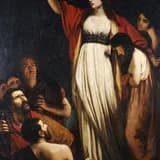
Boudica's rebel army destroyed the Roman colony of Camulodunum, the former Trinovantian capital and center of the imperial cult, killing its inhabitants.
In AD 60/61, Boudica led the Iceni, joined by the Trinovantes and other British tribes, in an uprising against Roman rule. The rebels' first major target was Camulodunum (modern Colchester), which had been the capital of the Trinovantes before becoming a Roman colonia populated largely by retired legionary veterans.
The city was also home to the Temple of Claudius, a massive structure built to venerate the deified emperor at great expense to the local population, making it a hated symbol of Roman occupation and religious imposition. Boudica's forces overwhelmed the poorly defended settlement — the Romans had failed to build adequate walls, confident in their military supremacy — and razed it to the ground.
Archaeological evidence, including a thick layer of burnt debris known as the 'Boudican destruction horizon,' confirms the ferocity of the attack. Roman survivors retreated to the temple for a final stand but were overwhelmed after a short siege, and the building was destroyed. Tacitus records that a relief force sent by the Roman commander Quintus Petillius Cerialis was ambushed and largely annihilated on its way to the city.
The sack of Camulodunum marked the opening blow of the most serious rebellion Roman Britain ever faced, striking fear into the provincial administration and demonstrating the depth of British resentment toward Roman exploitation.