← All women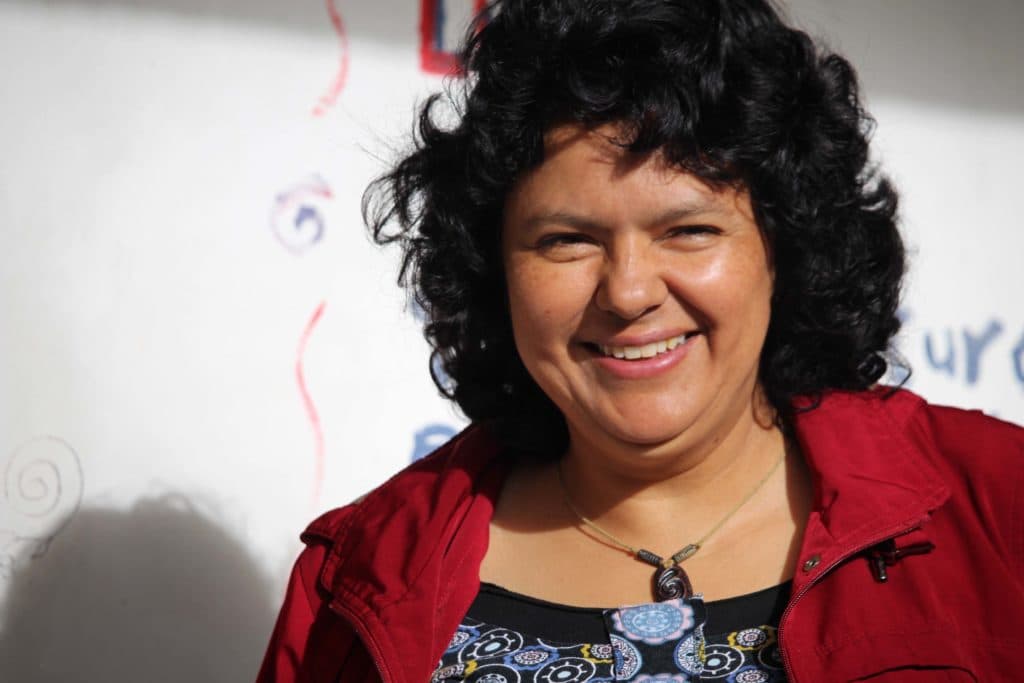
Honduran · Activism · Politics
Berta Caceres
March 4, 1971 – March 2, 2016
Early life and background
Bertha Isabel Cáceres Flores was born on 4 March 1971 in La Esperanza, in the mountainous department of Intibucá, Honduras.[2][6][9] She was of Lenca heritage, belonging to the largest indigenous group in the country.[2][6] Her mother, Berta Flores, was a midwife, community leader, and political activist who served as mayor and governor and opened the family home to refugees fleeing the civil war in neighboring El Salvador.[8][12] Growing up in this atmosphere of solidarity and political engagement exposed Cáceres to the realities of war, displacement, and rural poverty from an early age.
Cáceres attended local schools in La Esperanza and later pursued higher education, becoming a teacher.[5] As a student she became involved in activism, initially organizing against illegal logging on Lenca lands and participating in broader struggles against militarization and repression in Central America.[7][8] She was influenced by liberation theology, indigenous community traditions, and the revolutionary currents of the 1980s. During that decade she traveled to El Salvador to support the Salvadoran revolution, an experience that deepened her understanding of structural violence and the need for non‑violent paths of social transformation.[8]
Career beginnings and formation of COPINH
In 1993, at about twenty years of age, Cáceres co‑founded the Consejo Cívico de Organizaciones Populares e Indígenas de Honduras (COPINH), commonly translated as the Civic or Popular Council of Indigenous and People’s Organizations of Honduras.[2][6][7][16] COPINH emerged from campaigns against logging concessions and from broader demands by Lenca communities for recognition of land, cultural, and political rights. From its inception, the organization brought together indigenous, peasant, and other marginalized sectors to resist what its members saw as a new wave of dispossession driven by neoliberal economic reforms.
Cáceres quickly became one of COPINH’s principal leaders and later its general coordinator.[2][6][16] Under her guidance, COPINH adopted a strategy that combined community assemblies, road blockades, and public marches with legal advocacy grounded in international human rights and indigenous rights instruments. The organization challenged logging, hydroelectric, and mining concessions and opposed structural adjustment policies that privatized public services and natural resources.[7][10]
Struggles for indigenous rights and autonomy
One of COPINH’s earliest major achievements was its role in securing Honduras’s ratification of International Labour Organization Convention 169 on Indigenous and Tribal Peoples. In 1994, after sustained mobilization, the Honduran state ratified the convention, committing itself to respect indigenous peoples’ rights to free, prior, and informed consultation and to protect their lands and cultural integrity.[7][11] COPINH, with Cáceres among its leaders, framed this ratification as a collective conquest that would serve as a legal shield against future projects imposed without community consent.
In the same period, COPINH supported the creation of indigenous municipalities in western Honduras. Notably, it helped achieve the establishment of San Francisco de Opalaca as the first recognized indigenous municipality in the department of Intibucá.[10][11] This and similar initiatives in Lempira and La Paz allowed Lenca communities greater control over local governance and land use decisions. Cáceres emphasized that indigenous municipalities were essential for defending territory and ancestral forms of self‑government in the face of external economic pressures.
COPINH also engaged in struggles over historical memory and public symbolism. In 1998, the organization led an action to remove a statue of Christopher Columbus from outside the National Congress in Tegucigalpa and to replace it with a statue of Lempira, a sixteenth‑century Lenca leader celebrated for his resistance to Spanish conquest.[10] The replacement challenged the glorification of colonization and asserted the centrality of indigenous resistance in Honduran history. The Lempira statue continues to stand in the plaza, a lasting testament to this symbolic victory.
Defense of territory and the Agua Zarca conflict
From the 2000s onward, Cáceres and COPINH increasingly confronted large‑scale extractive and infrastructure projects. Honduras, like many Latin American countries, pursued an aggressively neoliberal development model that relied on mining concessions, hydroelectric dams, and agro‑industrial expansion. Indigenous and rural communities often faced eviction, environmental degradation, and loss of access to water and forests.[7][8]
In 2006, Cáceres helped lead a lengthy campaign against a Chinese dam‑building company backed by the Honduran government and international financial institutions, opposing plans to dam rivers in areas of indigenous significance.[9] This experience informed COPINH’s later strategy and highlighted the complex alliances linking local elites, transnational corporations, and global financiers.
The conflict that would define Cáceres’s international profile began in the early 2010s with the Agua Zarca hydroelectric project on the Río Gualcarque, a river sacred to the Lenca people and vital for their livelihoods. The Honduran company Desarrollos Energéticos S.A. (DESA) secured a concession to build a series of dams, backed by international investors and dam builders.[1][6] Lenca communities, organized through COPINH, argued that they had not been properly consulted and that the project violated their rights under ILO Convention 169.
In 2013, COPINH and residents of Río Blanco launched a sustained community blockade against Agua Zarca.[8][12] They set up encampments and roadblocks to prevent construction equipment from reaching the area, underscoring that the river was central to their spiritual and material life. The protest was met with militarization, threats, and violent attacks; community leader Tomás García was shot and killed by the Honduran army during a demonstration, and others were injured.[6] Despite this repression, the blockade persisted and succeeded in halting construction.
As the conflict intensified, Cáceres and COPINH brought their case to international forums. They denounced human rights violations and urged foreign investors and multilateral institutions to withdraw from Agua Zarca. The campaign targeted Sinohydro, the world’s largest dam builder, and European and multilateral financiers associated with the project.[1][3] Through sustained advocacy, they significantly raised the reputational risks of continuing involvement.
Awards, honors, and international recognition
Cáceres’s activism attracted growing international attention. In 2012, she received the Shalom Award in Germany, granted by a Catholic academic community to recognize non‑violent struggles for justice and peace.[11][14] The award highlighted her leadership in defending indigenous rights and environmental integrity in Honduras and underscored the ethical dimensions of her work.
In 2014, she was honored in Asturias, Spain, with the Nota Sol/Nota Cien Prize for her efforts to protect the Lenca people and to oppose destructive extractive projects.[11] This recognition helped extend solidarity networks in Europe and drew more attention to the Agua Zarca conflict and the broader situation of environmental defenders in Honduras.
The most prominent recognition came in 2015, when Cáceres received the Goldman Environmental Prize, often described as the world’s most prestigious award for grassroots environmental activism.[1][2][4][6] The prize cited her leadership of a grassroots campaign that successfully pressured Sinohydro to withdraw from the Agua Zarca project.[1][6] On 20 April 2015, she was formally presented with the prize at a ceremony in San Francisco.[1][3] In her acceptance speech and subsequent interviews, she emphasized the collective nature of the struggle and warned that environmental defenders in Honduras faced grave danger.
In the same year, Cáceres received the Monsignor Romero Award in the United States, honoring her commitment to human rights and social justice.[11] The award linked her work to the legacy of Salvadoran Archbishop Óscar Romero and signaled the religious and ethical support for her cause among North American communities.
After her death, the United Nations Environment Programme (UNEP) posthumously named her a Champion of the Earth in 2016, recognizing her as an emblematic environmental defender whose life and assassination illustrated the risks faced by those protecting nature and human rights.[14]
Personal life and feminist perspectives
Cáceres had a long‑term partnership with fellow activist Salvador Zúniga, with whom she shared organizing work in COPINH.[6] They had children together, and accounts emphasize that she balanced intense political commitments with family responsibilities, often bringing her children to community activities and teaching them about indigenous identity and solidarity.[11][12]
Her activism was explicitly feminist. She spoke about the intersection of patriarchy, racism, and capitalism, and emphasized that indigenous women were disproportionately affected by land dispossession, militarization, and extractivist violence.[6][10] Within COPINH and in broader movements, she advocated for women’s leadership and challenged traditional gender roles. She supported campaigns against domestic violence and worked to ensure that women’s voices were central in community decision‑making about territory and development.
Reports and testimonies describe Cáceres as deeply spiritual, drawing on Lenca cosmology and Christian liberation theology. She understood rivers, mountains, and forests as living entities with rights, and she framed environmental defense as both a political and spiritual duty.[8][12] This perspective infused her speeches and writings and helped articulate an indigenous ecological ethic that resonated far beyond Honduras.
Later life, escalating threats, and assassination
As COPINH’s successes grew, so did the backlash. Cáceres faced constant surveillance, smear campaigns, and legal harassment, including criminal charges related to protests against Agua Zarca.[6][16] She received numerous death threats from individuals linked to local elites, security forces, and corporate interests. International organizations such as Front Line Defenders documented the risks she faced and called for protective measures.[16]
The Inter‑American Commission on Human Rights granted precautionary measures on her behalf, ordering the Honduran state to protect her and other COPINH members.[16] However, these measures were inadequately implemented. Cáceres repeatedly stated publicly that her life was in danger, particularly after the Goldman Environmental Prize increased her visibility and potentially threatened powerful economic interests.
On the night of 2 March 2016, armed intruders entered her home in La Esperanza and shot her to death.[2][8][9][11] She was 44 years old, just two days before her forty‑fifth birthday.[8][15] Mexican activist Gustavo Castro Soto, who was staying at the house as a guest, was wounded but survived.[6] Her assassination shocked Honduras and the international community, triggering protests, vigils, and urgent demands for justice.
Subsequent investigations and trials resulted in the conviction of several individuals, including DESA executives and military personnel, for participation in the plot to kill her.[6][15] Nonetheless, many observers, including COPINH and international NGOs, argue that the full network of intellectual authors has not been held accountable and that the case illustrates broader patterns of impunity in crimes against environmental and human rights defenders.
Legacy and historical impact
Berta Cáceres is widely regarded as one of the most important environmental and indigenous rights activists of the early twenty‑first century. Her work defending the Río Gualcarque and other territories helped demonstrate that community‑led resistance could successfully challenge powerful corporations and financiers on a global scale.[1][6][15] The withdrawal of Sinohydro and other investors from the Agua Zarca project is frequently cited as a landmark example of how human rights and indigenous consent standards can reshape development decisions.
Her assassination became a catalyst for increased international attention to the dangers faced by environmental defenders. Organizations such as Global Witness have highlighted Honduras as one of the world’s deadliest countries for land and environmental activists and have used her case to call for stronger protections and accountability mechanisms.[15] UNEP’s recognition of her as a Champion of the Earth further solidified her status as a symbol of courage and sacrifice.
Cáceres’s legacy also lies in her articulation of an intersectional perspective that connects indigenous sovereignty, environmental protection, feminist critique, and anti‑capitalist analysis. She argued that extractivist projects represent a continuum of colonial violence and that defending rivers and forests is inseparable from defending women’s bodies, community autonomy, and cultural survival.[6][10] This framework has influenced activists and scholars across Latin America and beyond.
Within Honduras, COPINH continues its work, guided by the principles she championed. The organization and her family remain central in campaigns demanding full justice in her case and in broader efforts to protect defenders. Educational initiatives, publications, and commemorations keep her memory alive, and her story is increasingly included in curricula and materials on environmental justice and women’s history.[13][20]
Internationally, Berta Cáceres has become a touchstone for discussions about corporate responsibility, the obligations of international financial institutions, and the role of states in safeguarding human rights in the context of development. Her life and death highlight the need to center indigenous and local communities in decision‑making about natural resources and to recognize the leadership of women on the front lines of these struggles.
Historical significance
For women’s history, Cáceres’s trajectory illustrates how an indigenous woman from a small Honduran town rose to global prominence by challenging entrenched systems of patriarchy, racism, and economic exploitation. She helped secure legal advances such as the ratification of ILO Convention 169 and the recognition of indigenous municipalities, led emblematic resistance to large‑scale dams, and received some of the world’s highest honors for environmental activism.
Her story underscores both the possibilities and the risks of women’s leadership in human rights and environmental movements. It shows how gendered violence intersects with political and economic interests, and it highlights the importance of transnational solidarity in supporting and protecting such leaders. In the broader historical record, Berta Cáceres stands as a symbol of the power of grassroots organizing and as a martyr whose life continues to inspire movements for justice across continents.
Dated achievements
11 indexed.
- Mar041971Activism
Birth in La Esperanza, Honduras
Birth of Bertha Isabel Cáceres Flores in La Esperanza, Intibucá, Honduras.
View details Wikipedia - Berta Cáceres - Mar011993Activism
Co-founding of COPINH
Co-founded COPINH, a pivotal organization for indigenous and environmental advocacy.
View details