← All women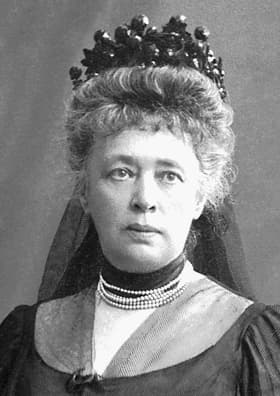
Austrian · Politics · Literature · Activism
Baroness Bertha Sophie Felicita von Suttner
June 9, 1843 – June 21, 1914
Early Life and Background
Bertha Sophie Felicita Kinsky, later known as Baroness Bertha von Suttner, was born on 9 June 1843 in Prague, then part of the Kingdom of Bohemia within the Austrian Empire. She was born into the aristocratic Kinsky family as the posthumous daughter of Count Franz Joseph Kinsky von Wchinitz und Tettau, a field marshal in the imperial army, and his second wife, Sophie Wilhelmine Kinsky, the daughter of a cavalry captain.[1][2][5][13] Her father died several months before her birth, leaving Bertha to be raised by her widowed mother in circumstances that combined noble status with reduced financial security.
As a child of the high aristocracy, Bertha grew up surrounded by military prestige and the culture of the Habsburg court, a background that would later sharply contrast with her outspoken pacifism.[1][2] She spent much of her youth in Vienna and on country estates, where she was educated privately by governesses and relatives rather than in formal schools, in line with upper-class expectations for girls. Her education included languages, literature, music, and philosophy, and she became fluent in several languages, including German, French, and Italian.[1][6][13] Autodidactic reading and discussion fostered a lifelong passion for philosophy, science, and social questions.
Although she enjoyed the privileges of rank, the family’s finances were strained, and Bertha was acutely aware of the precariousness of a woman’s position when dependent on marriage or family support. This early tension between social privilege and personal insecurity helped shape her later critiques of gender inequality and class society, as well as her insistence that women participate fully in public debates about war and peace.[9][13]
Career Beginnings and Development
In her twenties and thirties, Bertha moved increasingly into roles that reflected both the constraints and opportunities of her status. For a time she worked as a companion and governess in aristocratic households, an occupation typical for unmarried noblewomen who lacked substantial dowries.[13] In the 1870s she entered the household of the von Suttner family in Vienna as a companion to the daughters, where she met Baron Arthur Gundaccar von Suttner, a younger son of the family. Their intellectual and emotional bond deepened over several years, but the match lacked parental approval due to her lesser fortune and the couple’s limited prospects.[2][4][13]
In 1876, Bertha briefly served as a private secretary to Alfred Nobel in Paris, having responded to his advertisement for a secretary and housekeeper.[1][4][13] The arrangement lasted only a short time, but their acquaintance developed into a long-term correspondence. During these exchanges, Bertha discussed ideas of peace, disarmament, and the social responsibilities of science and industry with Nobel. Many historians credit her influence as one factor shaping his decision to establish a Peace Prize in his will, although Nobel’s motivations were complex and included other influences.[1][2][4]
Shortly after accepting the position, Bertha secretly married Arthur von Suttner in 1876, in defiance of his family’s wishes, and the couple left for the Caucasus region of the Russian Empire, settling first in Georgia.[1][4][13] From 1876 to 1885 they lived largely as émigrés, supporting themselves through literary work, translations, journalism, and music lessons. This period was formative: Bertha observed the impacts of the Russo-Turkish conflicts and imperial politics at closer range, experiences that deepened her skepticism toward war and helped crystallize the themes that would later dominate her writing.[1][4][6][13]
Transition to Political Writing and Early Works
During the Caucasus years, Bertha began to establish herself as a writer, initially producing short stories and feuilletons under pseudonyms so as not to compromise the family’s reputation.[6][13] Her early fiction often centered on women’s inner lives, social constraints, and the moral questions posed by progress and modernity. She and Arthur collaborated on some literary projects, reflecting a partnership based on intellectual as well as emotional companionship.[4][13]
In 1885, after a reconciliation with Arthur’s family, the couple returned to Austria and settled again in Vienna.[1][4] Bertha intensified her literary output and widened its scope to explicitly philosophical and political themes. In 1883 she published one of her first significant political works, Inventarium einer Seele (Inventory of the Soul), in Leipzig, a text exploring moral and psychological questions about the individual in an age of social change.[13] This work marked her emerging voice as a critic of contemporary society and as a thinker concerned with ethics, progress, and responsibility.
By the late 1880s, she was increasingly preoccupied with the question of war. She followed international affairs closely, read widely in contemporary peace writings, and began corresponding with activists in what was then a relatively small but growing international peace movement. Her writing shifted from purely literary concerns to the problem of militarism, the arms race, and the human costs of conflict.[1][5][9]
“Das Maschinenzeitalter” and the Road to “Die Waffen nieder!”
In the spring of 1889, Bertha published Das Maschinenzeitalter (The Machine Age), a work structured as a series of fictional lectures commenting on the technological and social transformations of the late nineteenth century.[9][13] The book critiqued the uncritical worship of progress and addressed the ambivalence of industrialization: while machines promised efficiency and comfort, they also enabled unprecedented destructive power in warfare.
Das Maschinenzeitalter brought her into contact with progressive and pacifist circles across Europe, but it was soon overshadowed by her next work, which would make her famous. Later in 1889, she published the novel for which she is best known: Die Waffen nieder! Eine Lebensgeschichte (Lay Down Your Arms! A Life Story).[1][2][5][11][13] The novel is narrated by a Viennese aristocratic woman, Martha Althaus, whose personal tragedies—losses of loved ones in successive wars—expose the human cost of militarism and the hollowness of nationalist glorification of war.
The book departed from conventional war literature by centering the perspective of a woman and focusing on civilian suffering rather than battlefield heroics. It combined emotional narrative with detailed, realistic depictions of contemporary European conflicts, making it both a gripping story and a vehicle for political argument.[1][5][13] Translated into numerous languages and continuously reprinted, Die Waffen nieder! achieved enormous popularity and has often been compared to Harriet Beecher Stowe’s Uncle Tom’s Cabin for its role in mobilizing opinion—this time against war rather than slavery.[2][5]
Organizational Pacifism and International Activity
The success of Die Waffen nieder! transformed Bertha von Suttner from a novelist into a central public figure in the peace movement. In 1891 she founded the Austrian Peace Society (Österreichische Friedensgesellschaft) and became one of the leading organizational pacifists in Central Europe.[1][5][8][9][13] She served as its president and used it as a platform to press for international arbitration, disarmament, and peace education.
In 1892, together with the Austrian pacifist Alfred Hermann Fried, she co-founded the journal Die Waffen nieder!, named after her novel, to disseminate peace ideas and report on international congresses and initiatives.[8][9][13] The journal provided a transnational forum for debate among activists, intellectuals, and politicians. In 1899, it was renamed Die Friedens-Warte, and von Suttner remained an important contributor and public voice associated with it.[8][9]
Von Suttner also rose to leadership in the broader international movement. She became vice president of the International Peace Bureau (IPB) in Bern, later its honorary president, and attended numerous international peace congresses.[1][5][13] In 1899 she participated in the First Hague Peace Conference, where states discussed arbitration mechanisms, the laws of war, and the establishment of a Permanent Court of Arbitration.[1][5][9] Her presence, while unofficial and representing civil society rather than a government, underscored the growing influence of non-state actors—especially women—in international diplomacy.
Her memoirs, Memoiren (Memoirs), published in 1901, further solidified her international reputation, offering insight into her intellectual development, her marriage, and her increasing dedication to peace work.[9][12][13] The English translation, The Records of an Eventful Life, brought her story to Anglophone audiences and helped secure her status as an icon of peace activism.
Major Works and Ideas
Von Suttner’s literary output was substantial; she wrote around thirty novels as well as essays, pamphlets, and speeches.[6][13] Yet several works stand out for their influence on political thought and the peace movement:
- Die Waffen nieder! Eine Lebensgeschichte (1889) – Her most famous work, an anti-war novel that humanized the victims of war and criticized militarism, conscription, and nationalist ideology.[1][2][5][11][13]
- Das Maschinenzeitalter (1889) – A reflection on the social and moral consequences of industrialization and technological progress, including their relationship to war.[9][13]
- Inventarium einer Seele (1883) – An early philosophical and psychological exploration of the modern self, foreshadowing her later moral concerns.[13]
- Memoiren (1901) – Her autobiographical work, crucial for understanding her intellectual journey and the evolution of organized pacifism.[9][12][13]
Across these and other texts, several themes recur. She argued that war was not a natural or inevitable condition but a socially constructed institution sustained by education, propaganda, and economic interests. She emphasized the role of public opinion and literature in delegitimizing war and insisted that international arbitration and legal institutions could replace armed conflict as a means of settling disputes.[1][5][13]
Her feminism was often implicit rather than programmatic, but she linked the struggle against war to broader demands for women’s emancipation. By giving a woman protagonist a central voice in Die Waffen nieder!, she highlighted women’s experiences of war—bereavement, displacement, economic hardship—and asserted that women had a right and duty to intervene in political questions that so profoundly affected their lives.[2][9][13]
Awards, Honors, and Recognition
Von Suttner’s most decisive public recognition came with the Nobel Peace Prize of 1905. On 10 December 1905, the Norwegian Nobel Committee awarded her the Peace Prize, citing her authorship of Lay Down Your Arms! and her leadership in the peace movement.[3][5][8] She was the first woman to receive the Nobel Peace Prize and only the second woman to receive any Nobel Prize, following Marie Curie’s Physics award in 1903.[3][5]
The official presentation of the prize took place on 16 April 1906.[9] The award recognized not only her novel and organizational work but also her role in popularizing the idea that peace was a practical political goal rather than a utopian dream. It also tacitly acknowledged her influence on Alfred Nobel’s decision to create a Peace Prize, an influence widely noted in contemporary and later accounts.[1][2][4]
Beyond the Nobel, she received numerous honors from peace societies and progressive organizations across Europe and the United States. She was appointed honorary president of the International Peace Bureau and became a sought-after speaker at international conferences. Her public stature was such that newspapers in major cities reported on her travels and lectures, treating her as a moral authority on questions of war and peace.[1][5][10][12]
Personal Life and Marriage
Bertha’s personal life was closely intertwined with her intellectual and political work. Her marriage to Baron Arthur Gundaccar von Suttner, solemnized on 12 June 1876, was initially conducted in secret because his aristocratic family feared the union would endanger his social and financial prospects.[13] Despite the tensions this caused, the marriage became a partnership founded on shared literary work, mutual respect, and a common commitment to progressive causes.
The couple had no children, a fact that may have facilitated Bertha’s unusual mobility and public engagement compared to many women of her class and time.[13] Arthur supported her writing career, collaborated on some projects, and accepted their relative financial precarity during the Caucasus years. He died in 1902, after which Bertha continued her work as a widow, often referencing his memory and their shared experiences in her speeches and writings.[1][13]
Her long intellectual friendship and correspondence with Alfred Nobel was another significant relationship. Although their personal association in 1876 was brief, their letters over subsequent decades reveal a mutual respect and an exchange of ideas about science, ethics, and peace. Nobel regarded her as a serious interlocutor, and her arguments in favor of supporting peace initiatives likely reinforced his inclination to create a Peace Prize.[1][2][4]
Lectures, Travel, and International Influence
From the 1890s onward, Bertha von Suttner complemented her writing and organizational work with extensive lecture tours. She believed that changing public opinion required personal engagement and persuasive oratory as well as texts. She spoke at peace congresses, women’s organizations, and public meetings across Europe.
In 1904, she undertook a significant tour of the United States, where she lectured widely and met with leading intellectuals, reformers, and philanthropists.[9][12] Her visit aimed both to raise funds for peace activities and to strengthen transatlantic networks of peace organizations. American audiences, already familiar with Lay Down Your Arms!, greeted her as an international celebrity of the peace cause. Her tour helped solidify the linkages between European and American peace movements in the years before World War I.
She returned to the United States in 1911 for another major speaking tour, again using lectures, interviews, and meetings with civic leaders to advocate for arbitration treaties and to warn against arms races.[9][12] Between these American visits she continued to be a prominent participant in European peace gatherings and attended the Second Hague Peace Conference in 1907–1908, where she again championed strengthened international legal institutions.[1][5][9]
Later Life and Final Years
After receiving the Nobel Peace Prize, von Suttner’s authority within the peace movement grew, and she used her enhanced visibility to intensify her advocacy. She continued writing articles, pamphlets, and books on peace and international relations and remained closely involved with the Austrian Peace Society and the International Peace Bureau.[1][5]
The early twentieth century, however, saw rising international tensions. Naval and military arms races, crises in the Balkans, and a general hardening of nationalist attitudes made the work of pacifists more difficult. Von Suttner responded by sharpening her warnings about the catastrophic consequences of a major European war. She argued that war would not only cause immense human suffering but also destroy the material and moral foundations of civilization.[1][5][13]
Her health declined in the early 1910s, but she continued to speak and write as much as possible. She remained in Vienna, observing with alarm the deteriorating political situation in Europe. On 21 June 1914, she died in Vienna at the age of seventy-one.[1][2][5][9][14] Only a week later, on 28 June, Archduke Franz Ferdinand was assassinated in Sarajevo, triggering the July Crisis and, soon after, the outbreak of World War I. Many contemporaries and later commentators have noted the tragic irony that one of the era’s foremost opponents of war died just before the conflict that most dramatically confirmed her worst predictions.
Legacy and Historical Impact
Bertha von Suttner’s legacy is multifaceted, spanning literature, international politics, women’s history, and the institutionalization of peace activism. Her novel Die Waffen nieder! remains a landmark of anti-war literature, notable both for its narrative power and for its centering of women’s experiences. Its wide readership helped to normalize the idea that war’s costs were intolerable and that peace could be a legitimate object of organized political effort.[1][2][5][11]
As an organizer and public intellectual, she played a central role in transforming scattered peace sentiments into a more coherent international movement. The Austrian Peace Society, the journal Die Waffen nieder! / Die Friedens-Warte, and the International Peace Bureau all bear the imprint of her leadership. These organizations, in turn, influenced the thinking that later underpinned the creation of the League of Nations after World War I and, ultimately, the United Nations system, particularly in their emphasis on arbitration and international law.[1][4][5][18]
Her influence on Alfred Nobel and the early history of the Nobel Peace Prize is also significant. While Nobel’s motivations were varied, von Suttner’s correspondence and advocacy clearly encouraged him to view peace work as both intellectually serious and deserving of material support.[1][2][4] By later becoming a laureate herself, she embodied the type of actor—civil society leader and moral critic of war—that the prize would often recognize.
In the history of women’s rights, von Suttner is remembered as an early and highly visible example of a woman exercising international political influence without holding public office. She navigated a male-dominated diplomatic world and gained recognition from governments and international institutions on the strength of her writing and organizing. Her life demonstrated that women could shape debates on international security and law, foreshadowing the later development of feminist approaches to peace and security.[2][9][12][13]
Modern scholarship and commemorations in Austria, Germany, and beyond continue to highlight her pioneering role. Institutions such as the United Nations Library in Geneva and various peace research centers curate collections on her writings and the movements she helped build.[18] Streets, schools, and organizations bearing her name testify to her lasting symbolic power as a "woman ahead of her time" and a foundational figure in the global history of pacifism.
Assessment
Viewed in retrospect, Bertha von Suttner’s life and work illustrate both the possibilities and limits of pre–World War I liberal internationalism. She helped create a language and organizational infrastructure for opposing war that would be drawn upon by later generations, even as the Great War revealed the depth of the forces she struggled against. Her insistence that peace is not merely the absence of war but a project requiring institutions, education, and moral courage remains relevant to contemporary peacebuilding debates.
As a writer, she demonstrated that literature can be a form of political intervention, capable of reshaping public sentiment and motivating collective action. As an activist, she modeled transnational collaboration long before contemporary notions of global civil society became common. And as a woman in a militarized aristocratic culture, she transformed the privileges and contradictions of her background into a powerful critique of that culture’s most cherished institution—war itself.
Today, Bertha von Suttner stands as one of the most important figures in the history of the peace movement and a central figure in women’s international history: a novelist whose words crossed borders and a campaigner whose ideas helped lay the groundwork for the modern quest for international peace and security.[1][2][3][5][9][13][18]
Dated achievements
4 indexed.
- Jun091843Activism
Birth in Prague
Bertha Sophie Felicita Kinsky was born in Prague, then part of the Austrian Empire, into an aristocratic military family.
View details Bertha von Suttner – Facts, Nobel Prize - Dec101905Activism
First woman awarded the Nobel Peace Prize
Bertha von Suttner became the first woman ever awarded the Nobel Peace Prize, and the first Austrian Nobel laureate.