← All women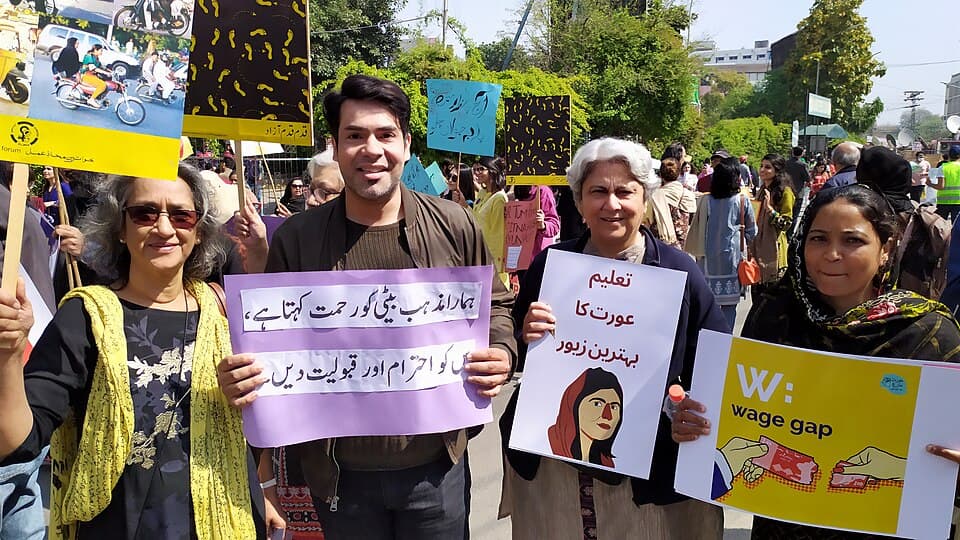
Pakistani · Activism
Aurat March
Unknown – present
Overview
Aurat March is a Pakistani feminist street protest movement that began on 8 March 2018 and is held annually on International Women’s Day in multiple cities across Pakistan. The movement is associated with women’s collectives, including Hum Aurtein and allied feminist and rights-based organizations, and has become one of the most visible contemporary expressions of women’s activism in Pakistan. It is not a person, but a social movement; accordingly, it has no birth or death date, family background, or personal life in the usual biographical sense. Its significance lies in its emergence as a recurring public demonstration demanding women’s rights, bodily autonomy, labor justice, and an end to gender-based violence.
Origins and early context
The roots of Aurat March lie in the political and social environment of Pakistan in the years leading up to 2018, when women’s rights activism had already been shaped by long struggles against legal discrimination, patriarchal norms, and violence. Feminist organizing in Pakistan has deep precedents, including earlier women’s protests against military rule and discriminatory laws. Aurat March drew on this broader history while also responding to contemporary forms of misogyny, harassment, and inequality that were becoming increasingly visible in public debate.
The first march, held in Karachi, Lahore, and Islamabad on International Women’s Day in 2018, was organized by women’s collectives and received support from a range of feminist, labour, and rights organizations. It was reported as the first Aurat March and quickly became a landmark in Pakistan’s women’s movement. The choice of International Women’s Day was symbolically important: it linked local demands to a global day of feminist mobilization while asserting that women in Pakistan had specific, urgent concerns of their own.
2018: the first march and the emergence of a public platform
The inaugural Aurat March was notable for its public visibility and the breadth of its demands. Participants called for greater accountability for violence against women, recognition of labor rights, maternity leave, daycare support, and social justice for women who are often excluded from public life. The march also created an arena in which women could speak publicly about their bodies, work, and safety. In a society where women’s movement through public space is frequently regulated, that act of collective presence was itself politically significant.
At the same time, the march’s organizers established it as a platform rather than a one-time demonstration. Feminist collectives such as Hum Aurtein helped articulate a broad, non-party agenda, making space for concerns including reproductive justice and gender-based violence. This structure allowed the movement to grow while remaining flexible enough to include diverse participants and causes. The result was a protest that was both locally grounded and broad in vision.
The march was met with attention, support, and backlash. That reaction was part of what made the event historically important: it made women’s rights impossible to ignore in mainstream political discussion. In that sense, the first Aurat March did more than gather marchers; it reconfigured public debate, forcing new conversations about feminism in a conservative social context.
Annual expansion and consolidation
In 2019, Aurat March returned on March 8 and expanded into additional cities. The repeated organization of the event transformed it from an inaugural protest into a durable annual tradition. By continuing on the same symbolic date, organizers made the march a recurring civic ritual that could accumulate memory, slogans, and political force. This annuality mattered because it showed that the movement had survived beyond its initial novelty and had become a continuing presence in Pakistan’s public life.
In 2020, the theme Khud Mukhtari placed autonomy at the center of the march’s political language. This was a notable development because it broadened the movement’s focus from opposition to violence and discrimination toward a more expansive claim over women’s bodily, economic, legal, and social self-determination. The theme reflected the march’s growing intellectual ambition and its willingness to challenge the boundaries of what could be said publicly about women’s lives.
In 2021 and 2022, the march continued on International Women’s Day and drew increasing attention from scholars, journalists, and activists. Academic discussion began to frame Aurat March as a key case study in contemporary feminist activism in South Asia. Its annual recurrence and thematic evolution demonstrated that it was not merely reactive, but an evolving political formation capable of setting agendas and shaping public language.
Public reception, controversy, and significance
Aurat March became famous not only for its demands but also for the controversy it generated. Critics often objected to its slogans and to the presence of women and allies in public streets. Supporters argued that these objections revealed the very inequalities the march sought to confront. This tension between public visibility and social backlash is central to the movement’s historical significance. By insisting on the right to occupy public space, Aurat March challenged both explicit discrimination and more subtle forms of social policing.
The movement also became an important site for debates about secularism, religion, class, labor, sexuality, and intersectionality. Some analyses describe it as a secular liberal feminist movement; others emphasize its coalition character and its attempts to speak for women across different social positions. What is consistent across these interpretations is that Aurat March opened a public space in which women’s rights could be discussed as a structural issue rather than a private concern.
Over time, the movement’s themes expanded to include environmental justice, reproductive justice, economic justice, and the rights of marginalized communities. That broadening is significant because it reflects a shift from a single-issue march to a more comprehensive feminist politics. Aurat March’s endurance suggests that the movement has achieved something rare in protest politics: it has created a recurring public institution of dissent.
Relationship to earlier women’s struggles
Aurat March is frequently linked to earlier struggles by Pakistani women, especially the anti-Zia protest of 12 February 1983, when women demonstrated against discriminatory laws and martial-law restrictions. The 2025 National Women’s Day march explicitly honored that history, showing that Aurat March sees itself as inheriting a long tradition of feminist resistance. This historical memory matters because it situates the movement not as a sudden import or isolated event, but as part of a continuous domestic struggle over women’s citizenship and rights.
By reviving street protest as a feminist tactic, Aurat March connected present-day activism with earlier generations who had confronted authoritarian power and legal discrimination. The movement’s ability to place itself in that lineage has helped it gain legitimacy among supporters and scholars alike. Its commemorative work is therefore part of its political work: it preserves memory while mobilizing the present.
Legacy
Aurat March’s most important legacy is its transformation of International Women’s Day into a major public platform for feminist politics in Pakistan. Since 2018, the march has helped normalize the idea that women have the right to demand safety, autonomy, labor protections, and dignity in public. It has also given younger generations of activists a recognizable annual structure through which to organize, assemble, and speak.
The movement has become a defining symbol of contemporary Pakistani feminism. Its annual presence demonstrates the persistence of feminist organizing despite backlash and attempts to delegitimize it. For historians of women’s activism, Aurat March is significant not because it ended gender inequality, but because it made women’s claims more publicly visible, more politically legible, and more difficult to ignore.
As a living annual movement, Aurat March continues to evolve. Its legacy is still being written in the streets, through slogans, themes, and coalitions that connect women’s rights to the broader struggle for social justice in Pakistan.
Dated achievements
11 indexed.
- Mar082018Activism
Inaugural Aurat March held in Karachi, Lahore, and Islamabad
The first Aurat March took place on International Women's Day 2018 in three major Pakistani cities, launching a new annual feminist street protest movement.
View details Aurat March - Wikipedia - Mar082018Activism
Hum Aurtein–led Aurat March platform established
Hum Aurtein and allied feminist collectives organized the inaugural Aurat March in Karachi and Lahore, creating a broad non-party feminist platform.