← All women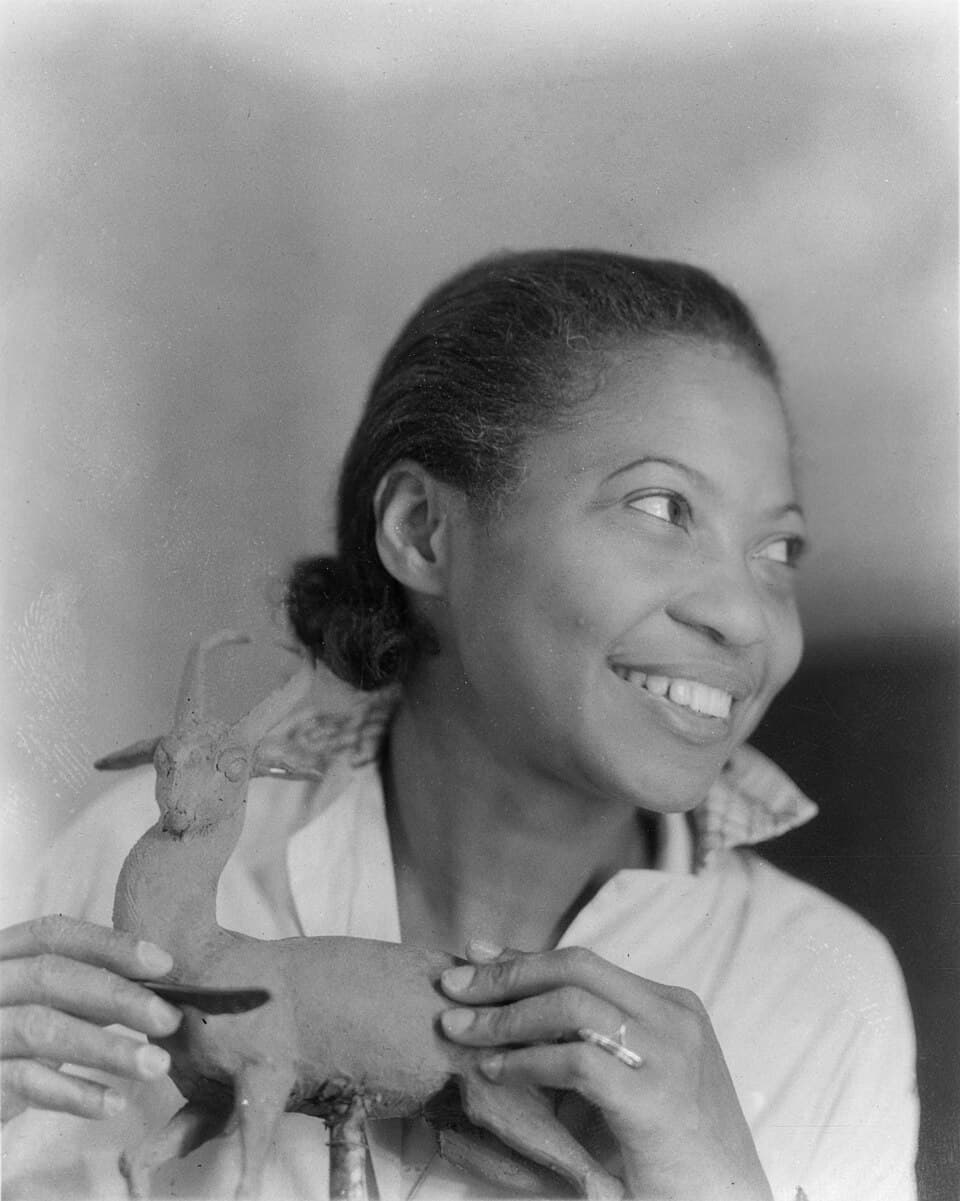
American · Arts · Activism
Augusta Savage
February 29, 1892 – March 26, 1962
Early life and background
Augusta Savage was born Augusta Christine Fells on February 29, 1892, in Green Cove Springs, Florida. She was the seventh of fourteen children born to Edward Fells and Cornelia Murphy Fells. Her father was a Methodist minister who strongly discouraged her early interest in making art, an opposition that reflected both family expectations and the wider social limits placed on Black girls in the post-Reconstruction South. Despite this resistance, Savage showed an early talent for modeling figures in clay and mud, a practice that would become the foundation of her career as a sculptor.
Growing up in Florida during the era of Jim Crow segregation, Savage encountered severe racial and economic barriers. Formal opportunities for Black artists were scarce, and the idea that a Black woman might become a professional sculptor was exceptional. In childhood and adolescence she continued to make figures, developing a tactile sense for form and expression that later distinguished her portrait busts and figurative sculpture. Her early life was shaped by poverty, family conflict over art, and the broader exclusion of African Americans from professional art education.
In the 1910s, Savage married, had a child, and experienced personal hardships that pushed her toward greater independence. The exact details of her early marriages are often summarized differently across sources, but it is historically clear that she was a mother and that family responsibilities shaped her life decisions. By the time she left Florida for New York, she had already shown both persistence and ambition in pursuing art against substantial odds.
Education and move to New York
Savage moved to New York City in 1919, where she pursued formal art study and made contact with the city’s expanding Black cultural community. She enrolled at the Cooper Union School of Art, where her talent quickly became evident. In a period when Black students faced discrimination in higher education, Savage’s success at Cooper Union was itself notable. She completed the school’s four-year program in three years, an indication of both ability and intensity of purpose.
Her move to New York placed her in the center of the emerging Harlem Renaissance. The city offered greater access to artists, patrons, journalists, and educators than she had known in Florida, yet racism remained a constant barrier. Savage supported herself through a combination of commissions, teaching, and institutional support, and she gradually became known for small-scale busts and portraits of Black subjects. Her work was distinctive for its dignity, psychological presence, and refusal of caricature.
In 1923 she won a scholarship to study at the Fontainebleau School of Fine Arts in France, but her admission was revoked after authorities learned she was Black. Savage publicly protested the exclusion, and the incident drew press attention. The episode exposed the contradictions of the international art world, which often celebrated artistic universality while enforcing racial exclusion. Her response established her reputation not only as a sculptor but also as an advocate who challenged discriminatory institutions.
Harlem Renaissance career
By the late 1920s, Savage had become one of the most visible Black sculptors in the United States. She received a Julius Rosenwald Fund Fellowship in 1929 and another in 1931, financial awards that helped sustain her work during a period when patronage was especially important to Black artists. These fellowships recognized her talent at a national level and made possible continued artistic development. They also helped place her among the leading visual artists associated with the Harlem Renaissance.
Savage was admired for her portrait busts of prominent Black figures and for sculptures that portrayed everyday Black life with empathy and seriousness. One of her best-known works, Gamin, presented a young Black subject with realism and tenderness rather than stereotype. Another major work, Lift Every Voice and Sing, later popularly called The Harp, became one of the defining sculptural statements of her career. Savage was also a teacher and mentor, and her studio became a training ground for younger artists.
In 1934, she became the first African American member of the National Association of Women Painters and Sculptors, a breakthrough that acknowledged her standing within a major professional art organization. This was an important barrier-breaking achievement for a Black woman artist in a field dominated by white institutions. Her election signaled that her work had achieved recognition beyond Harlem, while also revealing how exceptional such recognition remained.
In 1935, Savage co-founded the Harlem Artists Guild with Charles Alston, Elba Lightfoot, and others. The organization advocated for fair access to educational and financial resources for Black artists and helped lay the groundwork for more stable arts infrastructure in Harlem. Savage’s role in this effort showed her commitment to collective advancement, not just individual success.
Her influence expanded further in 1937, when she became the first director of the Harlem Community Art Center, a WPA-funded institution that offered instruction and professional support to artists in the neighborhood. Under her leadership, the center became a major site of cultural training and exchange. It also helped nurture artists who would later become central figures in twentieth-century American art.
World’s Fair and institutional leadership
In 1939, Savage reached a national audience through her commission for the New York World’s Fair. Her monumental sculpture Lift Every Voice and Sing was among the fair’s most memorable works. She was the only Black artist and one of only four women chosen to contribute a sculpture to the fair’s Fine Arts section. Although the original plaster work was destroyed after the fair, it remains a landmark of Black modern art because of its ambition, symbolism, and visibility.
Also in 1939, Savage opened the Salon of Contemporary Negro Art in Harlem. Widely regarded as the first art gallery in the United States owned and directed by an African American woman and devoted primarily to Black artists, the gallery was an extraordinary assertion of independence. It created a space where Black artists could exhibit work outside white-dominated institutions and where Black cultural production could be evaluated on its own terms.
These achievements show Savage at the height of her powers as both artist and institution builder. She was not only producing sculpture; she was building structures that could sustain a broader community of Black creative workers. That dual role is central to her importance in American cultural history.
Later life
By the early 1940s, Savage gradually withdrew from the New York art scene. The causes of this retreat are often described as a combination of financial hardship, institutional frustration, health problems, and changing personal circumstances. She eventually returned to Florida and later lived in upstate New York, where she remained more private and continued to work and teach on a smaller scale. Her later years were marked by reduced public visibility, even though she had once been one of the most prominent Black women artists in the country.
Sources consistently note that she spent her final years largely outside the mainstream art world. That relative obscurity stands in sharp contrast to the scope of her earlier influence. The public loss of many of her works further complicated her posthumous reputation, because surviving documentation and reproductions do not fully capture the scale of her achievement.
Personal life
Savage was married more than once and had one child, a daughter. Her personal life was shaped by the demands of motherhood, unstable finances, and the pressures placed on Black women who attempted professional careers in the early twentieth century. Although biographies often give more attention to her public accomplishments than to domestic details, her family responsibilities and relationships were part of the context in which she worked.
Her life also reflected a broader pattern among women artists of her era: the need to balance artistic ambition with economic survival, caregiving, and social expectations. Savage’s determination to continue working despite these pressures is part of what makes her career so historically compelling.
Legacy and historical impact
Augusta Savage is now recognized as one of the most important sculptors and arts advocates of the Harlem Renaissance. She helped redefine the place of Black subjects in American sculpture, insisting on dignity, realism, and cultural pride. Her portraits and figurative works contributed to a visual language of Black modernity at a moment when mainstream art institutions rarely supported such representation.
Her legacy is also institutional. Savage mentored younger artists, organized for resources, and created spaces in which Black art could thrive. Through the Harlem Artists Guild, the Harlem Community Art Center, and the Salon of Contemporary Negro Art, she helped build a more durable infrastructure for Black cultural life. Many artists who came after her benefited from the example she set and the opportunities she created.
At the same time, Savage’s story illustrates the costs of exclusion. Racism limited her training, destroyed opportunities, and contributed to the loss of work that might otherwise have survived. Yet those barriers also highlight the scale of her achievement: she built a significant artistic career in a society designed to deny Black women access to exactly such success. Today she is remembered not only for her sculpture but also for her leadership, activism, and insistence that Black art deserved a permanent place in American culture.
Death
Augusta Savage died on March 26, 1962, in New York City, after a long illness. Her death closed the life of a woman who had been central to the Harlem Renaissance and to the broader struggle for inclusion in American art. Although she died in relative obscurity, her historical importance has only grown as scholars, museums, and cultural institutions have restored her to the narrative of twentieth-century art.
Dated achievements
10 indexed.
- Feb291892Politics
Birth of Augusta Savage
Birth of Augusta Savage in Green Cove Springs, Florida, the future Harlem Renaissance sculptor and educator.
View details Britannica — Augusta Savage - Jun121923Activism
Protests racist exclusion from Fontainebleau program
Savage publicly protested racist exclusion from a French summer art program after her admission was revoked because she was Black.