← All women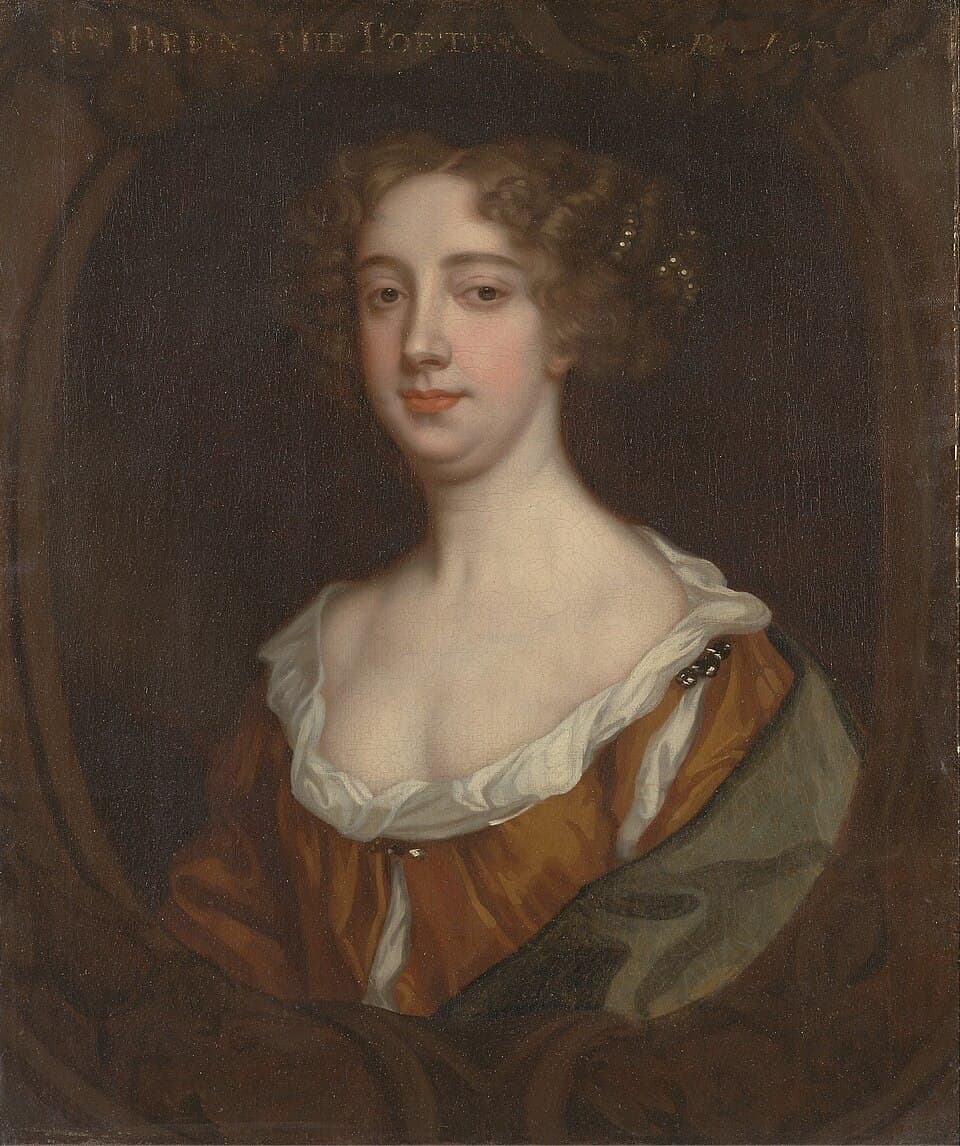
English · Literature · Arts
Aphra Behn
December 14, 1640 – April 16, 1689
Early Life and Background
Aphra Behn (baptised 14 December 1640 – died 16 April 1689) was an English playwright, poet, prose writer, translator, and spy associated with the Restoration era of Charles II. She is widely regarded as one of the first English women to earn her living by writing, a status that has made her an enduring symbol in the history of women’s authorship.[1][3][11][18]
Very little about Behn’s early life can be stated with certainty, and scholars frequently emphasize that her personal history is "very difficult to unravel."[3][18] Parish records show that a girl named Aphra (or Eaffrey) Johnson was baptised on 14 December 1640 at Harbledown, near Canterbury in Kent, and this entry is usually taken as belonging to the future writer.[2][3][15] Her birthplace is often given as Harbledown or nearby Wye, and later accounts identify her father as a barber or barber‑surgeon and her mother as a wet‑nurse, placing her origins firmly within the lower‑middle or artisan classes rather than the aristocracy.[8][10][18]
Several later narratives, and Behn’s own hints, suggest that she spent part of her childhood or youth in the English colony of Surinam (in present‑day Guyana and Suriname) on the northern coast of South America.[3][17] One common story is that her father, appointed to a minor colonial office, died en route, and the family continued to the plantation settlement. Whether or not this account is strictly accurate, Behn’s detailed descriptions of the landscape, peoples, and politics of Surinam in her prose narrative Oroonoko; or, The Royal Slave (1688) strongly indicate that she had first‑hand knowledge of the region.[3][17]
There is no firm evidence that Behn received formal higher education, and like most women of her time she probably lacked access to universities and the rigorous classical training available to men. Nonetheless, her later work demonstrates familiarity with French and Latin, suggesting that she acquired languages and literary knowledge through private study, informal tutoring, or self‑education.[2][4][5]
Marriage and Personal Circumstances
By the early 1660s, Behn—then still known as Aphra Johnson—appears to have married a merchant named Johann or John Behn, possibly of Dutch or German origin.[3][5] Details of the marriage are obscure: some accounts suggest that he was a London or Hamburg trader, and others that he died of illness not long after their union. Many scholars believe the marriage ended either in separation or in Behn’s widowhood by the mid‑1660s.[3][5][18] It is from this marriage that she took the surname "Behn" under which she would become known.
Later biographical notes and contemporary gossip link Behn to several intimate relationships, including with men named William (Will) Scott and John Hoyle, both of whom may have influenced characters in her plays or poems.[10] Hoyle, a lawyer notorious for his violent temper and bisexuality, appears in some sources as a long‑standing companion. The precise nature and chronology of these relationships remain uncertain, but they underscore Behn’s immersion in a cosmopolitan, often sexually transgressive social milieu associated with Restoration London.
Career Beginnings: Royalist Spy
Behn’s first documented professional role was not as a writer but as a royalist agent. During the Second Anglo‑Dutch War (1665–1667), she travelled to the Netherlands—specifically to Antwerp—on behalf of King Charles II’s government, using the pseudonym Astrea, a name she would later adopt as a literary persona.[3][5][13] Her mission appears to have involved gathering intelligence on English exiles and Dutch naval preparations, as well as attempting to secure the loyalty of the dissident colonel William Scot (or Scott).[13][18]
The spy venture was financially disastrous. Delays in reimbursement and the failure of promised funds left Behn deeply in debt; at one point she is believed to have been confined in debtor’s prison upon her return to England.[5][13] The episode was formative: it demonstrated the precariousness of relying on royal favor and underscored the need for a more stable form of income. These experiences as a female spy—rare in official records of the period—also shaped her later political writing, which sharply defended royal authority and critiqued republican or anti‑court factions.
Entry into the Theatre: The Forc’d Marriage and Early Plays
Facing financial difficulties in the late 1660s, Behn turned to the London theatre as a new source of livelihood.[5][10] The Restoration had reopened the theatres after the Puritan ban, and the playhouses of the Duke’s Company and the King’s Company became vibrant centers of entertainment, politics, and celebrity culture. Within this male‑dominated environment, Behn began to write plays for performance.
Her first known play, The Forc’d Marriage; or, The Jealous Bridegroom, was produced by the Duke’s Company in London in 1670, and around early September of that year it opened the company’s new season.[5][6] This professional staging signaled her emergence as a serious dramatist and is an early documented instance of an Englishwoman achieving a full‑length commercial production on the public stage.
In 1671, The Forc’d Marriage appeared in print, carrying the French epigraph "Va mon enfant! Prend ta fortune" (“Go, my child! Take your fortune”).[6] The publication, with Behn’s name attached, asserted her presence in the commercial book market and confirmed her status as a professional writer who expected to earn money from sales and performance fees.
Behn’s second play, The Amorous Prince (1671), further established her reputation, combining political intrigue with explorations of desire and honor.[5] She quickly became a regular provider of scripts for the Duke’s Company, and over the next decade she produced comedies, tragicomedies, and political allegories that engaged directly with contemporary anxieties over succession, religious conflict, and the so‑called "Popish Plot"—a fabricated Catholic conspiracy that fueled hysteria in the late 1670s.[10]
Major Dramatic Works: The Rover and Restoration Comedy
Among Behn’s many plays, The Rover; or, The Banish’d Cavaliers, first produced in 1677, became her most celebrated and enduring work.[3][5] Set in Naples during Carnival and centered on a band of exiled Royalists, the play offers a complex mix of romantic adventures, sexual bargaining, and political nostalgia. Its fast‑moving plot and vivid characters—especially the rakish hero Willmore—made it a favorite with audiences and ensured its continued revival in subsequent centuries.[3]
The Rover is notable for its frank treatment of female desire and its attention to the precarious position of women in a marketplace of sex and marriage. Characters such as the courtesan Angellica Bianca and the resourceful heroine Hellena reveal Behn’s interest in how women negotiate power, pleasure, and economic survival within patriarchal structures.[3][10] The play also reflects Behn’s Royalist sympathies, depicting exiled Cavaliers with a mixture of irony and admiration.
Behn wrote at least nineteen plays, including The Feigned Courtesans (1679), The City Heiress (1682), and The Lucky Chance (1686).[3][18] Many of these works sparked controversy for their sexual explicitness and politically charged content. Nonetheless, contemporary evidence suggests that her plays were popular with audiences and that she was a central figure in the theatrical world, providing more new plays for the London stage in the 1670s and 1680s than any other single author.[4][18]
Prose Fiction and the Early English Novel
As public appetite for new plays waned in the early 1680s—owing to political tensions, economic pressures, and shifting tastes—Behn began to focus increasingly on prose fiction, poetry, and translation.[10] Her transition from stage to page was partly a matter of survival: she needed to maintain income in a changing cultural environment. It also allowed her to experiment formally and to reach different audiences through print.
In 1684, she published Love‑Letters Between a Noble‑Man and His Sister, a multi‑part epistolary narrative based loosely on a notorious contemporary scandal involving the Earl of Rochester’s circle.[4][5] The work is often cited as an important milestone in the development of the English novel, both for its sustained psychological characterization and for its exploration of illicit desire and political faction through the medium of letters.[4][18] Some commentators have described it as one of the earliest English novels with a transatlantic dimension, though its exact status in that regard remains debated.[4]
Behn’s most influential prose work is Oroonoko; or, The Royal Slave, first published in 1688.[3][5] The narrative tells the story of an African prince captured and enslaved in the English colony of Surinam, his noble love for Imoinda, and their ultimate resistance to slavery. Behn’s depiction of Oroonoko as a heroic, cultured figure challenges contemporary racist stereotypes and presents slavery as morally abhorrent.
Critics have long debated the ideological complexity of Oroonoko, noting that while Behn condemns cruelty and betrayal, she remains a supporter of monarchy and does not fully reject colonial hierarchies.[3][17] Nonetheless, the work is widely regarded as one of the earliest English abolitionist or humanitarian fictions and as a foundation stone in the evolution of the English novel, particularly for its narrative voice, use of personal experience, and sustained attention to race, gender, and empire.[2][3][13][17]
Poetry, Translation, and Other Writings
Beyond drama and prose fiction, Behn produced a substantial body of poetry. Her verse appeared both in miscellanies and in dedicated collections such as Poems upon Several Occasions, with The Voyage to the Island of Love (1684) and Lycidus; or, The Lover in Fashion (1688).[5] These works explore themes of love, desire, friendship, and political loyalty, often with a frankness and wit that challenged conventional expectations of female modesty.
She was also an energetic translator, rendering texts from French and Latin into English. Among her projects were translations of works by the French writer Bernard de Fontenelle and other continental authors, including scientific and philosophical materials as well as romantic narratives.[4][13] Translation offered Behn both income and intellectual engagement, and it connected English readers to broader European currents of thought.
In addition, Behn wrote prose "histories" and novellas such as The Fair Jilt (1688), Agnes de Castro, and The History of the Nun; or, The Fair Vow‑Breaker, which continued her exploration of female agency, religious constraint, and emotional intensity. These works contributed to the diversification of early English fiction and reinforced her reputation as one of the period’s most versatile writers.[3][18]
Political Commitment and Controversy
Behn’s writing is deeply marked by her Royalist and pro‑Stuart sympathies. As a former spy for Charles II, she maintained a fierce loyalty to the monarchy and often used her plays and poems to defend royal authority against Whig and republican critics.[3][10] Works such as The Roundheads and The City Heiress satirize anti‑court factions and lampoon political opponents, while celebrating loyal Cavaliers.
Her outspoken politics and erotic candor made her a controversial figure. Some contemporaries attacked her as immoral or "lewd," and later eighteenth‑century critics marginalized or condemned her works on grounds of indecency.[3][18] The gendered nature of these critiques is evident: male Restoration dramatists frequently wrote material at least as explicit, yet Behn’s status as a woman intensified the suspicion and censure she faced.
Despite—or perhaps because of—these controversies, Behn’s plays were widely performed, and she enjoyed considerable fame in her lifetime. She occupied a complex position as both celebrated and scandalous, reflecting broader tensions about women’s participation in public culture.[2][10]
Economic Independence and Professional Authorship
One of the most historically significant aspects of Behn’s career is her sustained attempt to live by her pen. Contemporary and later sources emphasize that she was one of the first Englishwomen, and often described as the first, to earn her living through writing.[1][2][11][18] Unlike aristocratic women who wrote for private circulation or patronage, Behn relied on performance fees, publication profits, and occasional dedications to support herself.
Her economic situation was never comfortable; letters and prefaces suggest that she endured illness, debt, and periods of hardship. Yet she persisted in treating writing as a profession rather than a genteel pastime, negotiating with theatre companies, booksellers, and patrons in ways that foreshadow the modern author’s relationship to the marketplace.[3][18]
In later feminist criticism, this professional stance has been celebrated as a crucial break with the notion that women should write only privately or for moral edification. Behn’s emphasis on entertainment, profit, and personal voice carved out a new model for female authorship, one that would be taken up, in different forms, by writers such as Fanny Burney, Jane Austen, and the Brontë sisters.[8][15]
Later Life and Declining Health
By the late 1680s, Behn’s health was failing. Prefaces to her later works and contemporary references describe her as increasingly ill, yet she continued to write and publish, driven by both financial necessity and creative energy.[3][18] She produced prose narratives and translations up to the end of her life, even as physical weakness limited her ability to attend the theatre or participate fully in social life.
On 16 April 1689, Behn died in London.[2][3] She was buried in Westminster Abbey, in the east cloister, an area associated with distinguished clergy and cultural figures. Her grave is relatively simple, but its location within the Abbey signaled a degree of recognition and respect unusual for a woman writer of her time.[2][20]
Legacy and Historical Impact
In the immediate aftermath of her death, Behn’s works continued to be read and performed, but her reputation was vulnerable to shifting moral standards. As eighteenth‑century sensibility and Victorian prudery took hold, many critics and editors denounced or suppressed her more sexually explicit material, and she largely disappeared from canonical literary histories.[3][18]
The modern recovery of Behn began in the early twentieth century. In 1927, Vita Sackville‑West published a pioneering biography that argued for Behn’s importance as a writer and highlighted her adventurous life.[8] Two years later, in 1929, Virginia Woolf’s A Room of One’s Own famously declared that "all women together ought to let flowers fall upon the tomb of Aphra Behn" and characterized her as "the first woman in England to earn her living by writing."[8][14] Woolf’s essay played a crucial role in cementing Behn’s symbolic status as an ancestor of modern women writers.
From the 1970s onward, feminist scholars and literary historians undertook extensive work to edit, publish, and analyze Behn’s writings. Janet Todd’s research, including The Secret Life of Aphra Behn, and other documentary studies have provided more detailed accounts of her life and works, even as they underscore the many remaining uncertainties.[16] Academic interest has focused on her contributions to Restoration drama, the early novel, women’s writing, colonial discourse, and the history of sexuality.
Institutions have also recognized her significance. Modern reference works repeatedly identify Behn as a pioneering professional woman author and an innovator in prose fiction.[1][18] In recent years, Westminster Abbey and heritage organizations have used public platforms to commemorate her, emphasizing that she was one of the first women to earn a living by writing and acknowledging her role as a royal spy.[14][20]
Behn’s influence can be traced in several key areas:
- Women’s professional authorship: She demonstrated that a woman could negotiate directly with theatres and publishers, earning income from writing and asserting authorial identity.
- Restoration drama: Her plays helped shape the conventions of Restoration comedy, particularly in their treatment of gender, desire, and political allegory.
- Early prose fiction: Works like Love‑Letters and Oroonoko contributed to the formal and thematic development of the English novel.
- Colonial and racial representation: Oroonoko offered one of the earliest complex literary portrayals of an African protagonist in English, influencing later abolitionist narratives.
Today, Behn is studied not only as a writer of her time but as a figure whose life and career illuminate broader questions about gender, power, and the cultural marketplace. Her trajectory—from a poorly documented girl in Kent to a spy, celebrated dramatist, and foundational novelist—exemplifies both the possibilities and constraints faced by women in seventeenth‑century England.
Continuing Reassessment
Recent scholarship continues to refine our understanding of Behn. Researchers explore archival materials to clarify her early life, Surinam experiences, and spy missions, while literary critics re‑read her plays and prose through lenses of feminism, queer theory, postcolonial studies, and economic history.[13][18] Blogs, digital archives, and podcasts have brought her story to wider audiences, often emphasizing her status as the first professional woman writer in English and highlighting her bold explorations of gender and sexuality.[13][19]
Debates persist about how to define "professional" authorship and whether Behn should be considered absolutely the first woman to earn a living by writing in England. Nonetheless, there is broad consensus that she occupies a uniquely important place in the evolution of women’s literary labor. Her name now appears regularly in surveys of English literature, and her works are taught in university courses on drama, the novel, and women’s writing.
In this ongoing reassessment, Behn’s life continues to serve as a touchstone for discussions about authors’ rights, the economics of creative work, and the politics of representation. Her career illustrates how a woman, in a period of intense gender stratification and political turmoil, could harness wit, theatricality, and narrative power to shape both her survival and her legacy.
Dated achievements
8 indexed.
- Dec141640Science
Baptism at Harbledown, Kent
Aphra Behn was baptised at Harbledown, near Canterbury, Kent, on 14 December 1640 — the only securely dated marker of her birth.
View details Aphra Behn - Wikipedia - Sep011670Science
Debut of first play, The Forc'd Marriage
Behn's debut play The Forc'd Marriage opened the Duke's Company's new season around September 1670, launching her career as a Restoration playwright.