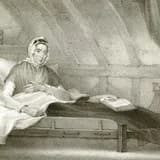
Ann Moore was buried on 3 October 1825 at Christ Church, Macclesfield, Cheshire, with the parish register noting her as 'The Fasting Woman.'
Ann Moore, once celebrated and then reviled as the 'fasting-woman of Tutbury,' was buried on 3 October 1825 at Christ Church in Macclesfield, Cheshire. The parish burial register makes explicit note of her infamous identity, marking the entry in the margin with the phrase 'The Fasting Woman' — a testament to how thoroughly her public deception had come to define her identity, even in death.
Following the exposure of her fraud in 1813, Moore had largely disappeared from public life, living out her remaining years in relative obscurity and reported poverty. The dramatic collapse of her once-celebrated status meant that the income and attention she had received during her years of fame evaporated, leaving her to navigate old age without the fame or fortune her earlier notoriety might have suggested.
Her burial site and the register's candid annotation reflect how enduring her infamy remained in local memory more than a decade after her exposure. The case of Ann Moore continued to be referenced throughout the nineteenth century in medical literature and popular writing as a landmark example of fraudulent claims of miraculous fasting, feeding into broader Victorian-era debates about hysteria, deception, and the reliability of eyewitness and testimonial evidence in medicine.
Her story endures today as a subject of historical curiosity, referenced by scholars studying the cultural history of fasting, bodily spectacle, and the intersection of medicine, religion, and public credulity in Georgian Britain.