← All women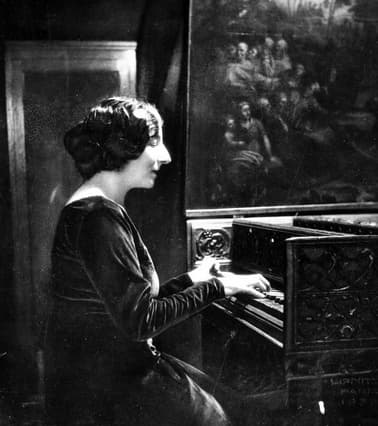
Polish, French, American · Arts
Wanda Landowska
July 5, 1877 – August 16, 1959
Early Life and Education
Wanda Aleksandra Landowska was born on 5 July 1877 in Warsaw, then part of the Russian Empire, into an assimilated, intellectually distinguished Polish-Jewish family. Her father, Marian Landowski, was a lawyer, and her mother, Eugenia Lautenburg, was a translator credited with rendering the works of Mark Twain into Polish. This household, steeped in literature, languages, and culture, provided fertile ground for young Wanda's precocious musical gifts.
She began piano lessons at the age of four and quickly demonstrated exceptional talent, prompting her family to enroll her at the Warsaw Conservatory, where she studied piano and composition. Even as a child, Landowska displayed a deep curiosity about the historical roots of the music she played, an interest that would come to define her life's work. In her teenage years she left Warsaw to pursue further studies, first with Aleksander Michałowski in Warsaw and later in Berlin, where she studied composition with Heinrich Urban.
Move to Paris and the Turn Toward Early Music
In 1900, Landowska relocated to Paris with her husband, the folklorist and Bach scholar Henry Lew, whom she had married in 1900. Paris at the turn of the century was a hub of artistic ferment and revivalist movements, and Landowska soon became immersed in the study of historical keyboard instruments and performance practice. She was struck by the disconnect between contemporary piano performances of Baroque repertoire and the actual sound world for which composers like Bach, Couperin, Rameau, and Scarlatti had written.
Landowska began to specialize in the harpsichord, an instrument that had fallen into near-total obscurity following the rise of the piano in the late eighteenth century. She undertook rigorous archival research into historical treatises, ornamentation practices, and period instruments, positioning herself as both scholar and performer. In 1909, she published her influential treatise Musique ancienne (co-written with her husband), articulating her philosophy of historically grounded performance and arguing forcefully for the harpsichord's irreplaceable role in early music.
Building the Harpsichord Revival
Landowska's public recitals on the harpsichord, beginning in the early 1900s and continuing for decades, were foundational to what became known as the early-music revival movement. She played a crucial role in convincing the piano manufacturer Pleyel to construct a modern concert harpsichord under her guidance, completed in 1912. This instrument, larger and more robust than historical models, allowed her to project sound in large concert halls and became her signature instrument for much of her career.
Her scholarship and advocacy elevated the harpsichord from a museum curiosity to a viable concert and recording instrument. She toured extensively across Europe, performing to enthusiastic and sometimes skeptical audiences accustomed to piano interpretations of Baroque works. Composers of her own time took note: Landowska's artistry inspired new works written specifically for harpsichord, including Manuel de Falla's Concerto for Harpsichord (1926) and Francis Poulenc's Concert champêtre (1928), both composed for and premiered by her. These commissions marked a significant modern validation of the harpsichord as a living concert instrument rather than a historical relic.
Teaching and Institutional Influence
In 1913, Landowska was appointed to teach harpsichord at the Hochschule für Musik in Berlin, marking one of the first formal academic positions dedicated to the instrument in the modern era. Her tenure was interrupted by the outbreak of the First World War, during which she and her husband, being Russian subjects, were detained in Germany as enemy nationals; Henry Lew died in an automobile accident in 1919 shortly after their return to France.
After the war, Landowska settled permanently in France and in 1925 founded the École de Musique Ancienne (School of Early Music) at Saint-Leu-la-Forêt, near Paris. This institution became a pilgrimage site for musicians and scholars interested in historically informed performance, drawing students from across Europe and the United States. There she assembled an important collection of historical keyboard instruments and continued her scholarly writing, teaching, and recording.
Among her most celebrated students and collaborators was Denise Restout, who became her devoted assistant, student, and life companion, remaining at Landowska's side through the upheavals of the following decades and eventually becoming the executor of her legacy.
Recordings and Major Works
Landowska was among the first musicians to embrace recording technology as a means of preserving and disseminating historically informed performance. She made pioneering recordings for various labels beginning in the 1920s and 1930s, capturing works by Bach, Handel, Couperin, Rameau, Scarlatti, and Mozart. Her most monumental recorded achievement was her complete recording of Johann Sebastian Bach's Das Wohltemperierte Klavier (The Well-Tempered Clavier), a project she undertook and completed after her emigration to the United States, released by RCA Victor in the 1950s. This recording remains a landmark in the history of early-music performance and is still studied and admired by harpsichordists today.
She also wrote and lectured extensively, contributing scholarly articles and giving public lectures across Europe and America that combined musicological rigor with passionate advocacy for period-appropriate performance style, ornamentation, and tempo.
War, Exile, and Life in America
The rise of Nazism in Germany and the outbreak of the Second World War brought devastating disruption to Landowska's life. As a Jewish woman living in France, she faced grave danger following the German occupation in 1940. In 1941, she and Denise Restout fled France, eventually making their way to the United States. Landowska's home, instrument collection, and archive at Saint-Leu-la-Forêt were seized and looted by occupying German forces; much of this material was never recovered, representing an immense scholarly and personal loss.
Settling first in New York City and later in the small town of Lakeville, Connecticut, Landowska rebuilt her career from near total loss. She gave triumphant recitals at Town Hall in New York, resumed teaching, and continued recording. American audiences, critics, and musicians embraced her as the world's preeminent harpsichordist, and her later years in the United States were marked by renewed acclaim, culminating in her celebrated Bach recordings of the 1950s.
Personal Life
Landowska married Henry Lew, a Polish-born folklorist and musicologist, in 1900; the couple collaborated closely on scholarly work until his death in 1919. She never remarried, and her closest lifelong companion in her later decades was Denise Restout, her student, secretary, and artistic collaborator, who cared for Landowska through her final illness and subsequently worked to preserve and promote her teacher's legacy, including through the establishment of an archive of her papers and recordings.
Legacy and Historical Impact
Wanda Landowska is universally regarded as the central figure in the twentieth-century revival of the harpsichord and of historically informed performance practice more broadly. Before her, the harpsichord was largely absent from concert life; after her, it became once again a legitimate and celebrated concert and recording instrument, paving the way for later generations of harpsichordists and early-music specialists, including Ralph Kirkpatrick, Gustav Leonhardt, and many others who built upon the foundation she established.
Her insistence on rigorous historical scholarship combined with genuine artistic interpretation set a model still followed by early-music performers today. Institutions, festivals, and competitions bearing her name continue to honor her contribution, and her recordings remain reference points for scholars and performers of Baroque keyboard music.
Death
Wanda Landowska died on 16 August 1959 at her home in Lakeville, Connecticut, at the age of 82. She was survived by her devoted companion Denise Restout, who continued to safeguard and promote her legacy. Landowska's pioneering life's work fundamentally reshaped the modern understanding and performance of early music, leaving an indelible mark on twentieth-century musical culture.
Dated achievements
3 indexed.
- Jul051877Arts
Born in Warsaw, Poland
Wanda Landowska was born in Warsaw, then part of the Russian Empire, into a cultured Jewish family.
View details Wanda Landowska - Wikipedia - Nov191903Arts
Performed pioneering harpsichord recital reviving Baroque performance practice in Paris
Landowska's Paris performances on the harpsichord in the early 1900s reintroduced the instrument to modern concert audiences.