← All women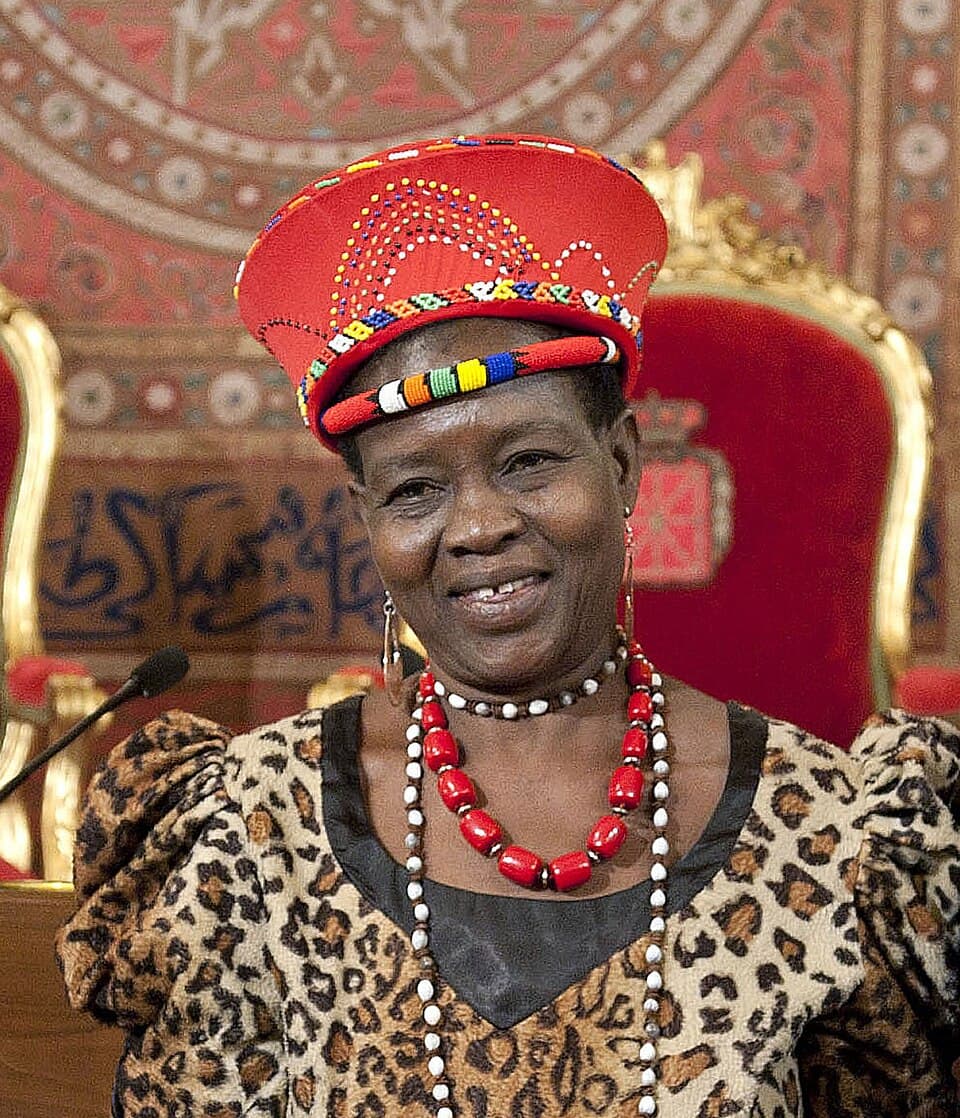
Malawian · Activism
Theresa Kachindamoto
November 23, 1958 – August 13, 2025
Early life and background
Theresa Kachindamoto was born on 23 November 1958 in the Dedza District of what was then the Federation of Rhodesia and Nyasaland, present‑day Malawi.[1][4][5][11][12][15] She grew up near Lake Malawi in a rural area where customary authority and clan structures played a central role in governance and social life. Multiple sources describe her as the youngest of twelve siblings in a family of traditional rulers whose lineage had governed Dedza for generations.[5][12][15] This background embedded her in Ngoni cultural traditions and the responsibilities of chieftaincy from an early age.
Although her family held long‑standing authority, Kachindamoto did not initially expect to become a chief. She pursued education and employment outside the family’s home area, reflecting broader post‑colonial shifts in Malawi that encouraged some women to seek work in urban centers. The combination of her rural upbringing, exposure to formal education, and experience in the civil service would later shape her approach to leadership, enabling her to bridge customary norms with statutory law and international human‑rights frameworks.[1][3][5]
Education and early career
Details of Kachindamoto’s formal schooling are not widely documented, but multiple biographical accounts note that she worked for 27 years as a secretary at a constituent college under the University of Malawi, in the southern region of the country.[5][12] This long tenure in the university system exposed her to bureaucratic procedures, record‑keeping, and interactions with students and academics, skills that later proved useful in organizing community campaigns and liaising with national and international bodies.
Her work as a secretary also placed her within a professional environment where conversations about development, education and public policy were common. According to profiles, she married and became the mother of five sons during this period, balancing family responsibilities with employment.[5][19] Living away from Dedza and working in Zomba, a southern city, gave her perspectives on regional differences, the challenges of educational access, and the ways in which national policies affected local communities.
Enthronement as paramount chief
In 2003, local leaders in Dedza District selected Theresa Kachindamoto as Senior Traditional Authority, or paramount chief, known by the title Inkosi ya makosi.[1][3][4][5][10][12][15] She returned to Dedza to assume the chieftaincy, receiving the red robe and leopard‑skin headdress that symbolize Ngoni leadership.[5] Later accounts describe her as the first female Ngoni chief in Malawi, a designation that underscores the barrier she broke in a patriarchal system of customary rule.[6][10][16]
As senior chief, Kachindamoto had informal authority over an estimated 800,000 to 900,000 people in Dedza District.[1][3][10][15] Her responsibilities included overseeing subordinate chiefs, mediating disputes, and maintaining customary law. However, she quickly became known for using this authority to pursue social reform, particularly around the issue of child marriage. Shocked by the prevalence of early and forced marriages in her jurisdiction, she declared that such practices would no longer be tolerated and began to work systematically to end them.[6][13][18]
Campaign against child marriage
Kachindamoto’s activism against child marriage emerged soon after her enthronement. Upon discovering that many girls in her district had been married off in their early teens, often leaving school, she vowed to change the situation.[6][13] She convened village heads and traditional leaders, announced that child marriages were banned, and required them to sign local bylaws committing to this policy.[6][13][18] She also created committees and mothers’ groups tasked with monitoring communities and reporting underage marriages.
Her approach combined moral persuasion with the explicit use of traditional authority. Sources describe how she threatened to depose village heads who refused to annul child marriages, leveraging her power to appoint or remove local leaders.[6][13][18] When a child marriage was identified, she would summon the families and insist that the union be dissolved. Crucially, she required that girls—and often boys—return to school after annulment, working with NGOs and supporters to provide uniforms, school fees and supplies where necessary.[6][13][17]
By 2015, international and national reporting credited Kachindamoto’s activism with helping to secure legal reforms at the national level.[12] Journalists and organizations highlighted her work in dissolving hundreds of child marriages and in changing community attitudes toward girls’ education.[6][13][16] Her relentless interventions earned her nicknames such as "terminator of child marriages" and "The Terminator," reflecting both admiration and the fear she inspired among those who sought to maintain early marriage practices.[6][12][13]
Influence on national law and policy
Kachindamoto’s grassroots efforts took place alongside broader legal reform in Malawi. On 13 April 2015, the country’s parliament passed the Marriage, Divorce and Family Relations Act, which set 18 as the minimum age of marriage for both males and females and banned exceptions based on parental consent or customary practice.[12] Reports on the reform note that Kachindamoto was one of several traditional leaders whose pressure and advocacy helped create momentum for the law, demonstrating that communities could support the abolition of child marriage.[12]
Despite the statutory change, Malawi’s constitution still allowed marriage from age 15 with parental consent. Activists and officials therefore worked to harmonize constitutional and statutory provisions. On 14 February 2017, Malawi adopted a constitutional amendment that raised the minimum age of marriage to 18, removing the earlier exception.[17] UN Women and other sources describe Kachindamoto’s collaboration with government agencies and UN partners in supporting the amendment, situating her as a key link between local practice and national law.[17]
These reforms placed Malawi among African countries with relatively strong legal protections against child marriage. Subsequent analyses drawing on DHS and UNICEF data documented declines in child marriage rates during and after the period of Kachindamoto’s activism, suggesting that both law and local enforcement were contributing to change.[3] While causality is complex, many commentaries point to her work as emblematic of how traditional authorities can help implement and legitimize new legal norms.
International recognition and awards
As her work gained attention, Kachindamoto received significant international recognition. On 8 March 2017, she was honored in Washington, D.C., with the Leadership in Public Life Award at the 16th Annual Vital Voices Global Leadership Awards.[17] Vital Voices cited her courageous efforts to annul child marriages and to ensure that girls returned to school, emphasizing her role as a community leader who had become a global symbol of resistance to child marriage.[8][17]
On the same day, UN Women published a profile titled "When girls are educated, everything is possible," which documented that she had annulled more than 1,500 child marriages in Dedza District.[17] The profile highlighted her insistence that boys and girls should have equal access to education and showcased her methods of working with village heads, religious leaders and mothers’ groups to enforce local bylaws.[17]
By 2016, media outlets such as Al Jazeera had already featured her campaigns, describing how she had dissolved more than 850 child marriages over three years and gained international fame as "Malawi’s fearsome chief" and "terminator of child marriages."[6][13] Profiles from organizations and news sites—including Girls Not Brides, IMPOWER and others—continued to highlight her as a leading figure in the global movement to end child marriage.[13][18][20]
In November 2019, biographical accounts reported that she had annulled over 2,600 child marriages, reinforcing her reputation for uncompromising enforcement of anti‑child‑marriage norms.[8][12][13] Later tributes, including those published after her death, stated that she had annulled more than 3,500 child marriages and sent thousands of girls back to school.[12][18]
Her work also attracted recognition from universities. KU Leuven announced on 8 February 2024 that its Academic Council had decided to award her an honorary doctorate for her advocacy against child marriage and for girls’ education.[10] In March 2024, she received a joint honorary doctorate from UCLouvain and KU Leuven, and later that year she was honored at the African Genius Awards, according to UCLouvain’s tribute.[15] These awards placed her within a select group of grassroots leaders whose contributions to human rights and development were recognized at the highest academic levels.
Methods and philosophy
Analyses of Kachindamoto’s activism emphasize both her practical strategies and her underlying philosophy. She often articulated the belief that "when girls are educated, everything is possible," framing education as the core pathway out of poverty and toward gender equality.[17] She viewed child marriage not only as a violation of individual rights, but also as a barrier to community progress.
Her methods included:
- Issuing and enforcing local bylaws that banned child marriage and mandated school attendance for children.[6][13][18]
- Annulling identified child marriages and requiring that girls—and many boys—return to school, with support from NGOs for fees and supplies.[6][13][17]
- Threatening to strip uncooperative village heads of their positions, using the authority of the chieftaincy to ensure compliance.[6][13][18]
- Collaborating with religious leaders, mothers’ groups and youth committees to monitor communities and encourage cultural shifts away from early marriage.[6][13][18]
- Working with government and international organizations to align local practice with national law and global human-rights standards.[3][12][17][18]
Her philosophy thus combined respect for tradition with a transformative vision of social justice. She argued that customs should not be used to harm children and that traditional authority must evolve to protect the most vulnerable. This stance positioned her as both guardian and reformer of Ngoni culture.
Personal life
Sources indicate that Theresa Kachindamoto was married and the mother of five sons
Her relatives and extended kinship networks also played roles in her activism. Being part of a ruling family gave her legitimacy, but her decision to confront entrenched norms occasionally created tensions. Accounts describe that despite resistance from some community members, her firmness and willingness to dialogue over time won over many families who had initially opposed annulment of their daughters’ marriages.[6][13] Theresa Kachindamoto’s legacy is multifaceted. At the local level, she reshaped norms around marriage and education in Dedza District. Annulment of thousands of child marriages meant that large numbers of girls who would otherwise have become wives in early adolescence instead returned to school, with potential long‑term effects on health, income and civic participation.[12][17][18] Her insistence that boys also remain in school contributed to broader educational gains. At the national level, her activism intersected with legislative reforms that strengthened protections against child marriage. The 2015 Marriage, Divorce and Family Relations Act and the 2017 constitutional amendment form part of her legacy, as commentators frequently cite her as a leading traditional authority who supported and helped secure these changes.[3][12][17] Later analyses referencing DHS and UNICEF data note continuous declines in child marriage rates during and after the period of her activism, suggesting that legal, social and cultural shifts were taking hold.[3] Internationally, Kachindamoto became an emblematic figure in the global movement to end child marriage. Organizations such as Girls Not Brides, UN Women, Vital Voices, UCLouvain and KU Leuven highlighted her as a model of how traditional authorities can use their power to protect children.[8][15][17][18] Her story has been shared in documentaries, news features and advocacy campaigns, inspiring activists in other countries to engage chiefs, elders and religious leaders as partners in reform. From a women’s-history perspective, she represents a distinctive form of leadership: a rural woman who occupied a traditional office historically reserved for men and used that position to transform both custom and law. Her life complicates simple narratives of tradition versus modernity, showing instead that customary structures can be sites of feminist intervention. In her later years, Kachindamoto continued her activism while gaining further recognition. In 2024, she received a joint honorary doctorate from UCLouvain and KU Leuven, and was honored at the African Genius Awards, underscoring her status as an international figure in the struggle against child marriage.[10][15] She maintained her role as senior chief and remained engaged in community work, even as health issues emerged. On 13 August 2025, Theresa Kachindamoto died of liver failure in Lilongwe, Malawi, at the age of 66.[1][3][4][5][11][12][15] Following her death, the UN Malawi office and other organizations issued statements of condolence that praised her achievements and noted that she had annulled more than 3,500 child marriages and sent thousands of girls back to school.[12][18] Girls Not Brides published an in‑memoriam tribute honoring her legacy as a senior chief who demonstrated exceptional leadership in protecting girls’ rights.[18] Universities that had honored her, including UCLouvain and KU Leuven, released homages reflecting on her contributions to gender equality and education.[10][15] These tributes consolidated her reputation as one of the most important grassroots activists against child marriage in contemporary African history. Her death marked the end of a remarkable career, but her influence continues to be felt through the laws she helped shape, the communities she transformed, and the thousands of girls whose lives took different paths because she refused to accept early marriage as inevitable. Theresa Kachindamoto occupies a significant place in the history of women’s rights and traditional leadership. As a woman chief, she challenged gendered assumptions about authority within Ngoni and Malawian society. As an activist, she demonstrated that legal reform is most effective when accompanied by community‑level enforcement and cultural change. Her life illustrates how local leadership can be central to realizing international human‑rights commitments. Her strategies—annulling child marriages, enforcing bylaws, collaborating with NGOs and state actors, and insisting on education for all children—have been widely cited as best practices in programming to end child marriage.[6][13][17][18] Future research on women’s history and legal anthropology is likely to continue examining her work as a case study in how customary institutions can be transformed from within to promote gender justice.Legacy and historical impact
Later life and death
Historical significance
Dated achievements
9 indexed.
- Nov231958Activism
Birth of Theresa Kachindamoto
Birth in Dedza District, Malawi; part of a family of traditional rulers.
View details Wikipedia: Theresa Kachindamoto - Jan012003Activism
First Female Ngoni Chief
In 2003, Theresa Kachindamoto became the first female Ngoni chief in Malawi.
View details