← All women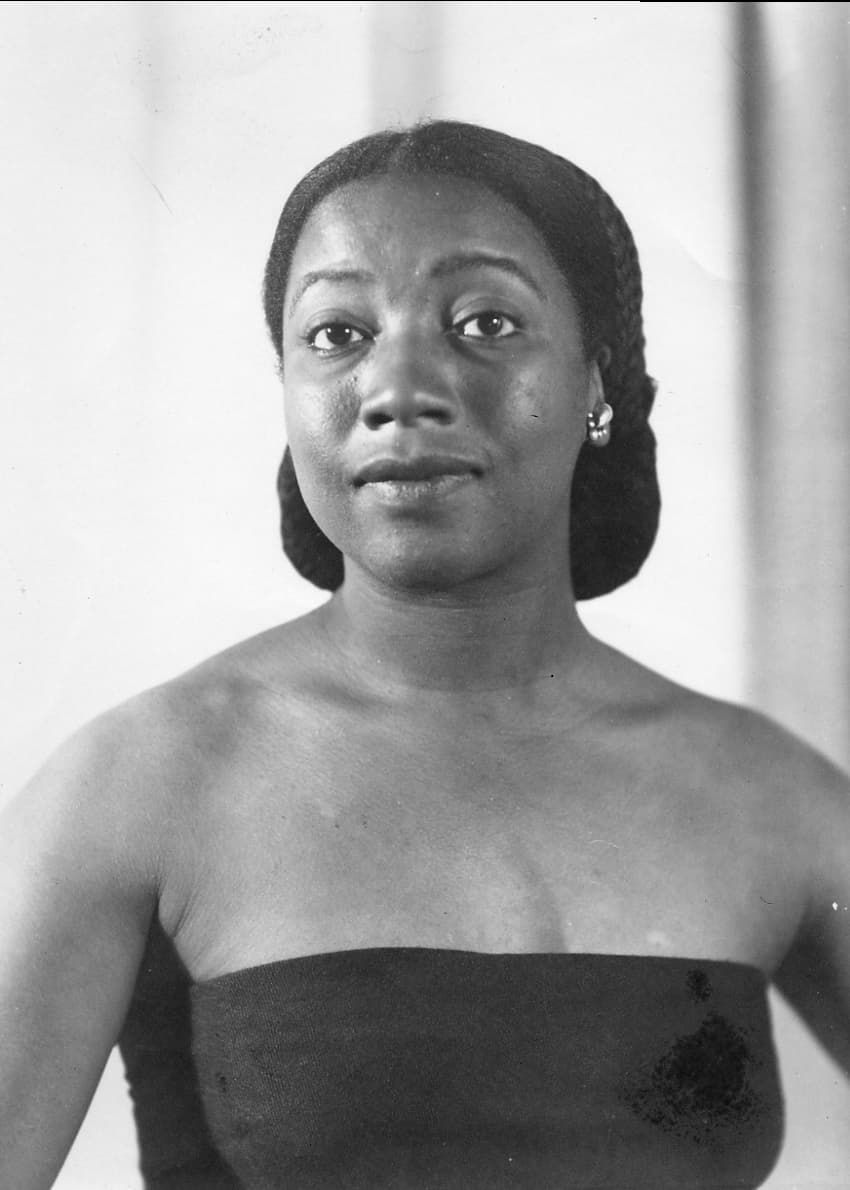
American · Arts · Activism
Thelma Johnson Streat
August 29, 1912 – May 21, 1959
Early Life and Background
Thelma Beatrice Johnson Streat was an African American artist, dancer, educator, and cultural activist whose work gained prominence in the 1940s for its fusion of modernist painting, performance, and intercultural education.[1][13][15] She is widely recognized as one of the earliest African American women modernists to achieve national and international visibility.
Streat was born 29 August 1912, in Yakima, Washington, a small agricultural town in the Pacific Northwest.[1][3][4] Her father, James Johnson, is frequently described as an artist who encouraged his daughter’s early interest in drawing and painting.[1][3][7] Her mother was Gertrude Johnson, and the family’s movements across the region—Yakima to Boise, then Pendleton, and ultimately Portland—exposed her to different communities and landscapes that later informed her work.[4][7]
Some institutional sources, including museum records and later articles, list her birth year as 1911 rather than 1912.[2][7][8][12][14] English-language biographical entries that provide a full date, however, most commonly give 29 August 1912.[1][3][13] Scholarly work on her art notes this discrepancy and generally treats 1912 as the more likely year, though the evidence is not absolutely conclusive.[7][15]
Streat showed artistic promise from an early age, reportedly beginning to paint at around seven years old, encouraged by her father’s guidance.[2][4][5][7] Growing up Black in predominantly white neighborhoods of the Pacific Northwest, she experienced isolation that would later shape her interest in both African American history and intercultural understanding.[4][12][15] Her childhood and adolescence in Portland, where the family eventually settled, placed her within a small but active Black community that confronted housing discrimination and restrictive covenants.[9][15]
In Portland, Streat attended Washington High School, from which she graduated in the early 1930s.[4][7][8] While still a student, she began to receive local recognition for her talent; one account notes that she obtained her "first big break" in high school, when her work attracted attention beyond the classroom.[12] Her schooling coincided with a period when art education in the region was slowly opening to women, though opportunities for African American students remained limited.[4][7]
Following high school, Streat pursued formal art training at the Museum Art School in Portland—later the Pacific Northwest College of Art—where she briefly studied painting in the mid‑1930s.[2][4][7] Some sources also indicate that she studied at the University of Oregon, further consolidating her technical skills and exposure to modern art.[7][15] These experiences laid the foundation for her later work in government-sponsored art programs and for her development as a modernist painter.
Career Beginnings and Development
By the late 1930s, Streat had begun to build a professional artistic career. Around 1938, she moved from Portland to San Francisco, where she joined the Works Progress Administration (WPA) Federal Art Project in California.[2][4][5][15] The WPA program, part of the New Deal, provided employment for artists during the Great Depression and fostered public art projects across the United States.
In San Francisco, Streat worked in multiple media, including tempera, oil, and watercolor, and became a frequent exhibitor in regional museums and galleries.[4] She participated in exhibitions at institutions such as the de Young Museum and the San Francisco Museum of Art (now the San Francisco Museum of Modern Art), where her paintings and murals reached audiences beyond the Black community.[4][15] Her involvement with the WPA also connected her to other artists engaged in socially oriented art, muralism, and experiments with modernist styles.
In 1939, Streat took part in one of the most ambitious mural projects of the era: she assisted Mexican muralist Diego Rivera on his mural Pan American Unity, created for the "Art in Action" exhibition at the Golden Gate International Exposition on Treasure Island in San Francisco.[7][13][15] Working with Rivera, a leading figure in modern muralism and socially engaged art, exposed her to large-scale narrative composition and reinforced her interest in depicting historical and political themes.
Throughout the late 1930s and early 1940s, Streat’s work increasingly addressed African American experiences, labor, and military service. She produced canvases and murals that explored Black contributions to American society and the contradictions of democracy in a segregated nation.[4][5][15] Her participation in the WPA coincided with the lead-up to World War II, a period in which Black activists and artists were pressing for a "Double V" victory over fascism abroad and racism at home.
Major Works and Accomplishments
Streat’s most widely cited work is the painting "Rabbit Man", an oil on canvas dated by museum records to 1941.[1][11] The piece portrays a figure with a rabbit, rendered in a modernist style that combines simplified forms and strong color contrasts. In 1942, the Museum of Modern Art (MoMA) in New York acquired "Rabbit Man" for its permanent collection.[1][4][7][10][11]
This acquisition is historically significant: it is consistently described as the first work by an African American woman—and more specifically the first by a Black woman—to be procured for MoMA’s collection.[1][4][5][7][10][11][15] At a time when major museums rarely collected work by Black artists, and almost never by Black women, the purchase of "Rabbit Man" marked a breakthrough in institutional recognition. The exact date of acquisition within 1942 is not documented in accessible sources, but the year is firmly established.[1][7][11]
Another key painting, often titled "Death of a Negro Sailor" or "Death of a Black Sailor," illustrates the dangers and discrimination faced by African American servicemen during World War II.[4][5][10][15] The work depicts a dying sailor’s reflections on democracy, juxtaposed with imagery referencing segregation in defense plants, Red Cross policies that excluded Black blood donations, segregated barracks, and restaurants that refused to serve Black servicemen.[4][5] This painting drew the ire of the Ku Klux Klan, and in 1942 Streat reportedly received death threats in response to its political content.[4][5][10][15]
Her response to this harassment was not retreat but intensification of educational work. Streat created a program called "Negro in History" aimed at teaching youth about African American achievements and the fight for equality.[10][13][15] She used lectures, performances, and visual materials to present Black historical figures and to challenge racist narratives. This initiative foreshadowed her later Children’s City projects and exemplified her commitment to activism through art and education.
By the mid‑1940s, Streat had also become known for her murals depicting African American contributions to U.S. history. She completed works that traced Black participation from slavery through emancipation and into modern life, often emphasizing labor and military service.[2][4][15] Her mural studies and finished pieces blended narrative figuration with modernist stylization, reflecting both Rivera’s influence and her own distinct visual language.
In 1947, Streat reached a notable milestone in the New York art world. Contemporary reports state that by that year, only four African American artists were known to have solo exhibitions in New York City: Thelma Johnson Streat, Romare Bearden, Norman Lewis, and Rose Piper.[5][16] She was further recognized as one of only four African American abstract painters with solo shows in the city at that time, situating her firmly within the early history of Black abstraction.[5][16] The exact dates of her solo exhibitions are not specified, but the year indicates her presence in key modernist networks.
Streat’s practice expanded significantly in the late 1940s. In 1945, she relocated to Chicago, where she chaired a committee dedicated to sponsoring murals, further supporting public art and educational projects.[2] She later spent time in the Queen Charlotte Islands (Haida Gwaii) off the coast of British Columbia, where she studied local cultures and integrated Indigenous motifs and themes into her art and dance performances.[2][7][15]
One of the most unusual and pioneering aspects of her career was her engagement with television. In 1949, while living temporarily in France, Streat became the first American woman to have her own television program in Paris.[5][16] The show presented her artwork and performances to French audiences, marking an early intersection of television, fine art, and dance. Documentation of the program’s format and episodes is limited, but the achievement underscores her innovative approach to disseminating art through new media.
Her international recognition continued into the early 1950s. In 1950, Streat was reportedly requested to perform a dance program at Buckingham Palace, reflecting her status as a cultural ambassador and the interest of the British royal household in her work.[5] She was admired by figures such as First Lady Eleanor Roosevelt, the King and Queen of England, actor Vincent Price, and dancer and choreographer Katherine Dunham, all of whom appreciated her blend of art and performance.[5][10][13]
Beyond her paintings and murals, Streat developed performances in which she danced before her works, often in costumes inspired by various cultures. She incorporated indigenous dance styles and music from around the world, seeking to promote intercultural understanding and a sense of shared humanity.[10][13][15] This combination of visual art and movement was distinctive among mid‑century artists and contributed to her reputation as a multidimensional creator.
Awards, Honors, and Recognition
Although specific awards and presentations are less documented than her projects, Streat enjoyed significant recognition during her lifetime. The MoMA acquisition of "Rabbit Man" in 1942 represented a major honor, signaling acceptance into the highest ranks of modern art institutions.[1][4][7][11] Her inclusion in exhibitions at the de Young Museum, the San Francisco Museum of Art, and New York galleries further validated her standing as a serious modernist painter.[4][5][15]
Contemporary coverage and later retrospectives emphasize that she was a favorite artist of prominent public figures. Eleanor Roosevelt admired her work, as did members of the British royal family, actor Vincent Price, and dancer Katherine Dunham.[5] These endorsements, while informal rather than codified as awards, functioned as cultural recognition that expanded the audience for her art.
Streat’s accomplishments have been increasingly acknowledged in recent decades. Scholarly articles—including the essay "Mapping a New Humanism in the 1940s"—situate her within broader histories of African American modernism and humanist thought.[15] Museums and historians now highlight her role as a pioneer who challenged racial and gender barriers in the mid‑twentieth-century art world.[1][7][9][15]
Personal Life
Streat’s personal life intersected closely with her artistic and educational endeavors. She married Romaine Virgil Streat in the 1930s; biographical sources indicate that she moved to San Francisco in 1938 with her first husband, during the period when she joined the WPA Federal Art Project.[7][13] This marriage eventually ended, though the exact date of dissolution is not clearly documented.
In 1948, she married John Edgar Kline, a playwright and producer who also served as her manager.[2][13] With Kline, she traveled frequently and lived abroad, including time spent in Europe and in the Queen Charlotte Islands. The couple shared a strong interest in education, tolerance, and intercultural communication, which they pursued through collaborative projects.[2][7][13]
One of their major initiatives was the establishment of Children’s City projects in Canada and Hawaii. These programs aimed to teach children about different cultures through art, storytelling, and performance, encouraging respect and curiosity rather than prejudice.[2][7][13] The couple settled in Hawaii in the early 1950s, making it a base for their educational work while continuing to travel.
Streat’s personal identity was shaped by her heritage; sources note that her parents were of African and Cherokee descent, elements she often explored in her mature work.[12] Her experiences of racial isolation in nearly all‑white neighborhoods and of activism against discrimination contributed to her commitment to intercultural understanding, which she expressed in both her private life and public projects.[4][12][15]
Legacy and Historical Impact
Streat’s legacy is multifaceted, spanning art history, dance, education, and Black women’s cultural activism. Her role as the first Black woman artist collected by MoMA has been repeatedly cited as a landmark in the diversification of major museum collections.[1][4][5][7][10][11] This achievement helped open institutional doors, even if progress remained slow and uneven for subsequent generations of Black women artists.
As a painter, she contributed to the early history of African American modernism. Her works combine modernist aesthetics—stylization, bold color, abstraction—with socially engaged content addressing labor, war, and racial injustice.[4][5][15] Scholars have emphasized her efforts to articulate a "new humanism" in the 1940s, using art and performance to promote empathy across racial and cultural lines.[15]
Her integration of dance and painting was particularly innovative. Long before performance art became a recognized genre, Streat staged events in which she danced in front of her paintings, often in culturally specific attire, to dramatize the themes of her work and to convey the vitality of different traditions.[10][13][15] This synthesis anticipated later cross-disciplinary practices among Black artists and choreographers.
Educationally, her "Negro in History" program and Children’s City projects prefigured multicultural curricula that would gain prominence in later decades.[10][13][15] She used art and storytelling to counter racist narratives, highlight Black achievements, and foster appreciation of global cultures among young audiences. In this respect, she can be seen as an early practitioner of what is now called culturally responsive pedagogy.
Despite her achievements, Streat’s name largely receded from mainstream art histories after her death. An article in The Oregonian describes how this "pioneering Portland artist" "disappeared into the folds of history" even as her work survived in collections.[9] Renewed interest in her career has emerged in the twenty‑first century, spurred by scholarship, museum acquisitions, and community-based historical initiatives.
A significant development in her posthumous recognition occurred in 2012, when the Smithsonian National Museum of African American History and Culture acquired her mural study "Medicine and Transportation" for its permanent collection.[8][11][14] The work, dated by the museum to 1948–1951, underscores her contributions to narrative muralism and her focus on Black life and technological progress.
Regional organizations such as Oregon Black Pioneers and historians in Yakima and Portland have highlighted Streat’s achievements as part of broader efforts to document Black history in the Pacific Northwest.[1][4][16][17] Articles, blog essays, and talks—including those by Ourstorian projects and Smarthistory—present her as a key figure whose life challenges assumptions that Black cultural innovation in the mid‑twentieth century was confined to large urban centers like New York or Chicago.[6][15][17]
Later Life and Death
In her later years, Streat continued to travel and to develop educational and artistic projects with John Edgar Kline. They spent considerable time in Hawaii, where they expanded the Children’s City concept and engaged with local communities.[2][7][13] She remained active as a painter and performer, though detailed records of her specific activities in the 1950s are more fragmentary than for the 1940s.
On 21 May 1959, Streat died suddenly of a heart attack in Los Angeles, California.[1][3][13] She was in her mid‑forties, and her death cut short a career that had already traversed several continents and artistic disciplines. At the time of her death, she had not yet been fully integrated into canonical histories of modern art, which remained largely focused on white male painters.[9][15]
Following her death, her works remained in collections and resurfaced periodically in exhibitions, but wide recognition lagged. Over time, however, scholars and curators began to reassess the contributions of Black women artists, leading to renewed interest in Streat’s oeuvre. Her paintings, murals, and performance documentation are now studied alongside those of contemporaries such as Norman Lewis, Romare Bearden, and Rose Piper.[5][15]
Today, Streat is increasingly acknowledged as a pioneering African American woman modernist, a dancer and educator who used art to foster intercultural understanding, and a figure whose career illuminates the complex geographies of Black creativity in the Pacific Northwest, California, and beyond.[1][4][7][15] Her life story—rooted in Yakima and Portland, but extending to San Francisco, Chicago, Paris, the Queen Charlotte Islands, Hawaii, and London—offers a rich case study in the global circulation of African American art and ideas in the mid‑twentieth century.
Dated achievements
6 indexed.
- Aug291912Arts
Birth of Thelma Beatrice Johnson in Yakima, Washington
Birth of Thelma Beatrice Johnson (later Thelma Johnson Streat) in Yakima, Washington, to James and Gertrude Johnson.
View details Thelma Johnson Streat – English Wikipedia - Jan011942Arts
First Black woman with work in MoMA’s permanent collection ("Rabbit Man")
MoMA purchases Thelma Johnson Streat’s painting "Rabbit Man," the first work by a Black woman in its permanent collection.