← All women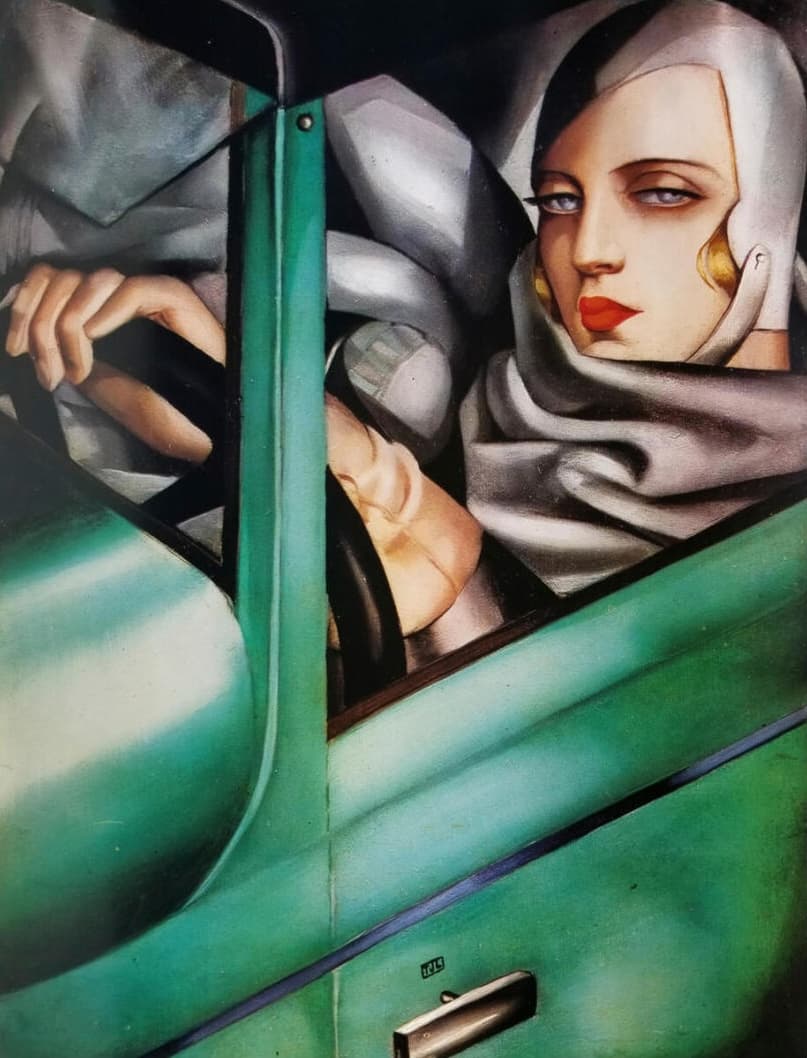
Polish, French, American · Arts
Tamara De Lempicka
May 16, 1898 – March 18, 1980
Early Life and Background
Tamara de Lempicka, born Tamara Rosalia (or Rozalia) Gurwik-Górska, came into the world on 16 May 1898 in Warsaw, then part of the Russian Empire.[13][14][15] Her father is generally described as a Russian‑Jewish lawyer, sometimes identified as Boris Gorski, and her mother as a Polish socialite, Malvina Decler.[3][15][14] This mixed background situated Tamara at the intersection of Russian, Polish, and broader European cultures, and her childhood was marked by mobility between urban centers and cosmopolitan resorts.
Sources note that she spent parts of her youth in St. Petersburg, Warsaw, and LausanneItaly.[13][14][19] Around 1911, as a teenager, she reportedly visited Italy with her grandmother, encountering Renaissance and Mannerist painting that would deeply influence her later work.[13][19] The monumental figures and sculptural drapery of artists such as Bronzino and Botticelli informed the stylized, volumetric bodies she would later create.
De Lempicka’s own accounts of her early life were often self‑mythologizing. She occasionally altered details such as her birth year and even her birthplace, leading to conflicting records that list dates ranging from 1894 to 1900 and locations such as Moscow.[1][4][5] Modern reference works—including Britannica, AWARE, and major art market databases—converge on 16 May 1898 in Warsaw as the most likely date and place.[1][13][14] This ambiguity reflects both the difficulties of documentation in a turbulent region and her conscious effort to craft a glamorous persona.
Marriage and Displacement: From Russia to Paris
By the mid‑1910s, Tamara was living in Saint Petersburg, then the imperial capital of Russia. On 3 March 1916, she married Tadeusz Łempicki, a young Polish lawyer working in Petrograd.[11][15] The union secured her entry into aristocratic and professional circles and gave her the surname she would use throughout her career. Their daughter, Kizette (Maria Krystyna), was born later that year.[11][15]
The Russian Revolution of 1917 profoundly disrupted their lives. Tadeusz was arrested by the Bolsheviks, and Tamara reportedly secured his release using connections and determination—a story often retold, though embellished in different sources.[11][16][18] In 1918, facing the dangers of the new regime, the family left Russia, traveling via Copenhagen before settling in Paris.[11][15] Polish sources give 6 December 1918 as the date of their arrival in Paris, marking their transition from imperial subjects to émigrés in the French capital.[3]
In Paris they experienced a sharp decline in material circumstances compared with their pre‑revolutionary life. This precariousness pushed Tamara to transform her artistic aptitude into a profession, a move that was unusual but increasingly possible for women in the progressive cultural atmosphere of the 1920s.[11][16]
Artistic Training and Career Beginnings
Once in Paris, de Lempicka undertook serious training. She studied at the Académie de la Grande Chaumière and later with prominent figures such as Maurice Denis and André Lhote at the Académie Ranson.[5][15] These teachers introduced her to Post‑Impressionist color theory and Cubist structuring of space, which she would blend with her admiration for Italian Mannerism.
By around 1922, she began exhibiting in Parisian Salons, including the Salon d’Automne and the Salon des Indépendants.[11][19] These public showings launched her career and brought her into contact with the avant‑garde. During the 1920s she became part of the city’s artistic and literary circles, meeting figures such as Pablo Picasso, Jean Cocteau, and André Gide.[13]
Her early paintings already bore the hallmarks of her mature style: sharply contoured bodies, polished surfaces, and an architectonic use of space. Critics later described this as "stylized Cubism" and highlighted the way it combined 16th‑century Mannerist monumentality, the mechanical feel of Futurism, and the exaggerated poses of fashion photography.[1]
Major Works and Art Deco Recognition
De Lempicka’s breakthrough coincided with the emergence of Art Deco. On 28 April 1925, her work was exhibited at the Exposition Internationale des Arts Décoratifs et Industriels Modernes in Paris, the ground‑breaking fair that gave Art Deco its name.[3][5] This exhibition celebrated modern luxury, industrial design, and forward‑looking aesthetics, and her inclusion aligned her with the movement’s leading creators.
In 1925, she also painted one of her most iconic works, the Self-Portrait (Tamara in a Green Bugatti), commissioned for the cover of the stylish German magazine Die Dame.[3][11] The painting depicts her as a chic, helmeted driver gripping the wheel of a racing car, an image of speed and autonomy. On 30 October 1925, this self‑portrait appeared on the magazine’s cover, dramatically increasing her visibility in German‑speaking Europe and establishing her as a symbol of the modern, liberated woman.[3]
Her reputation rose quickly throughout the later 1920s. She became known for highly finished portraits of aristocrats, industrialists, and fashionable women, such as Portrait of Madame M., Young Lady with Gloves, and La Belle Rafaëla, a sensual nude that underscores the queer and erotic subtexts in her work.[11][18] Her paintings simplified volume into tubular and crystalline forms, rendered in luminous, enamel‑like color, and often set against architectonic backgrounds suggestive of skyscrapers and modern cities.[13]
A key milestone came on 18 September 1927 when she received first prize at the Exposition Internationale des Beaux-Arts in Bordeaux for her painting Kizette on the Balcony.[5][10] The canvas portrays her daughter amid strong verticals and horizontals, combining maternal subject matter with rigorous geometric composition. The award signaled her acceptance into establishment art circles and confirmed the marketability of her distinctive style.
By the 1930s, de Lempicka had achieved international fame. She exhibited widely in Europe and the United States, and her patrons included members of the aristocracy and celebrities.[11][16] She cultivated an image of glamour, living in well‑appointed Paris apartments, traveling, and dressing fashionably. Her nickname "La Belle Polonaise" and later the epithet "Baroness with a Brush" underscored the fusion of social status and artistic talent.[15][6]
Awards, Honors, and Exhibition Highlights
Although de Lempicka did not accumulate the kind of official honors often accorded to male contemporaries, several events mark important recognitions. Her participation in the 1925 Art Deco Exposition placed her among a select cohort defining modern decorative arts.[3][5] The Die Dame cover functioned as a cultural accolade, presenting her as both subject and creator of modern femininity.[3][11]
The first prize at the 1927 Bordeaux Exposition for Kizette on the Balcony is one of the clearest examples of institutional recognition by a juried exhibition.[5][10] Later, as her work began to be rediscovered, several mid‑century exhibitions helped to rehabilitate her reputation. A notable one occurred on 17 September 1963, when she held a solo show at the Iolas Gallery in New York.[3] The gallery’s support signaled a renewed interest in her oeuvre and anticipated the wider revival of Art Deco aesthetics in the 1960s and 1970s.
By the later 20th century, her paintings were entering museum and major private collections, and posthumous exhibitions—such as retrospectives organized in the United States and Europe—cemented her status as a significant modern artist, although precise dating of many shows is documented only by year in available sources.[16][17]
Personal Life and Relationships
De Lempicka’s personal life was as complex and cosmopolitan as her art. Her marriage to Tadeusz Łempicki in 1916 ended in divorce around 1928, amid her rising success and increasingly independent lifestyle.[1][15] Their daughter Kizette often served as a subject in her paintings, and although Tamara’s frequent travel and social engagements meant that Kizette spent significant time in boarding schools, the artist’s portraits of her daughter suggest emotional attachment and pride.
In 1929 (some sources place the wedding in 1933–1934), she married Baron Raoul Kuffner, a Hungarian baron whose patronage and title further enhanced her social stature.[1][11][15] Through this second marriage she styled herself as "Baroness Tamara de Lempicka-Kuffner," a persona she used in both social and professional contexts.
De Lempicka’s relationships were not limited to traditional heterosexual marriage. Biographical accounts and art‑historical studies note that she had affairs with both men and women, including models and aristocratic lovers, and that her work often reflects a strong erotic charge, particularly in female nudes.[11][18] Her bisexuality, while not openly labeled in her own time, is now widely acknowledged and forms an important part of queer readings of her paintings.
Her lifestyle—characterized by fashionable dress, parties, and travel—was both an assertion of autonomy and a strategic performance that attracted patrons in an era when women’s social visibility could be leveraged into commissions. However, it also sometimes drew criticism from more conservative observers and contributed to a perception of her as a figure of decadence aligned with the jazz age.
Emigration, American Years, and Stylistic Shifts
In the late 1930s, the political situation in Europe deteriorated. De Lempicka and Baron Kuffner, both of Jewish background according to some sources, were acutely aware of the danger posed by fascism and Nazism. On 16 June 1939, they emigrated from France to the United States.[3][11] Initially settling in Los Angeles, they later moved to New York, joining other European émigrés seeking refuge and new careers.
In 1941, she relocated from New York to Hollywood/Los Angeles for a period, attempting to insert herself into American cultural spheres including film and high society.[11][3] She continued painting, producing portraits of film personalities and socialites, but the rapidly changing art scene in the U.S.—dominated by regionalism and, soon, Abstract Expressionism—made her highly finished Art Deco style seem stylistically conservative.
On 2 February 1943, she became a naturalized U.S. citizen, an important step in securing her position in wartime America.[3] Citizenship allowed her greater security and mobility, important for a woman whose life had already been reshaped by revolution and exile. Throughout the 1940s she experimented with new techniques, including looser brushwork and religious subjects, but these were generally less acclaimed than her interwar portraits.
During the 1950s, her angular Art Deco style fell largely out of fashion, and she explored more abstract, textured surfaces, sometimes influenced by contemporary trends but rarely fully aligning with them.[16][18] Financial pressures and the waning of her earlier fame contributed to a quieter phase in her career, though she remained active.
Later Life, Revival, and Death
From the 1960s through the 1970s, a renewed interest in Art Deco and interwar design led to a significant revival of Tamara de Lempicka’s reputation.[16][18] Collectors and galleries began to seek out her earlier works, and exhibitions introduced her to new audiences. Celebrities and fashion figures acquired her paintings, and reproductions of key images—especially the Self-Portrait (Tamara in a Green Bugatti) and Young Lady with Gloves—entered popular culture.[11][16]
The solo exhibition at the Iolas Gallery in New York on 17 September 1963 was one of the steps in this rediscovery.[3] Later retrospectives and articles framed her not only as a decorative painter but as an artist whose work encapsulated the gender politics and visual language of modernity. Her bold depictions of independent women were increasingly read in light of second‑wave feminism and queer studies.
In her final years, de Lempicka lived in Mexico, residing in Cuernavaca near her daughter Kizette.[5][15] She continued to paint, though less prolifically, and enjoyed the recognition that came with the rising market value of her earlier works. On 18 March 1980, she died in Cuernavaca, reportedly in her sleep, with her daughter by her side.[5][13][18] Her ashes were later said to have been scattered over the Popocatépetl volcano, an appropriately dramatic final gesture for an artist whose life and work were steeped in theatricality.[18]
Legacy and Historical Impact
Tamara de Lempicka occupies a distinctive place in 20th‑century art history as one of the few women to become closely identified with the Art Deco style.[10][6] Her paintings offer a visual lexicon of the interwar period’s fascination with luxury, speed, and modern urban life. She is particularly celebrated for images of the "ideal woman" of the 1920s—elegant, independent, and sexually liberated.[1]
From a stylistic standpoint, she fused elements from multiple sources: the monumentality and elongated forms of Italian Mannerism, the faceted geometry of Cubism, the smooth sheen of machine‑age aesthetics, and the poses and fashions of contemporary magazines.[1][11] This synthesis produced what some scholars call "stylized cubism" or "synthetic modern classicism." Her goal, as she once stated, was "never to copy, but to create a new style, clear luminous colors and feel the elegance of the models."[13]
In terms of women’s and gender history, her work is crucial. She crafted images of women that departed sharply from traditional passive or domestic roles. Her female figures, whether clothed or nude, are often muscular, self‑possessed, and coolly erotic. They inhabit sleek modern spaces and are frequently coded as queer or bisexual, reflecting her own desires and challenging normative gender scripts.[11][18] Her self‑portrait in the Green Bugatti, in particular, has become an enduring icon of female autonomy, still cited in discussions of women’s representation in visual culture.
As a Polish‑born, Russian‑raised, French‑based, and later American and Mexican resident, de Lempicka’s biography illustrates the transnational nature of modernism and the ways geopolitical upheavals shaped artists’ lives. Twice forced to flee political crises, she rebuilt her career by leveraging style, persona, and skill in male‑dominated art markets.
Posthumously, her paintings have achieved high prices at auction and are held in major collections, including museums in Europe and North America.[6][13] Scholarly attention has increased, with monographs, films, and essays emphasizing her role as a "survivor" who navigated revolution, war, and changing tastes while producing images that continue to resonate with contemporary concerns about gender, sexuality, and spectacle.[16][17][18]
Today, de Lempicka is widely recognized not only as an Art Deco stylist but as an artist whose work helps historians understand the visual construction of modern femininity. Her biography, including contested details and self‑fashioned myths, underscores the broader challenges of documenting women’s lives in the early 20th century, while her canvases remain potent statements of power, glamour, and self‑possession.
Dated achievements
10 indexed.
- May161898Arts
Birth of Tamara de Lempicka in Warsaw
Tamara de Lempicka was born in Warsaw, which she often romanticized.
View details Wikipedia: Tamara de Lempicka - Mar031916Arts
Marriage to Tadeusz Łempicki in Saint Petersburg
Tamara married Tadeusz Łempicki, a young Polish lawyer, in 1916.
View details