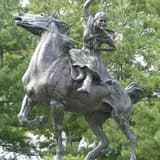
Legendary midnight ride on April 26, 1777, in which 16-year-old Sybil Ludington is said to have ridden about forty miles to warn militia of a British raid on Danbury, Connecticut.
On the night of April 26, 1777, at about sixteen years of age, Sybil Ludington is said to have undertaken an arduous horseback ride of roughly forty miles across rural New York to warn Patriot militia units of a British raid on Danbury, Connecticut. According to long-standing family tradition and many popular accounts, she left her father Colonel Henry Ludington’s home in a driving rainstorm and rode through scattered farmsteads in Putnam and Dutchess Counties, calling militiamen to arms.
These narratives describe her route through communities such as Fredericksburg, Kent, and Stormville, rousing as many as 400 soldiers to assemble at Ludington’s farm and then march toward the threatened supply depot at Danbury. Her ride is frequently compared to Paul Revere’s, with authors noting that she allegedly covered nearly twice his distance and avoided capture.
The historical significance of this event lies partly in its symbolism: Sybil’s ride has come to represent the often overlooked participation of young women in Revolutionary resistance, highlighting the ways they carried intelligence, managed farms, and supported militia mobilization. For generations, schoolbooks and children’s literature have celebrated her as a "female Paul Revere" whose courage helped galvanize local defense.
However, modern scholarship has questioned the evidentiary basis for the story, noting the scarcity of contemporaneous documentation and the reliance on later family recollections. A 2015 study in The New England Quarterly and research by local historians emphasize that while the ride remains a powerful legend, its factual details—and even its occurrence—cannot be fully verified from surviving records. Even so, the April 26, 1777 narrative continues to shape public memory of women’s roles in the American Revolution.