← All women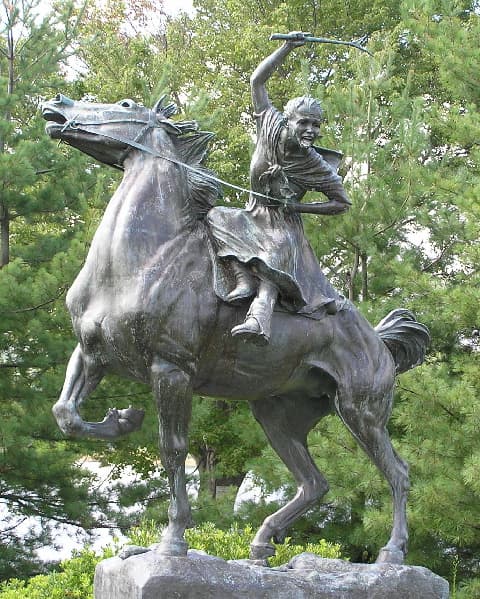
American · Activism
Sybil Ludington
April 5, 1761 – February 26, 1839
Early Life and Background
Sybil (or Sibbell) Ludington was born on April 5, 1761, in Fredericksburg, a rural community in Dutchess County, New York, later known as Ludingtonville. She was the eldest child of Colonel Henry Ludington and Abigail Knowles Ludington.[1][14] Her father, of English origin, was a farmer, mill owner, and local leader who became a colonel in the Patriot militia during the American Revolution.[1][3] Her mother managed a large household and supported her husband’s increasingly risky political and military commitments.
As the first of what would become twelve children, Sybil grew up with substantial responsibilities on the family’s farm. Frontier life in the Hudson Valley required everyone’s labor: girls like Sybil helped with chores, cared for younger siblings, and learned the network of roads and neighbors that tied scattered homesteads together.[2][8] This intimate knowledge of local geography and families later made her a plausible courier in family and community stories about the Revolution.
Little is known about Sybil’s formal education, which was limited for most colonial girls. Children in such households typically received basic instruction in reading, religious practice, and domestic skills. Henry Ludington’s rising profile in local politics and militia affairs meant that Sybil’s home was exposed to discussions of imperial policy, Loyalist–Patriot tensions, and the growing resistance to British rule.[1][11] These circumstances placed her family at the center of political upheaval as the colonies moved toward war.
Family’s Role in the Revolutionary Crisis
By the mid‑1770s, Henry Ludington had emerged as a key Patriot organizer in the region that would become Putnam County.[3][5] He commanded a militia regiment responsible for guarding the vulnerable corridor between the Hudson River and New England, an area threatened by British offensives from New York City and coastal Connecticut. The Ludington farm served as both family home and informal headquarters, where messages arrived and militia officers met.
The area around Fredericksburg was divided between Patriots and Loyalists, with skirmishes and raids unsettling daily life.[3][11] For women and children, this meant heightened danger as Loyalists and British scouting parties attempted to disrupt Patriot communication and supply lines. Sybil’s experience of the war was therefore both domestic and military: she lived in a household where the boundaries between home and battlefield were porous.
Within this context, family and local oral traditions later portrayed Sybil as stepping into an active role in militia mobilization. Whether or not every detail of these stories can be corroborated, they reflect a broader reality: Patriot households relied on women and girls to carry information, manage farms, and sustain social networks that were essential to the war effort.[2][11]
The Legendary Midnight Ride of April 26, 1777
Sybil Ludington is best known for a single dramatic episode: an alleged midnight ride on April 26, 1777.[1][3][4] According to accounts based largely on later family recollections, a messenger arrived at the Ludington home with news that British troops were attacking Danbury, Connecticut, a vital depot for Continental Army supplies.[3][4][15] With many militia men dispersed across the countryside and her father needing to prepare for command, sixteen‑year‑old Sybil is said to have volunteered to ride through the night to alert them.
Popular narratives describe her mounting a horse—often named "Star" in children’s books—and riding roughly forty miles through a driving rainstorm, calling at scattered farmhouses in present‑day Putnam and Dutchess Counties.[3][4][15] She purportedly stopped at homes in Fredericksburg, Kent, and other hamlets, banging on doors and shouting warnings to rouse Patriot soldiers. By dawn, these accounts claim, some 400 men had assembled at the Ludington farm and were marching toward Danbury.
In these retellings, Sybil’s ride is explicitly compared to that of Paul Revere two years earlier. Writers emphasize that she supposedly rode nearly twice Revere’s distance, avoided capture, and braved rugged terrain and Loyalist threats.[2][4][7][8][15] Some secondary sources add that her efforts earned praise from George Washington, though documentary evidence for such commendation is thin and appears only in later biographical summaries.[4][15]
Historical Debate and Evidence
Although the story of Sybil Ludington’s ride has been widely repeated in textbooks, local histories, and children’s literature, its evidentiary basis is contested. There is little contemporaneous documentation of the event, and most detailed narratives trace back to family traditions and twentieth‑century popular histories.[1][11]
According to a study summarized by Wikipedia, a 2015 article in The New England Quarterly examined available primary sources and concluded that there is "little actual evidence" backing the story, noting that skepticism among historians dates to at least 1956.[1][11] The Putnam County Historian, quoted in a 1975 New York Times article, similarly indicated that there was "no solid evidence" that the ride occurred as described.[1]
At the same time, many educational and heritage organizations continue to present the ride as factual. The American Battlefield Trust, EBSCO Research Starters, and various popular history outlets describe the April 26, 1777 ride in detail, emphasizing her bravery and 40‑mile journey to summon nearly 400 militiamen.[3][4][12][15] A modern historian of the Ludington family, Vincent Dacquino, argues that letters and documents in family archives provide credible support for the event, though these materials remain debated among scholars.[2][11]
Women’s‑history researchers therefore treat the ride as a significant cultural narrative rather than a fully verified incident. Its persistence reflects both the appeal of highlighting female heroism in the Revolution and the broader challenge of reconstructing women’s wartime roles from sparse records. Whether or not Sybil actually completed the full ride, the story points to the kinds of tasks Patriot women and girls were capable of performing.
Sybil Ludington’s Role in Wartime Life
Setting aside the question of the ride’s precise details, Sybil’s adolescent years unfolded in a household deeply involved in the Patriot cause. The Ludington farm functioned as a node in regional militia organization, and family members managed complex logistics: receiving messages, housing officers, and coping with shortages and threats.[3][5]
Women in such households took on responsibilities that extended beyond conventional domestic roles. They produced clothing and food for soldiers, monitored local movements, and occasionally carried intelligence between settlements.[2][11] Sybil’s familiarity with local roads and families—documented in the way accounts place her at the center of regional communication—suggests that she participated in this informal infrastructure of support.
From a women’s‑history perspective, the very emergence of the Sybil Ludington legend is instructive. It demonstrates how communities remembered and valued the contributions of a young woman whose work might otherwise have remained invisible in official military records. The contested ride thus serves as a case study in how gender, memory, and patriotism intersect.
Marriage, Children, and Post‑Revolution Life
After the war, Sybil’s life followed a path typical for many women of her time. In 1784, she married Edward Ogden, a farmer.[15] Sources indicate that the couple had six children—four sons and two daughters—and lived in rural New York, where they engaged in agriculture and community life.[15] The exact date of the marriage is not recorded in the commonly cited references, reflecting broader gaps in documentation for women’s domestic lives.
Sybil’s adult years were spent largely outside the spotlight of public history. She managed household duties, childrearing, and farm work in a young republic struggling with economic instability and westward expansion. Her experiences would have included the challenges of frontier settlement, the rhythms of seasonal labor, and participation in local religious and social networks.
These decades of unrecorded labor form an important part of her biography. They remind historians that even women who are later celebrated for a single dramatic act spent most of their lives in roles that rarely generated archival traces. Sybil’s story exemplifies how ordinary domestic work underpinned the survival and growth of the early United States.
Later Life and Death
In her later years, Sybil and her family relocated within New York State. By the end of her life she was living in Unadilla, New York, a town in the state’s interior.[14][15] She died there on February 26, 1839, at about 77–78 years of age.[3][14] Some older biographical summaries list only the year of her death or an age of 78, but major reference works—including Britannica and the American Battlefield Trust—agree on the specific date and place.[3][14][15]
There is limited information about her final years, including her health, daily activities, or involvement in family affairs. Like many women of her generation, she passed away with little formal documentation beyond local records and later genealogical notes. Her husband and children continued their lives as part of the expanding agrarian society of nineteenth‑century New York.
Sybil’s death closed the chapter on an eighteenth‑century life that would only be widely recognized long after she was gone. The contrast between the modest archival record surrounding her death and the later prominence of her name illustrates how historical memory can transform ordinary lives into symbols.
Modern Honors, Commemorations, and Awards
Sybil Ludington’s reputation grew steadily in the late nineteenth and twentieth centuries as local historians and writers sought to highlight women’s roles in the American Revolution. Her story entered school curricula and children’s literature, often presented as an inspiring counterpart to Paul Revere.[1][2][6]
Physical commemorations now mark her presence in the Hudson Valley. A bronze statue of Sybil on horseback stands near Lake Gleneida in Carmel, New York, depicting her in mid‑ride and serving as a permanent reminder of her supposed heroism.[8] Historic roadside markers trace a version of her route, reinforcing regional identity and tourism centered on Revolutionary heritage.[2][8] Local races and marathons have been named in her honor, with organizers explicitly referencing the forty‑mile ride as a metaphor for endurance.[2][4]
In 1975, during the nation’s Bicentennial, the United States Postal Service issued a commemorative stamp in its "Contributors to the Cause" series that featured Sybil Ludington.[2][6] The National Postal Museum notes that this stamp recognized her as a "Revolutionary fighter," placing her among a select group of individuals honored for aiding the struggle for independence.[2] The stamp played a significant role in popularizing her story and affirming her status as a national heroine, even as scholarly debate continued.
Her name has also been adopted for awards. The Sybil Ludington Women’s Freedom Award, established by the National Rifle Association, recognizes women who demonstrate extraordinary dedication to the cause of freedom, explicitly invoking Ludington’s alleged ride as an example of courage.[7] While such honors reflect contemporary organizational values, they also illustrate how her figure has been used to symbolize female patriotic activism.
Cultural Representation and Educational Use
Sybil Ludington has become a fixture in educational and popular culture narratives about the Revolution. Children’s books, online articles, and classroom materials often retell her ride as an established fact, emphasizing the youth, gender, and bravery of a girl who rode through the night to protect her community.[2][4][10][12] She is frequently described as the "female Paul Revere" and cited as evidence that women and girls played active, risky roles in wartime.[2][7][15]
Modern organizations focused on girls’ empowerment, such as A Mighty Girl, present Sybil as a role model who demonstrates that courage and leadership are not limited by age or gender.[2] These portrayals stress the message that ordinary young people can perform extraordinary acts in times of crisis, regardless of whether every historical detail is verifiable.
At the same time, more critical treatments, including articles in Smithsonian Magazine and academic journals, invite readers to consider how legends form around historical figures, especially women whose contributions were poorly recorded.[1][11] They encourage students and the public to balance admiration for symbolic stories with careful attention to available evidence.
Legacy and Historical Impact
Sybil Ludington’s legacy lies at the intersection of women’s history, Revolutionary memory, and the politics of commemoration. Whether or not she completed the ride exactly as later narratives describe, her story has profoundly shaped how Americans imagine women’s participation in the founding era.
For historians of women, the Ludington narrative highlights the methodological challenges of reconstructing female lives from fragmentary records. It demonstrates how oral traditions and family histories can both preserve important information and introduce embellishment. The scholarly debate surrounding her ride has become a case study in source criticism: researchers weigh local pride and popular representations against documentary evidence.[1][11]
Publicly, Sybil’s image serves as a powerful symbol of female patriotism, courage, and agency. Monuments, stamps, awards, and educational materials use her story to argue that the American Revolution was made not only by famous male leaders but also by ordinary citizens— including young women on horseback in the dark—whose contributions were essential but often overlooked.[2][4]
Her contested legend also encourages broader reflection on whose stories are remembered. The fact that Sybil Ludington has become "one of the best‑known female heroes of the American Revolution" despite limited documentation shows how cultural needs—such as the desire for female exemplars in national narratives—can drive the elevation of particular figures.[6] In this way, her impact extends beyond the question of a single ride to encompass how modern societies construct and revise historical memory about women.
Name, Identity, and Historiographical Notes
Sybil’s given name appears in variant spellings—including Sybil, Sibyl, and Sibbell—across different sources.[1][4] After her marriage to Edward Ogden, she is sometimes referred to as Sybil Ludington Ogden, reflecting common naming practices in early America.[11][15] These variations have implications for archival research, as documents may list her under different forms.
Historians continue to scrutinize genealogical records, local archives, and family papers related to the Ludingtons. New findings may refine understandings of her life or clarify the origins of the ride narrative. For now, researchers distinguish between well‑documented biographical facts—such as her birth and death dates, marriage year, and family context—and the more legendary elements of her story.
In editorial almanacs of women’s history, Sybil Ludington is typically included not as a fully verified military hero but as a significant cultural figure whose story has helped bring attention to women’s roles in the American Revolution. Her biography thus serves both as an account of a specific eighteenth‑century woman and as a lens through which to examine the processes by which female heroism is remembered and debated.
Dated achievements
5 indexed.
- Apr051761Activism
Birth of Sybil Ludington
Birth of Sybil Ludington in Fredericksburg (later Ludingtonville), New York, eldest child of Patriot militia colonel Henry Ludington and Abigail Knowles Ludington.
View details Encyclopædia Britannica – Sybil Ludington - Apr261777Activism
Sybil Ludington’s legendary midnight ride
Legendary midnight ride on April 26, 1777, in which 16-year-old Sybil Ludington is said to have ridden about forty miles to warn militia of a British raid on Danbury, Connecticut.