← All women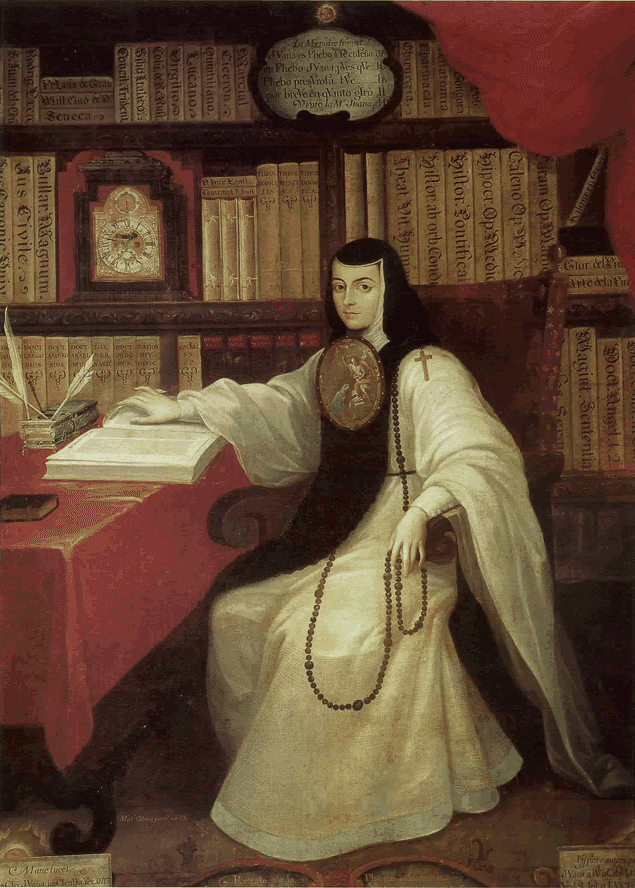
New Spanish · Literature · Activism
Sor Juana Ines de la Cruz
November 12, 1651 – April 17, 1695
Early life and background
Juana Inés de Asbaje y Ramírez de Santillana, later known as Sor Juana Inés de la Cruz, was born on the hacienda of San Miguel Nepantla in the Viceroyalty of New Spain, near present‑day Tepetlixpa in the State of Mexico. Most general reference works give her birth as 12 November 1651, though a baptismal record discovered in the 20th century has led many specialists to argue for 1648; both the exact year and day remain uncertain. She was the illegitimate daughter of a Spanish father, often identified as Pedro Manuel de Asuaje y Vargas Machuca, and a Creole mother, Isabel Ramírez de Santillana, of modest landowning background.[1][5][10]
Raised primarily on her maternal grandfather’s estate, Juana was immersed in a rural yet culturally complex environment shaped by Indigenous, Creole, and Spanish influences. Biographers emphasize that she learned to read and write in Spanish at a very young age, reportedly by observing an older sister’s lessons. Driven by a precocious thirst for knowledge, she is said to have begged her mother to allow her to disguise herself as a boy so she could attend the University of Mexico, a request that was refused on account of her sex.[5][10] Instead, she educated herself by reading extensively in her grandfather’s library and, according to later accounts, mastered Latin within a remarkably short period.
Her illegitimate birth and gender placed structural obstacles before her from the outset. In 17th‑century New Spain, formal schooling for girls was extremely limited, generally restricted to basic religious and domestic instruction. Universities were closed to women, and access to books and scholarly communities was largely confined to clerical or elite male circles. Within this context, Juana’s self‑directed learning and early literary production already set her apart from her contemporaries and foreshadowed the intellectual defiance that would characterize her adult life.[1][5][9]
Entrance into viceregal circles and early career
Around her mid‑teens, Juana was sent to Mexico City to live with relatives, a move that brought her into closer contact with the intellectual and political center of the viceroyalty.[1][5] There her reputation as a prodigy soon reached the attention of the viceregal court. According to early biographies, including that by the Jesuit Diego Calleja, she dazzled scholars when, at the viceroy’s request, a panel of learned men questioned her on a wide range of topics—from theology and philosophy to poetry and logic—tests she reportedly passed with ease.[5][10] This episode, while partly shaped by hagiographic tradition, underscores how unusual her erudition was for a young woman of her time.
Juana became a lady‑in‑waiting at the court of the viceroy Antonio Sebastián de Toledo, Marquis of Mancera, and his wife, the vicereine Leonor Carreto.[1][10] The viceregal palace offered her unparalleled access to books, music, and conversation with clerics, scholars, and officials. She began to compose poetry for court occasions, including birthday odes and celebratory verses, and her work circulated in manuscript among New Spanish elites. These early compositions, though occasional in nature, already show the wit, formal mastery, and interweaving of classical and Christian references that would characterize her mature Baroque style.[1][8]
Yet life at court also brought social pressure. As an unmarried young woman of high intellectual visibility, she faced expectations to marry. Juana, however, saw marriage as incompatible with her vocation for study and writing. Seeking a social condition that might protect her chastity and give her more regular access to books, she turned to the convent. Her decision reflects both religious motives and the pragmatic realization that the cloister was one of the few spaces in which a woman could engage in sustained intellectual work.[1][5][7]
Religious vocation and the convent of San Jerónimo
In 1667, Juana briefly entered the convent of the Discalced Carmelites in Mexico City, a strict order whose rigorous discipline proved detrimental to her health.[1][5] She soon left and, in 1669, took the habit in the more moderate Jeronymite convent of San Jerónimo, also in Mexico City, where she would remain for the rest of her life.[5][8] Upon profession she received the name Sor Juana Inés de la Cruz.
The convent provided Sor Juana with a cell, a small income, and relative freedom to pursue her studies. Within its walls she assembled what contemporary sources describe as one of the largest private libraries in the New World, along with a collection of scientific instruments.[1][9] She continued to read voraciously in theology, philosophy, science, history, and literature, and composed works in multiple genres. The cloister, often imagined as a site of intellectual deprivation, functioned in her case as a laboratory of cultural production, sustained by the patronage of successive viceroys and vicereines who admired her talents.
Sor Juana’s social position in the convent was unusual. While she fulfilled religious duties, she also maintained a network of correspondence and patronage with secular elites. The vicereines in particular—first Leonor Carreto and later María Luisa Manrique de Lara y Gonzaga—served as dedicatees and protectors of her works. Her cell became a meeting place for members of the Mexico City intelligentsia, blurring the boundaries between cloistered life and public intellectual exchange.[1][8][10]
Major works and literary accomplishments
Sor Juana is widely regarded as the greatest poet of colonial Spanish America and one of the last major figures of the broader Spanish Golden Age.[1][8][10] Her oeuvre spans lyric poetry, philosophical verse, autos sacramentales (allegorical Eucharistic dramas), secular comedies, religious plays, villancicos (liturgical songs), and prose.
Among her dramatic works, the secular comedy Los empeños de una casa (The House of Trials) exemplifies her agility in plot construction and her sophisticated use of disguise, mistaken identity, and gender inversion. Written for the viceregal court, it merges elements of Spanish comedia with local colonial settings and sensibilities. Her religious plays, such as El divino Narciso, display a highly original allegorical technique and engage with Eucharistic theology while implicitly addressing the encounter between European Christianity and Indigenous cultures.[1][8]
Her villancicos, composed for major feast days in the cathedrals of Mexico and Puebla, further attest to her versatility. These pieces, often performed in the late 1670s and 1680s, incorporate a range of musical and linguistic registers, including African‑influenced and Indigenous voices, thus reflecting the multiethnic character of New Spanish society within a liturgical framework.[1][17]
In the realm of poetry, Sor Juana’s most ambitious work is the long philosophical poem Primero sueño (First Dream), first published in 1692 in Madrid as part of a collection of her writings.[1][9] This complex Baroque meditation narrates, in dense and intricate verse, the nocturnal journey of the soul in its quest for total knowledge and its inevitable failure to encompass the universe. Drawing on Aristotelian, Thomist, and neo‑Platonic thought, as well as scientific imagery, the poem has been read as a poetic summa of 17th‑century epistemology and as an expression of Sor Juana’s own intellectual self‑consciousness.
Sor Juana’s works reached a wider audience with the publication of her first collected volume, Inundación castálida (Castalian Flood), in Madrid in 1689.[1][9] This collection, prepared under the patronage of the Countess of Paredes, gathered her lyric poetry and some plays, announcing her as a major literary figure not only in New Spain but also in metropolitan Spain. Subsequent volumes, including Segundo volumen (1692) and posthumous collections, further solidified her transatlantic reputation.
Alongside these works, Sor Juana wrote prose pieces that reveal her intellectual range beyond literature. Notably, she composed a now‑lost treatise on music theory and engaged in scientific and philosophical speculation in her letters. Her ability to move between devotional, courtly, philosophical, and satirical modes makes her an exemplary Baroque polymath.[1][10]
Respuesta a Sor Filotea and the defense of women’s education
The pivotal text in Sor Juana’s intellectual and spiritual biography is the Respuesta a la Ilustre Sor Filotea de la Cruz, dated 1 March 1691.[9][5] The immediate context was a controversy sparked by her Carta atenagórica, a critical analysis of a 40‑year‑old sermon by the Portuguese Jesuit António Vieira on Christ’s love. Without her consent, the Bishop of Puebla, Manuel Fernández de Santa Cruz, published her critique in 1690 under the pseudonym "Sor Filotea de la Cruz" and admonished her, in an accompanying letter, to devote herself more to religious themes and less to secular learning.
Sor Juana’s Respuesta is framed as a humble reply to this admonition, but it swiftly expands into a rigorous and eloquent defense of women’s intellectual rights.[9][7] She recounts her own lifelong passion for knowledge—from cutting her hair as a child when she felt she was not learning fast enough, to her efforts to master Latin and logic—and argues that this inclination is a divine gift that cannot be suppressed without doing violence to God’s design. She cites scriptural and patristic examples of learned women, such as Deborah and Catherine of Alexandria, to argue that women’s study is both permissible and beneficial to the Church.
In one famous passage, she insists that "one can philosophize while cooking," suggesting that domestic spaces and tasks do not preclude intellectual reflection and that women can transform their constrained circumstances into sites of learning.[9] The Respuesta thus challenges the gendered division between public intellectual life and private domesticity, even while Sor Juana outwardly professes obedience.
Modern scholars widely regard the Respuesta as the first sustained, published feminist treatise in the New World, and some biographers call Sor Juana "Mexico’s first feminist" or "the first published feminist of the Americas."[7][10] Though these labels are interpretive rather than contemporary titles, they capture the long‑term impact of her arguments on subsequent debates about women’s education and rights.
Conflict with ecclesiastical authorities and enforced silence
The boldness of Sor Juana’s intellectual pursuits and the public circulation of her work eventually provoked substantial resistance from ecclesiastical authorities. Her Carta atenagórica had already signaled her willingness to engage critically with prominent male theologians, which some viewed as inappropriate for a nun. The publication of her writings in Spain, the size of her library, and her engagement with secular topics intensified suspicions that she was neglecting her religious vocation.[1][10]
Following the Respuesta, Sor Juana appears to have come under increased pressure from church superiors to curtail her studies and writing. Evidence suggests that she was urged to sell her library and scientific instruments and to focus on penitence and devotional practices. The most concrete documentation of this shift is the entry she wrote on 5 March 1694 in the convent’s Libro de profesiones de la fe, where she signed, in her own blood, an act of repentance that has often been interpreted as her renunciation of secular learning and literature.[9][18]
Some scholars argue that this act reflects genuine spiritual crisis or a late‑life turn toward contemplative piety; others read it as a coerced surrender under institutional pressure, pointing to the broader climate of post‑Tridentine Catholic reform and censorship.[18] Whatever the precise combination of motives, the effect was to end her public career as a writer. The last year of her life thus stands in stark contrast to the preceding decades of intellectual productivity, and has become a symbol of the limits imposed on women who challenged established hierarchies of knowledge.
Personal life and relationships
Sor Juana never married and had no children. Her personal life unfolded almost entirely within the structures of the convent and the networks of patronage that connected her to the viceregal court. Biographical sources emphasize her close relationships with several vicereines, especially Leonor Carreto and María Luisa Manrique de Lara y Gonzaga, Countess of Paredes.[1][8] Many of her most passionate and intricate poems are dedicated to these women, leading some modern readers to explore the possibility of romantic or homoerotic dimensions in these attachments.
While 17th‑century conventions of courtly and spiritual friendship complicate such interpretations, contemporary LGBTQ+ projects have claimed Sor Juana as an early queer figure or icon of same‑sex desire in the Americas, drawing on the emotional intensity and gendered dynamics of her lyric addresses.[12] Historically, however, documentary evidence beyond the poems themselves is scant, and mainstream scholarship typically describes these relationships within the framework of patronage, intellectual affinity, and baroque rhetoric of love and devotion.
Within the convent, Sor Juana held administrative roles and participated in communal life, though details of her daily routine are limited. She managed her finances, maintained her library, and corresponded with friends and patrons. Her choice of the convent over marriage, and her lifelong adherence to that choice despite tension with authorities, underscores the degree to which she used religious life as a strategic space for autonomy, study, and self‑expression.[1][5]
Later life and death
After the events surrounding the Respuesta and her act of repentance, Sor Juana’s final year was marked by withdrawal from public intellectual activity and increased involvement in the convent’s communal responsibilities. In 1695, an epidemic—often identified as typhus—swept through Mexico City and the convent of San Jerónimo. Sor Juana devoted herself to caring for the sick nuns, exposing herself repeatedly to infection.[18]
On 17 April 1695, she died in the convent, likely having contracted the epidemic disease she had been helping to combat.[1][5][8] The date and place of her death are well documented in early accounts and have been consistently reproduced in modern reference works. She was buried in the convent, and although her physical remains suffered the fate of many colonial burials—subject to later disinterment and loss—her textual legacy ensured her enduring presence in Mexican and Hispanic cultural memory.
Posthumously, her friends and admirers arranged for the publication of Fama y obras póstumas (Reputation and Posthumous Works) in 1700, edited by Diego Calleja.[17] This volume, along with earlier collections printed in Spain, kept her work in circulation even as literary tastes shifted in the 18th century. For a time, however, interest in her writings waned, and she was not consistently canonized until later literary histories of Spanish America began to revalue colonial Baroque production.
Awards, honors, and recognition
In her own lifetime, Sor Juana’s "awards" took the form of patronage, commissions, and international publication rather than formal prizes. The fact that her works were printed in Madrid during the 1680s and 1690s, and that she was praised by Spanish critics as the "Tenth Muse" and "Phoenix of America," indicates the exceptionally high prestige she enjoyed within the Hispanic literary world.[1][8][17]
Formal state and academic honors came long after her death. In modern Mexico, Sor Juana has been celebrated as a national cultural icon. Her portrait has appeared on currency, including 20th‑ and 21st‑century banknotes issued by the Bank of Mexico, which also publishes an official biographical profile highlighting her status as "one of the greatest exponents of New Spanish literature."[13] Educational institutions, cultural centers, and prizes bear her name, and her likeness is ubiquitous in Mexican schools and public art.
Internationally, literary scholars rank her alongside figures such as Luis de Góngora and Pedro Calderón de la Barca as a master of the Baroque, and feminist historians frequently cite her as a pioneering advocate for women’s education in the Americas.[1][7][10] The late 20th century saw a surge of critical editions, translations, and monographs on her work, reinforcing her position in global literary canons.
Legacy and historical impact
Sor Juana’s legacy operates on multiple intertwined levels: literary, philosophical, feminist, and cultural. As a literary innovator, she expanded the expressive possibilities of Spanish Baroque poetry and drama in the colonial context. Her intricate metaphors, learned allusions, and formal experimentation influenced later Latin American writers and continue to challenge translators and critics. Works like Primero sueño remain touchstones in discussions of Baroque epistemology and the relationship between poetry and knowledge.[1][9]
Philosophically, Sor Juana engaged with the scientific and theological debates of her time, from scholasticism and neo‑Platonism to emerging empirical approaches. Her writings demonstrate both mastery and critical use of these traditions, situating her within the broader intellectual currents of the 17th‑century "Republic of Letters," even though she wrote from the colonial periphery and from within the cloister.[1][10]
From a gender perspective, her life and works have been central to the development of Latin American feminist thought. Beginning in the mid‑20th century and accelerating with the rise of women’s studies and feminist literary criticism in the 1970s and 1980s, scholars reinterpreted Sor Juana as a forerunner of feminist theory, drawing especially on the Respuesta as a manifesto for women’s right to knowledge and speech.[10] Biographers and cultural institutions often describe her as "Mexico’s first feminist" or "the first feminist of the New World," emphasizing the continuity between her struggle for intellectual autonomy and later women’s movements, even while acknowledging the historical distance and differences in conceptual frameworks.[7][10]
Her legacy also has a specifically Mexican national dimension. In the 19th and 20th centuries, as Mexico constructed a post‑independence cultural identity, Sor Juana emerged as a symbol of Creole intellectual achievement and as evidence that New Spain had produced figures equal to those of Europe. Her face on Mexican banknotes and in school curricula functions as a sign of national pride and of the deep historical roots of Mexican literature.[13]
In LGBTQ+ and queer scholarship, Sor Juana has been embraced as an icon whose intense poetic addresses to women, particularly vicereines, open space for exploring non‑normative desire in colonial contexts. Projects like the Legacy Project Chicago include her as an "early feminist" whose life exemplifies resistance to heteronormative expectations of marriage and motherhood, even if the historical record does not permit definitive conclusions about her sexual orientation.[12]
Today, Sor Juana’s writings are widely taught in courses on world literature, women’s writing, colonial Latin American history, and feminist theory. New translations and digital editions continue to expand access to her work across linguistic and national boundaries. Her insistence that intellectual hunger is a God‑given vocation, and that women have a right to participate in the pursuit of knowledge, retains striking resonance in contemporary debates about gender, education, and authority.
Assessment
Assessments of Sor Juana Inés de la Cruz converge on her status as a polymath and boundary‑breaker who negotiated extraordinary intellectual achievement within the restrictive frameworks of 17th‑century colonial Catholicism. Her life illustrates how the convent could serve both as a space of constraint and as a site of resistance and creativity. The tensions between obedience and dissent, humility and assertion, cloister and public sphere, permeate her writings and make them particularly rich for historical and theoretical analysis.
As an author, she combined the cosmopolitan baroque of metropolitan Spain with local New Spanish realities, integrating Indigenous and Afro‑descendant voices into liturgical music, dramatizing colonial social dynamics in her plays, and reflecting on the condition of women in societies that denied them formal education. As a historical figure, she prefigures later feminist and decolonial critiques, even though she articulated her claims from within the idioms of Counter‑Reformation Catholicism.
In sum, Sor Juana stands as a central figure in women’s history and world literature: a nun who turned the cloister into a library, a colonial subject who spoke in the universal language of baroque poetics, and a woman who, in defending her own right to study, articulated principles that would inspire struggles for women’s intellectual freedom centuries after her death.
Dated achievements
4 indexed.
- Nov121651Literature
Birth in San Miguel Nepantla, New Spain
Born in San Miguel Nepantla, later adopting the name Sor Juana Inés de la Cruz, a key figure in New Spain's cultural history.
View details Sor Juana Inés de la Cruz Biography on Britannica - Mar011691Activism
Completion of Respuesta a Sor Filotea
Sor Juana completes her 'Respuesta a Sor Filotea', defending women's intellectual freedom.