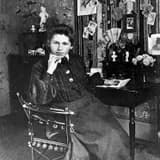
Sophie Taeuber performed her radical, mask-wearing abstract dance at Dada events in Zurich, becoming a key artistic contributor to the Dada movement.
In 1916, Sophie Taeuber became directly involved with the founders of the Dada movement in Zurich, performing expressive, abstract dances—often wearing masks created by Marcel Janco—at the Cabaret Voltaire and the subsequent Galerie Dada. Her performances combined marionette-like, geometric bodily movement with the anti-rational, provocative spirit of Dada.
This was historically significant because Taeuber was one of very few women who participated as a full creative force within Dada—a movement otherwise dominated by male figures such as Hugo Ball, Tristan Tzara, and Hans Richter. Her dance was not decorative accompaniment but was recognized by contemporaries as a radical artistic statement in its own right, merging abstraction, performance, and craft.
Her work in this period embodies the barrier-breaking role women played in early avant-garde movements, even though their contributions were frequently minimized in later historical accounts that centered male 'geniuses.' Taeuber's Dada-era dance and mask work directly influenced her later abstract visual compositions and cemented her reputation, within her circle, as an innovator who dissolved boundaries between disciplines: dance, sculpture, textile, and painting.