← All women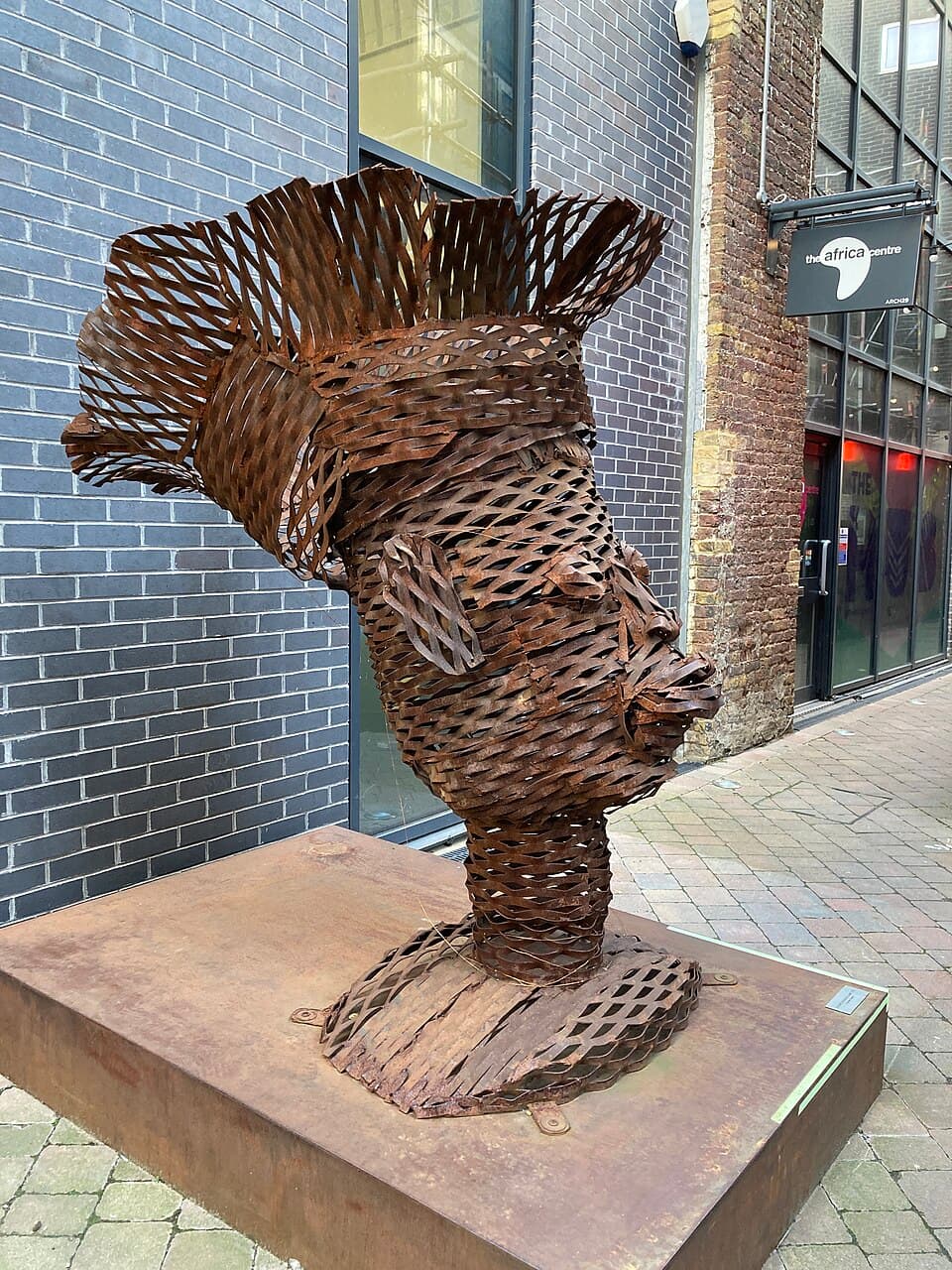
Nigerian, British · Arts
Sokari Douglas Camp
1958 – present
Early Life and Background
Sokari Douglas Camp was born in 1958 in Buguma, a Kalabari town in Rivers State, Nigeria, located in the Niger Delta.[1][3][4][9][10][12] She describes herself as coming from a Kalabari family rooted in the coastal region, an environment later central to the environmental and political concerns in her work.[9][19] The discovery and expansion of the oil industry in Rivers State during her childhood formed a backdrop to her early life, and the social and ecological consequences of fossil fuel extraction would become recurring themes in her sculptures.[13][18][19]
As a child, Douglas Camp experienced transnational movement that shaped her perspective on culture and identity. When her mother became ill, she moved away from the Niger Delta to live with her older sister and her brother-in-law, the British anthropologist Robin Horton, who specialized in Kalabari culture.[3][7][9] Horton became her guardian, and she was sent to boarding school in Britain, first at a young age and later again in adolescence; sources note that she attended boarding school in Totnes, Devon, around the age of twelve.[3][4][7]
Growing up between Nigeria and the United Kingdom, she encountered both Kalabari masquerade traditions and British educational systems. In interviews, she stresses that this dual background informed her artistic imagination, especially her interest in how performance, costume, and ritual can be translated into sculptural form.[3][7][9][19] Her early awareness of environmental degradation in the Niger Delta and of racial and cultural difference in Britain would later surface in works addressing oil politics, migration, and the African diaspora.
Education and Artistic Formation
Douglas Camp pursued formal art education in multiple countries. In the late 1970s she attended the California College of Arts and Crafts (now California College of the Arts) in Oakland, California, where she studied art and began to refine her interest in three-dimensional work.[3][6][9] She has explained that she initially tried painting but felt it did not suit her, prompting her to focus on sculpture because she "liked putting [her] hand" in her work, emphasizing the physical engagement that welding and forming steel requires.[7]
Returning to London, she enrolled at the Central School of Art and Design, one of the leading art schools in the United Kingdom. She studied sculpture there from 1980 to 1983, graduating with a BA (Hons) in Fine Art Sculpture.[3][6][9][12] Her time at the Central School introduced her to British and European sculptural traditions while she maintained strong connections to Nigerian culture through Horton’s anthropological work and visits home.
Douglas Camp continued her studies at the Royal College of Art in London, undertaking a Master’s degree in Sculpture from 1983 to 1986.[3][6][9][12] The Royal College provided advanced technical training and exposure to contemporary sculpture, installation, and conceptual art. During these years she developed her distinctive practice of working with welded and fabricated steel, experimenting with scale, figuration, and the incorporation of references to Kalabari masquerades and Nigerian social life.
Her educational trajectory—spanning Nigeria, the United States, and the United Kingdom—situated her within transatlantic artistic networks. It also positioned her as part of a generation of African and diasporic artists who navigated Western art institutions while drawing on non-Western visual and cultural traditions. By the mid-1980s, she had established the technical and conceptual foundations for the large-scale steel sculptures that would define her career.[1][3][6][11][14]
Career Beginnings and Development
After completing her MA in 1986, Douglas Camp began exhibiting in London and internationally. She first showed work at October Gallery in London in 1985, establishing a relationship with an institution known for championing artists from Africa, Asia, and Latin America.[11] October Gallery would remain a central venue for her work over the following decades, hosting numerous solo exhibitions and enabling her to present large steel sculptures that addressed global issues.
Her early career coincided with growing interest in contemporary African art among Western museums and galleries. In 1988, she achieved a major breakthrough when the National Museum of African Art, part of the Smithsonian Institution, moved to a new building on the National Mall in Washington, D.C. The museum’s grand opening featured a solo exhibition of her work, making her the first contemporary artist to be given a solo show there.[19][asset.library.wisc.edu] This event placed her at the forefront of efforts to present contemporary African artists within prominent museum spaces traditionally oriented toward historical or ethnographic collections.
Throughout the late 1980s and 1990s, Douglas Camp developed a body of work characterized by welded steel figures, often life-size or larger, that evoked masqueraders, dancers, and public performers. She explored how industrial materials—sheet steel, rods, and sometimes recycled oil barrels—could be manipulated to suggest cloth, skin, and movement.[1][3][7][11][14] Her sculptures frequently reference Kalabari masquerade costumes and the performative aspects of Nigerian festivals, translating ephemeral performances into enduring sculptural forms.
At the same time, she increasingly addressed political and historical themes. By the mid-1990s, her work engaged with the legacies of the transatlantic slave trade, colonialism, and the ongoing exploitation of the Niger Delta by oil companies. This combination of cultural memory and political critique became a hallmark of her practice, distinguishing her within the international field of contemporary sculpture.[1][3][11][14][18]
Major Works and Themes
Douglas Camp’s major works span several interconnected themes: slavery and emancipation, oil politics and environmental harm, diaspora and migration, and gender and authority. Her sculptures often operate as visual narratives that compress historical episodes and contemporary crises into allegorical scenes.
Slavery, Emancipation, and Historical Memory
One of her best-known works is "All the World is Now Richer", a sculptural ensemble commemorating the abolition of slavery and honoring those who were enslaved.[1][11][14][18] The work comprises a group of standing figures, each representing different historical roles and experiences, and has been exhibited in high-profile venues including the UK Houses of Parliament (House of Commons) and St Paul’s Cathedral in London.[14][18] Created in the early 2010s, the ensemble explores how emancipation did not erase the enduring effects of slavery and racism, suggesting that the world’s wealth remains unequally distributed.
Her sculpture "Europe Supported by Africa and America" reinterprets an abolitionist image by William Blake, turning a historical print into a monumental steel sculpture.[13][18][19] The work depicts allegorical figures representing Europe, Africa, and America, with Africa and America literally supporting Europe—a commentary on how European wealth was built on the exploitation of African and American lands and peoples. Exhibited in Liverpool, a former slave-trading port, the piece engages directly with the city’s historical role in the transatlantic slave trade and with contemporary debates about memorialization.[13][17][18]
Through these and related works, Douglas Camp contributes to ongoing dialogues about how slavery is remembered in public spaces. Her sculptures offer alternative monuments that foreground Black perspectives and interrogate the power relations embedded in historical imagery. They also connect past exploitation to present inequalities, including environmental racism and global economic disparity.[13][18][19]
Oil, Environment, and the Niger Delta
Another central theme in Douglas Camp’s work is the impact of the oil industry on the Niger Delta. Having grown up at a time when oil was discovered and developed in Rivers State, she draws on personal and collective memories of environmental degradation and political conflict.[13][19] She often uses recycled oil barrels and fuel cans in her sculptures, transforming them into crowns, garments, or structural elements that symbolize both wealth and destruction.[11][14][19]
Works dealing with oil politics include pieces made in the 2000s that address the struggles of communities in the Niger Delta and the activism of figures such as Ken Saro-Wiwa, a writer and environmental campaigner executed in 1995.[11][18][19] Douglas Camp was one of the artists involved in the Memorial to Ken Saro-Wiwa in London, a project highlighting the consequences of oil extraction and state violence in Nigeria.[11][18] Her sculptures use the hardness and weight of steel to evoke the heavy burden of environmental harm, while their dynamic forms suggest the resilience and resistance of affected communities.
In this context, she has repeatedly linked fossil fuel extraction to what she describes as an ongoing form of economic colonialism, in which multinational companies and political elites profit from resources while local populations bear the costs.[13][18][19] Her works addressing oil confront both Nigerian state policies and global consumption patterns, making her practice relevant to broader environmental justice movements.
Diaspora, Migration, and Identity
Douglas Camp’s sculptures frequently engage with the experiences of migration and diasporic identity, informed by her own life between Nigeria, Britain, and the United States. She has produced works that reference African diasporic communities in Europe and America, exploring how cultural practices such as masquerade and carnival adapt in new contexts.[3][7][9][13]
Her "Jonkonnu Masquerade" project, discussed in a 2022 publication, examines the Caribbean Jonkonnu tradition and its links to West African masquerade forms, tracing continuities across the Atlantic.[9] Through steel figures that suggest dancers and revelers, she connects performance cultures developed under slavery and colonial rule to contemporary celebrations of survival and creativity.
More broadly, her work reflects on the challenges and possibilities of living as a Black woman artist in London. Sculptures often depict elaborately dressed figures that embody hybrid identities, mixing African motifs with Western fashion and references to global consumer culture. In this way, Douglas Camp uses steel to materialize the fluid, layered nature of diasporic identity and to critique stereotypes about African and Black bodies.[3][7][11][14]
Gender, Power, and Representation
Gender is a significant dimension of Douglas Camp’s practice. Many of her sculptures depict women as central figures, sometimes in positions of authority or spiritual power, and at other times highlighting their vulnerability within systems of oppression.[3][7][11][14] She examines how gender roles are constructed within both Kalabari society and Western contexts, using costume and gesture to question expectations placed on women.
In pieces such as those grouped under "fashion and fortune," she explores how clothing serves as a signifier of status, femininity, and wealth, while also revealing the labor and exploitation that underpin luxury.[11] Her use of steel to represent flowing dresses, head wraps, and jewelry underscores the strength and resilience of the women portrayed, even as it points to the rigid constraints of social norms.
By foregrounding women’s experiences in narratives of slavery, migration, and environmental struggle, Douglas Camp contributes to feminist art histories that emphasize the role of Black women in shaping collective memory. Her work challenges male-centered accounts of both African and European histories, insisting on the visibility of women’s bodies and voices in public art.[10][11][18][19]
Awards, Honours, and Institutional Recognition
Douglas Camp has received numerous awards and honours over the course of her career. Early recognition came in the form of prizes such as the Amy Sadur Friedlander Prize and the Saatchi & Saatchi Award in the early 1980s, reflecting her promise as a young sculptor.[12] She later received support from the Henry Moore Foundation, which awarded her a bursary that contributed to the development of her large-scale steel works.[1][2]
In the United Kingdom’s honours system, she was appointed a Member of the Order of the British Empire (MBE) for services to art, with the award dated to 2003.[1][2][3][10][12] She was subsequently promoted to Commander of the Order of the British Empire (CBE) in the 2005 Birthday Honours list, again for her contributions to the arts.[1][2][5][8][10][12] These honours acknowledge both her artistic achievements and her influence as a leading figure in contemporary sculpture.
Douglas Camp has been shortlisted for significant public art commissions, including the Fourth Plinth project in Trafalgar Square, London, in 2003.[8][11] She has served as a governor and honorary fellow of the University of the Arts London, reflecting her engagement with art education and institutional governance.[8] Her works are held in major museum collections, including the National Museum of African Art in Washington, D.C., the British Museum in London, and the Setagaya Art Museum in Tokyo.[1][8][11][14][19] These acquisitions confirm her status as a sculptor of international significance.
In addition, research and advocacy organizations have recognized her importance. The Ben Uri Research Unit includes her in its digital project documenting artists of migration and diaspora in British art, and profiles on platforms such as AWARE (Archives of Women Artists, Research and Exhibitions) and Africa Women Experts highlight her role as a major woman artist of the Nigerian diaspora.[4][10][17]
Personal Life
Douglas Camp’s personal life reflects continuing ties to Nigeria and long-term residence in London. After studying in England, she returned for a period to Nigeria, during which she met her husband.[7] She has spoken of teaching architecture and traveling within Nigeria, visiting parts of the country she might not otherwise have seen, experiences that broadened her understanding of Nigerian social and spatial landscapes.[7]
She eventually settled in London, where she lives and works in the Elephant and Castle area in South London.[7][11] She maintains a studio on a small street there and has emphasized her preference for working without assistants, choosing instead to make all her pieces herself.[7] This hands-on approach reflects her belief in the importance of physical engagement with materials and in the intimate connection between the artist’s body and the act of welding and shaping steel.
While detailed information about her family life remains private, her statements and interviews indicate that she continues to travel, research cultural traditions, and draw on both Nigerian and British contexts in her work. Her personal narrative of movement between continents and cultures informs the diasporic themes evident in her sculptures.[3][7][9][13]
Legacy and Historical Impact
Sokari Douglas Camp occupies a significant place in the history of contemporary sculpture and in women’s art history. As a Kalabari-British sculptor working primarily in steel, she has contributed to redefining what materials and narratives can belong to African and diasporic art in global institutions.[4][7][10][11] Her pioneering solo exhibition at the National Museum of African Art’s opening on the National Mall marked an important moment in the recognition of contemporary African artists within major museum spaces.[19]
Her work’s combination of industrial materials with references to masquerade, carnival, and ritual performance has expanded the vocabulary of figurative sculpture. By using steel—often associated with modern industry, weapons, and infrastructure—to represent bodies, costumes, and movement, she underscores the entanglement of culture with the economic and political forces that shape people’s lives.[1][3][11][14][19]
For historians of slavery and postcolonial memory, Douglas Camp’s sculptures offer critical interventions into how the past is remembered. Pieces such as "All the World is Now Richer" and "Europe Supported by Africa and America" function as counter-monuments that foreground Black experiences and critique Eurocentric narratives.[14][18] They contribute to broader efforts to decolonize public art and museum displays, making her work central to discussions about representation and historical justice.
Her focus on oil politics and environmental devastation in the Niger Delta situates her within emerging art histories of climate and environmental justice. By turning oil barrels and fuel cans into visual symbols of power and harm, she connects local Nigerian struggles to global debates about fossil fuels and the climate crisis.[13][18][19] In this way, her sculptures help articulate the cultural and emotional dimensions of environmental change, particularly from the perspective of communities who live with its consequences.
As a Black woman artist recognized with British state honours and included in major museum collections, Douglas Camp has also contributed to expanding the visibility of women of African descent in sculpture—a field historically dominated by men. Her success challenges assumptions about who can work with heavy industrial materials and produce large-scale public works, offering a model for younger artists.[1][3][10][11]
Later Career and Ongoing Work
Douglas Camp remains active as an artist, continuing to produce new sculptures and participate in exhibitions. Her work has been featured in institutional exhibitions such as those at the Victoria and Albert Museum (V&A), where her monumental sculptural groups addressing slavery, power, gender, and climate have been displayed.[18] She has also participated in artist talks and public programming, including events that foreground her perspectives on slavery, power, gender, and the climate crisis.[13][16]
In recent years, she has engaged with projects such as "Jonkonnu Masquerade," which examine transatlantic links between African and Caribbean performance traditions.[9] Her practice continues to evolve as she explores new configurations of steel, acetate, glass, and other materials, while maintaining her commitment to narrative and allegory.
International platforms like Artsy and Art UK present her work to global audiences, and profiles on research sites and activist platforms—such as Black Lives Matter UK—highlight her significance as a contemporary artist whose work confronts racism, colonialism, and environmental injustice.[12][14][15] The Art Newspaper’s detailed coverage of her career in 2021 and 2023 signals sustained interest in her oeuvre among art critics and historians.[19]
As of the mid-2020s, Sokari Douglas Camp continues to live and work in London. Her ongoing production and the growing body of scholarship on her work ensure that she will remain a central figure in accounts of contemporary sculpture, African diaspora art, and women’s contributions to visual culture.[1][3][4][10][11][19]
Dated achievements
8 indexed.
- Nov111988Arts
First contemporary artist with a solo exhibition at the National Museum of African Art
Sokari Douglas Camp held a solo exhibition at the grand opening of the National Museum of African Art, a first for a contemporary artist.
View details National Museum of African Art Exhibition Document - Oct062003